1
About This Document
Purpose
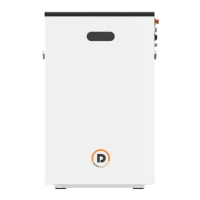
This document describes the application scenarios, installation, electrical connection, commissioning and
troubleshooting of IPack C3.3, a 3.3 kWh standalone Energy Storage Battery (hereinafter simply put as
battery). Before installing and operating battery, please ensure that you are familiar with product features,
functions, and safety precautions as provided in this document.
Target Audience
Installer, operator, commissioning personnel, maintenance personnel of the RESS product
Symbols and Conventions
Warning and caution messages are listed in the document to remind users, installers and maintainer of safe
operation.
Symbol Description
Indicates a potentially hazardous situation, if not avoided, could result in serious injury
or death.
!
CAUTION
Indicates a potentially hazardous situation, if not avoided, may result in minor or
moderate injury
2
1 Important Safety Information
1.1 Warning Label
Do not dispose battery in household trash.
Battery is heavy enough to cause severe
injury.
Recyclable. Keep battery away from children.
Certification in European Union area. Do not reverse polarities.
Risk of electric shock. Do not expose battery to flame.
Explosive gas. Operate as specified by the manual.
Battery may leak corrosive electrolyte. Read the manual before operating.
Nameplate Warning Label
IFpP16/122/360/[1P16S]M/-10+50/90
Model
Nominal Voltage
Total/Rated Capacity
Total/Rated Energy
Ingress Protection
Operating Ambient Temperature
Max Short Current and Duration
Shanghai Dowell Technology Co.,Ltd.
Web: http://www.dowellelectronic.com
Email:sales@dowellelectronic.com
iPack C3.3
51.2V
64Ah/58.6Ah
3276Wh/3000Wh
IP20
-10˫~50˫
1700A, 2ms
Made in China
1.2 Precautions
Risks of electrolyte leakage
• Do not subject battery to strong impact.
• Do not crush or puncture battery.
• Prevent battery from falling. In case of fall, turn off the battery immediately and stop using it.
• Do not open or mutilate batteries. Released electrolyte is
harmful to the skin and eyes.
WARNING AVERTISSEMENT
1. Do not disassemble or alter the battery in any way.
Ne démontez ni modifiez la batterie en aucune façon.
2. Do not use the battery for purposes not described in its documentation.
N'utilisez pas la batterie à des fins non décrites dans sa documentation.
3. Do not drop, strike, puncture, or step on the battery.
Ne laissez pas tomber, ne heurtez pas, ne percez pas et ne marchez pas sur la batterie.
4. In case of electrolyte leakage, keep leaked electrolyte away from contact
with eyes or skin, immediately clean with water and seek help from a doctor.
En cas de fuite d'électrolyte, gardez l'électrolyte qui fuit loin du contact avec les yeux
ou la peau, nettoyez immédiatement avec de l'eau et demander de l'aide à un médecin.
5. Do not put the battery into a fire. Do not use it or leave it in a place near fire, heaters,
or high temperature sources.
Ne mettez pas la batterie au feu. Ne l'utilisez pas et ne le laissez pas dans un
endroit près de feu, de radiateurs ou de sources de températures élevées.
6. Do not submerge the battery in water, or expose it to moisture.
Ne plongez pas la batterie dans l'eau et ne l'exposez pas à l'humidité.
7. Do not allow the terminals to contact exposed wire or metal.
Ne laissez pas les bornes entrer en contact avec du fil ou du métal exposé.
8. The battery is heavy and can cause injury if not handled safely.
La batterie est lourde et peut provoquer des blessures si elle n'est pas manipulée en toute sécurité.
9. Keep out of reach of children or animals. Tenir hors de portée des enfants ou des animaux.
7
5 Max
.
Discharging Current &7&
:
10 A
&7&$
&7&$
&7&$
6 Max. Discharging Power 3kW
7 Peak Discharging Power 4.14kW/3s
8 Max Charging Power 3kW
9 Peak Charging Power 4.14kW/3s
10 IP Protection IP20
11 Operating Temperature -10°C~+50°C
12 Recommended Operating Temperature -15°C~+30°C
13 Storage Temperature Temperature: -20°C ~ + 45°C, within 6 months
Temperature: -30°C ~ -20°C, 45°C~ 60°C, within 7 days
(for shipping state)
Humidity
:
5%-95%RH
Within 6 month after each charge
14 RTE 94%, 0.2C charge/discharge 25°C
15 DOD 94.5%
16 EOL 10 years, or SOH
<
50%
,
or single cell voltage falls
below 2V
17 Cooling Natural cooling
18 Operation altitude P
19 Parallel Connection Max. 6 packs
20 Communication Port CAN2.0 / RS485
21 Safety Certification IEC62619
,
CE
22 Transportation Certification UN38.3+PI965 (Sea)
23 Environmental Certification RoHS, REACH
8
3 Battery Storage and Transportation
3.1 Safe Storage
Battery storage life
Life Temperature Humidity
7 days -30
ႏ
to -20
ႏ
or 45
ႏ
to 60
ႏ
5%RH-95%RH
180 days
-
20
ႏ
to 45
ႏ
5%RH-95%RH
If the battery is not used for more than 1 week, you need to store it in accordance with the requirement for
storage conditions.
• Place battery according to signs on packing box and do not put battery upside down or sidelong.
• Store batteries in a place free from direct sunlight and rain.
• Keep batteries at least two meters away from a heat source (such
as a radiator).
• Avoid contacting with corrosive and organic substances (including gas exposure).
• Batteries with deficiencies should be separated from normal batteries by setting wall between or placing in
difference fire protection zones.
• Keep the storage area dry, clean and well ventilated.
In case of storage over 6 months, batteries should be recharged in the following steps:
1. Identify batteries that need recharging;
2. Ensure batteries in power-off mode. Refer to Quick Guidance to complete the installation and wire
connection;
3. Set “CV=55V, CC=16A (5°C-45°C)";
4. 5HFKDUJHXQWLO/('ÀLFNV
3.2 Safe Transportation
Battery has cleared UN38.3 (Section 38.3 of the Seventh Revised Edition of the Recommendations on the
Transport of Dangerous Goods: Manual of Tests and Criteria) and SN/T 0370.2-2009 (Part 2: Performance
Test of the Rules for the Inspection of packaging for Exporting Dangerous Goods). The battery is classified as
class 9 dangerous goods, and is subject to land and water transportation. It is mandatory to report to the airline
company and obtain approval before air transport.
• Before transportation, press POWER button for two seconds and five LED lights flicker for three times to
power off battery.
• During transportation, put battery flat, do not have battery stand on or lean against the floor to avoid
possible crash.
• Maintain temperature between -20
ႏ
to 45
ႏ
during the transportation.
• Prohibit mixing up with explosive, inflammable or toxic objects.
• Use van-type vehicle including container and metallic van-type vehicle. Platform vehicle and convertible
are prohibited.
• Do not pile up foreign objects on the top of battery.
• At most four batteries in package can be piled up.
• Maintain original packaging and keep labels complete and recognizable.
• Prevent from direct sun exposure, rain, condensation and mechanical damages.


 To Next Page
 Loading...