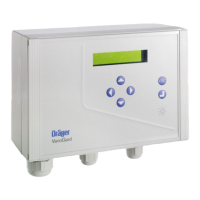
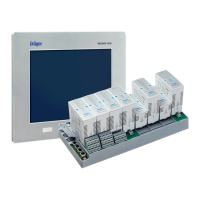
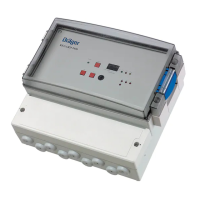
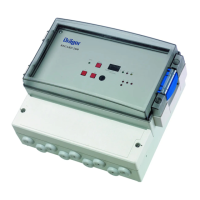
The provided document is a supplement to the instructions for use and assembly instructions for the Dräger Area Control Unit for central gas supply systems.
Function Description
The Area Control Unit (ACU) is a component of a Medical Distribution System, designed for the continuous monitoring of pressures and volume flows of medical gases and vacuum. It is delivered with a display unit (pressure gauge and LEDs) and is supplemented by a digital display integrated into the door, which also features a door opening alarm.
The backlit color touchscreen of the digital display provides the following information:
- Numerical values of the current pressures for all monitored gases.
- Visualization of pressure alarms.
- Numerical values of the current volume flows for all monitored gases.
The ACU can display information for various monitored gases, including:
- AIR (with additional supply circuits if required, e.g., AIR (1), AIR (2), AIR (3))
- AIR800 (compressed air for operating surgical tools)
- O2 (with additional supply circuits if required, e.g., O2 (1), O2 (2), O2 (3))
- CO2 (carbon dioxide)
- N2O (nitrous oxide)
- N2O+O2 (mixture of nitrous oxide and oxygen)
- VAC (vacuum)
The device incorporates a door opening alarm that triggers a visual and audible signal when the door is opened or unlocked. This alarm can be transmitted to an external monitoring system or the Dräger Alarm Management System if connected. The alarm can be temporarily muted for operational purposes, disabling acoustic signals and alarm transmission.
Important Technical Specifications
Ambient Conditions:
- During operation:
- Temperature: 10 to 40 °C (50 to 104 °F)
- Air pressure: 800 to 1060 hPa (1950 - 0 m NN)
- Relative humidity: 30 to 95% (non-condensing)
- Pollution level of the environment: 2
- Maximum volume: < 80 dB
- During storage and transport:
- Temperature: -20 to 60 °C (-4 to 140 °F)
- Air pressure: 800 to 1060 hPa
- Relative humidity: 30 to 95% (non-condensing)
Electronic Operating Specifications:
- Mains power supply:
- Electrical mains connection: 230 V, 50 Hz
- Permissible voltage fluctuation: ± 10%
- Overvoltage category: II
- Current consumption:
- At 230 V: Max. 0.2 A (Max. 0.33 A with AIM power supply unit)
- Power consumption:
- With AIM: Max. 76 VA (at 230 V)
- Without AIM: Max. 46 VA (at 230 V)
- Protection class: Class 1
- Door opening alarm:
- Normally open or normally closed: Open in the event of an alarm
- Switching voltage: Max. 50 V DC
- Switching current: Max. 1 A
Measurement Displays:
- Gas types: Air, O2, Air800, CO2, N2O, VAC, N2O+O2
- Pressure indication: in bar
- Volume flow (only with VoluCount): in L/min
- Messages: Line of text with status bar
Classification:
- In accordance with European Directive 93/42/EC Appendix IX: Class II b
- UMDNS code: 18-046
- GMDN code: 36271
Electromagnetic Compatibility (EMC):
- Emissions: Class A, group 1 (30 MHz to 1 GHz) for radiated emissions; Class A, group 1 (150 kHz to 30 MHz) for conducted emissions.
- Immunity against:
- Electrostatic discharge (ESD) (IEC 61326-1): Contact discharge ±4 kV, Air discharge ±8 kV.
- Fast transient electrical disturbances (bursts) (IEC 61326-1): Power cable ±2 kV, Longer signal input lines/output lines ±1 kV.
- Surges (IEC 61326-1): Voltage, external conductor – external conductor ±1 kV; Voltage, external conductor – protective ground conductor ±2 kV.
- Magnetic fields at mains frequency (IEC 61326-1): 50 Hz: 30 A/m.
- Voltage dips and short interruptions in the supply voltage (IEC 61326-1): Voltage dips of 30% to 100%, 8.3 ms to 5 s, different phase angles.
- Radiated high-frequency disturbances (IEC 61326-1): 80 MHz to 2 GHz: 3 V/m; 2 GHz to 2.7 GHz: 1 V/m. Note: In the range of 250 MHz to 300 MHz, the digital pressure display may be interrupted.
- Conducted high-frequency disturbances (IEC 61326-1): 150 kHz to 80 MHz: 3 V.
- Recommended separation distances from wireless communication devices: At least 1.0 m (3.3 ft) to ensure full functional integrity.
Usage Features
Operating Concept:
The digital display shows current pressure values and volume flow rates for all monitored gases. Displayed values are current measured values and are shown in different colors to indicate status:
- Blue: Measured pressure is within tolerance.
- Red (Flashing): Measured pressure is above tolerance (>20% for medical gases, >-0.34 bar for vacuum).
- Red (Flashing): Measured pressure is below tolerance (<20% for medical gases, <-0.34 bar for vacuum).
- Gray (---): No measuring device for volume flow of the relevant gas is installed.
- Blue (---): Digital display is not receiving any valid data.
The status bar provides general status information and the door opening alarm status. Specialized service personnel can access a configuration menu via the status bar.
Door Opening Alarm:
- Muting: The door opening alarm can be temporarily muted by touching a button, entering a user password, and confirming. This disables acoustic signals and alarm transmission. If an active pressure alarm is present, the acoustic signal of the door opening alarm is automatically disabled.
- Enabling: The alarm automatically enables 60 seconds after closing the door or can be manually enabled by touching a button, entering the user password, and confirming.
User Password:
The device settings are protected by a factory-set user password (1744) to prevent unauthorized modifications. The manual advises cutting out the section with the password and keeping it in a safe place.
Maintenance Features
Reprocessing:
The document provides detailed instructions for reprocessing the device, emphasizing safety information and classifications for reprocessing.
- Safety Information: Warns against risks from inappropriately reprocessed products and penetrating liquids. Users must follow infection prevention policies, national regulations, and validated reprocessing procedures. Reprocessing must be performed by defined user groups with specialist knowledge.
- Classification of Medical Devices: The ACU components are classified as "Non-critical" (Surfaces), meaning they only come into contact with intact skin.
- Validated Reprocessing Procedures:
- Surface disinfection with cleaning:
- Components: Surfaces.
- Disinfectants: Dismozon plus (BODE Chemie, 1.6%, 15 min contact time) and Oxycide (Ecolab USA, 2.3%, 5 min contact time) are validated.
- Prerequisites: Disinfectant prepared per manufacturer's instructions, manufacturer's instructions observed, uncontaminated lint-free cloth soaked in disinfectant used.
- Cleaning steps:
- Wipe off obvious soiling with a disposable cloth soaked in disinfectant.
- Wipe all surfaces until no soiling is visible.
- Surface disinfection steps:
- Wipe cleaned surfaces to visibly wet them with disinfectant.
- Wait for the contact time.
- Moisten a new, uncontaminated, lint-free cloth with water (drinking water quality).
- Wipe all surfaces until no disinfectant residue is visible.
- Wait until surfaces are dry.
- Check surfaces for visible damage and replace if necessary.
- Other Agents and Reprocessing Procedures: Lists nationally approved disinfectants suitable for surface disinfection, including chlorine-releasing agents, oxygen-releasing agents, and quaternary ammonium compounds. Dräger notes that oxygen-releasing and chlorine-releasing agents may cause color change in some materials, but this does not indicate malfunction. Other surface disinfectants are used at the user's own risk.
Disposal:
The product must be disposed of in accordance with national regulations.
Final Assembly and Acceptance:
- Safety Information: Emphasizes that only specialized service personnel should handle live electrical components due to electric shock risk.
- Acceptance and Handover: After installation or service, the system must be tested and approved by specialized service personnel to ensure compliance with safety, performance, and national regulations. Test results are documented, and the installation, documents, and user instructions are handed over to the operator.

 Need help?
 General

 To Next Page