102
fire or water, or expose a battery pack to temperatures higher than 60˚C (140˚F).
Exposure to Radio Frequency (RF) Signals
Your wireless phone is a radio transmitter and receiver. It is designed and
manufactured not to exceed the emission limits for exposure to radio frequency
(RF) energy set by the Federal Communications Commission of the U.S.
Government. These limits are part of comprehensive guidelines and establish
permitted levels of RF energy for the general population. The guidelines are
based on the safety standards previously set by both U.S. and international
standards bodies:
• American National Standards Institute (ANSI) IEEE. C95.1-1992
. • National Council on Radiation Protection and Measurement
(NCRP). Report 86. 1986
. • International Commission on Non-Ionizing Radiation Protection (ICNIRP) 1996
. • Ministry of Health (Canada), Safety Code 6. The standards include a substantial
safety margin designed to assure the safety of all persons, regardless of age and health.
In the U.S. and Canada, the SAR limit for mobile phones used by the public is 1.6
Watts/kg (W/kg) averaged over one gram of tissue. The standard incorporates
a substantial margin of safety to give additional protection for the public and to
account for any variations in usage. Normal conditions only ensure the radiative
performance and safety of the interference. As with other mobile radio
transmitting equipment, users are advised that for satisfactory operation of the
equipment and for the safety of personnel, it is recommended that no part of the
human body be allowed to come too close to the antenna during operation of the
equipment.
SAR Information
. • 1.272 W/Kg @ 1g (FCC) body
. • 0.278 W/Kg @ 1g (FCC) head
. • 0.856 W/Kg @ 10g (CE) body
. • 0.317 W/Kg @ 10g (CE) head
.
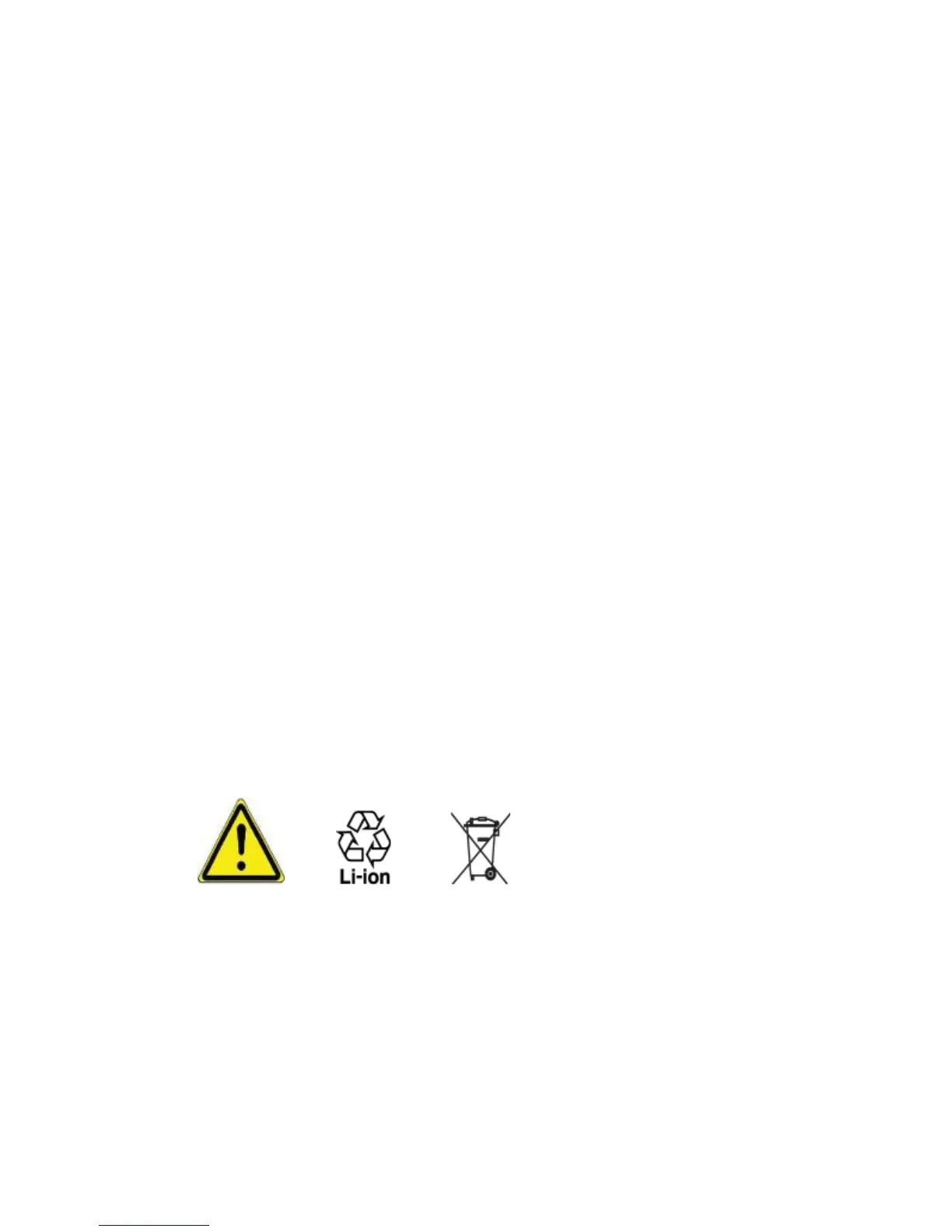
Warning! DANGER OF EXPLOSION IF BATTERY IS INCORRECTLY REPLACED.
TO REDUCE RISK OF FIRE OR BURNS, DO NOT DISASSEMBLE, CRUSH,
PUNCTURE, SHORT EXTERNAL CONTACTS, EXPOSE TO TEMPERATURE
ABOVE 60˚C (140˚F), OR DISPOSE OF IN FIRE OR WATER. REPLACE ONLY
WITH SPECIFIED BATTERIES. RECYCLE OR DISPOSE OF USED BATTERIES
ACCORDING TO THE LOCAL REGULATIONS OR REFERENCE GUIDE
SUPPLIED WITH YOUR PRODUCT.
WEEE Notice



 To Next Page