Need help?
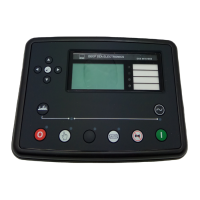
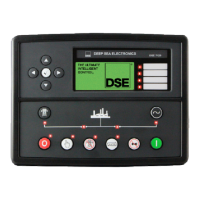
Do you have a question about the DSE DSE4610 and is the answer not in the manual?
Details on installing the DSE4610/DSE4620 modules.
Handouts covering specific subjects for training sessions.
List of product manuals available for download.
References to external standards and publications.
Details the types and sizes of connectors used on the module.
Outlines the voltage and current needs for module operation.
Technical details on how voltage and frequency are measured.
Technical details on how current is measured using CTs.
Describes the various digital and analogue inputs available on the module.
Details the specifications for the module's DC outputs.
Provides physical dimensions and panel cutout information.
Explains the function of each terminal on the module's rear.
Illustrates a standard wiring setup for the DSE4610/DSE4620.
Outlines procedures for Negative, Positive, and Floating Earth systems.
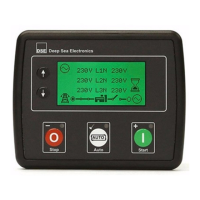
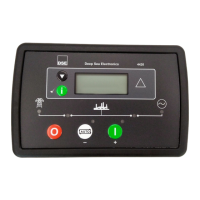
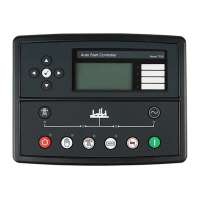
Explains the function of the front panel buttons for module control.
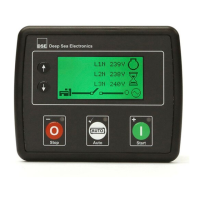
Details the sections and icons shown on the module's LCD display.
Lists and explains icons indicating warning, trip, and shutdown alarms.
Guide on navigating and viewing system parameters on the display.
Provides a basic guide to starting and stopping the engine.
Explains how to place the module in stop mode and reset alarms.
Describes the automatic start/stop and load management functions.
Details how to manually start and operate the engine.
Covers setting up and resetting engine maintenance reminders.
Explains the built-in scheduler for automatic engine exercise runs.
Steps to enter and use the module's on-panel configuration menu.
Lists configurable parameters for module settings and displays.
Details configurable options for inputs, outputs, and alarms.
Troubleshooting common issues related to engine starting problems.
Diagnosing problems when the generator fails to take load.
Explains remedies for common alarm conditions like low oil pressure.
Addresses issues with inaccurate readings on controller displays.
Information on ordering replacement connector plugs.
Information on ordering replacement fixing clips.
Guidelines for recycling electronic equipment.
Information on hazardous substances in products.
 General
| Model | DSE4610 |
|---|---|
| Type | Auto Start Control Module |
| DC Supply | 8 V to 35 V Continuous |
| Generator & Mains (Utility) Frequency | 3.5 Hz to 75 Hz |
| Magnetic Pick-up Frequency | 10, 000 Hz (max) |
| Storage Temperature Range | -40 °C to +85 °C |
| Display | LCD |
| Maximum Operating Altitude | 3, 000 m |
| Communication | RS485 |
| Protection Class | IP65 |
| Cranking Dropouts | Able to survive 0 V for 50 mS providing supply was at least 10 V before dropout and supply recovers to 5 V. This is achieved without the need for internal batteries. |

 To Next Page