This document is the User's Manual for the DST RL-61/61L desiccant dehumidifier, a product manufactured by Seibu Giken DST, a company that identifies itself as "World leaders in dehumidification." The manual provides comprehensive information on the device's safety, introduction, product description, installation, operation, maintenance, technical data, and troubleshooting.
Function Description
The DST RL-61/61L is a desiccant dehumidifier designed for industrial and commercial applications. Its primary function is to remove moisture from the air using a desiccant rotor. The dehumidifier operates on a continuous process, drawing in process air, passing it through a rotating desiccant rotor where moisture is adsorbed, and then discharging dry air. A separate regeneration airflow is used to remove the adsorbed moisture from the rotor, which is then expelled as wet air. This continuous process ensures efficient and consistent dehumidification.
The dehumidifier is suitable for various applications, including chemical, pharmaceutical, food or confectionery production, and storage areas where precise humidity control is critical. It is particularly effective in environments requiring very low dew points. The unit's design allows for flexible installation and integration into existing ventilation systems.
The device can be controlled manually or automatically. In automatic mode, the dehumidifier adjusts its operation based on a connected humidistat or regulator signal, maintaining a set humidity level. Manual mode allows for continuous dehumidification or specific fan and heater settings.
Important Technical Specifications
The manual provides detailed technical specifications for both the RL-61 and RL-61L models.
Capacity:
- Capacity [kg/h]: RL-61: 7.5, RL-61L: 11
- Nominal dry air flow [m3/h]: RL-61: 1300, RL-61L: 1800
- External static pressure dry air [Pa]: RL-61: 200, RL-61L: 200
- Nominal wet air flow [m3/h]: RL-61: 280, RL-61L: 420
- External static pressure wet air [Pa]: RL-61: 300, RL-61L: 300
Regeneration Heater - Electric:
- Heater power [kW]: RL-61: 9, RL-61L: 13.5
- Number of electric heater steps: RL-61: 2, RL-61L: 2
- Heating power in steps [kW]:
- RL-61: 1/2-4.5, 2/2-9
- RL-61L: 1/2-6.75, 2/2-13.5
- Heating power with linear control [kW]: RL-61: 0-9, RL-61L: 0-13.5
- Humidistat 2 opens and reduce the power to [kW]: RL-61: 4.5, RL-61L: 9
Total Motor Power - Electrical:
- Total motor power [kW]: RL-61: 1.12, RL-61L: 2.05
- Total power [kW]: RL-61: 10.12, RL-61L: 15.55
Other Electrical Information:
- Supply fuse 3x400V/50Hz [A]: RL-61: 25, RL-61L: 25
- Humidistat connection: RL-61: 230VAC, RL-61L: 230VAC
- Humidistat supply current [A]: RL-61: <1, RL-61L: <1
Temperature Setpoint Settings:
- Overheat protection TH1 [°C]: RL-61: 190, RL-61L: 190
- Thermostat TH2 [°C]: RL-61: 160, RL-61L: 160
- Overheat protection TH3 [°C]: RL-61: 80, RL-61L: 80
Temperature Limits:
- Max. process air inlet temperature [°C]: RL-61: 40, RL-61L: 40
- Max. operating temperature [°C]: RL-61: 50, RL-61L: 50
- Min. operating temperature [°C]: RL-61: -20, RL-61L: -20
Other Technical Data:
- Air filter class (regeneration/process): F7/F7
- Filter change at pressure (G4/F7) [Pa]: 200/250
- Airflow guard - Regeneration [Pa]: 90
- Delta P - Process/Regeneration [Pa]: 30
- Noise level [dB(A)]: RL-61: 70, RL-61L: 70
- Regeneration air fan delay [min]: 10
- Weight [kg]: RL-61: 130, RL-61L: 132
The unit is designed for inlet conditions of 20°C/60%RH (equal to 1.2 kg/m3). The volume flow above is given at free blowing airflow. The unit is connected to uninsulated ducts. Nominal airflows are for dehumidifiers with installed optional feature. The current provided by the humidistat connection is for units that are capable of the load current.
Usage Features
The RL-61/61L dehumidifier offers several features to enhance usability and control:
- Control Panel: The unit is equipped with a control panel that includes buttons for "OFF / ON," "AUTO / MAN," "HEATER," and "MAIN" (main isolation switch). It also features indicators for "ALARM," "ALARM, ΔP," "FILTER REGEN," and "FILTER PROCESS." A digital display shows humidity and temperature readings.
- Operating Modes:
- AUTOMATIC (AUTO): Continuous dehumidification controlled by a humidistat/regulator signal. This mode allows for automatic adjustment of dehumidification capacity to maintain a set humidity level.
- MANUAL (MAN): The unit runs continuously until manually turned off. This mode is suitable for situations where a constant dehumidification rate is desired, or when a humidistat is not connected.
- AUTO-ECO VENT: A semi-ventilation mode that provides airflow in intervals by turning the process fan ON and OFF. This mode is designed for energy saving.
- Ventilation Modes: The unit can operate in two different ventilation modes when the dehumidification automatically stops:
- AUTO-VENT: Provides a constant airflow by keeping the process fan running.
- AUTO-ECO VENT: A semi-ventilation mode that provides an airflow in intervals by turning the process fan ON and OFF.
- Humidistat Connection: The unit can be connected to a 1-step or 2-step humidistat for automatic control. It also supports 0-10VDC signals for external humidity controllers or other regulator signals.
- Remote Control: The unit has a connection point for a remote switch, allowing for remote start/stop functionality.
- Potential-Free Signals: Potential-free contacts are available for various indicators, including alarm, filter, regeneration indicator, and process fan indicator, which can be used to transmit signals to a remote control.
- Energy Saving Features: The unit can be fitted with different "Energy saving" features, such as reactivation heater power output regulation based on humidity and temperature, and a multi-step or linear control for the drying capacity.
- C4 PLC with 5.7" Color Touchscreen: An optional C4 touchscreen-enabled PLC with multiple I/O and custom software is available for advanced dehumidification control. Add-on modules allow for remote control using Modbus, Ethernet, or modern control systems.
Maintenance Features
Regular maintenance is crucial for the optimal performance and longevity of the DST RL-61/61L dehumidifier. The manual outlines a comprehensive service chart with recommended intervals for various inspections and tasks.
Regular Service Intervals (Run time in hours (x1000) / Calendar time in months):
- Inspect filter - replace if necessary: Every 4,000 hours or 6 months.
- Clean and inspect casing: Every 4,000 hours or 6 months.
- Inspect fan - replace if necessary: Every 4,000 hours or 6 months.
- Inspect features and functionality: Every 4,000 hours or 6 months.
- Inspect electric, feature, cables and electrical components - replace if worn or damaged: Every 8,000 hours or 12 months.
- Inspect frame, chassis, locks and panel seals - replace if necessary: Every 8,000 hours or 12 months.
- Inspect duct and duct connections: Every 8,000 hours or 12 months.
- Inspect heater and cooler: Every 8,000 hours or 12 months.
- Inspect humidistat/humidity sensor - replace if necessary: Every 8,000 hours or 12 months.
- Inspect rotor motor - replace if necessary: Every 8,000 hours or 12 months.
- Inspect rotor seals - replace if worn or damaged: Every 8,000 hours or 12 months.
- Check operation of geared drive motor, drive pully, belt/chain, rotor - adjust as necessary: Every 8,000 hours or 12 months.
- Inspect rotor for contamination or damage - clean/repair (contact DST): Every 8,000 hours or 12 months.
- Inspect condenser*: Every 8,000 hours or 12 months.
- Inspect evaporator*: Every 8,000 hours or 12 months.
- Inspect compressor*: Every 8,000 hours or 12 months.
- Inspect cooling system*: Every 8,000 hours or 12 months.
Safety Feature Check (if fitted):
- Function test on humidistat: Every 4,000 hours or 6 months.
- Function test on fine fuse alarm: Every 4,000 hours or 6 months.
- Function test on rotation guard alarm, check and adjust sensor clearance: Every 4,000 hours or 6 months.
- Function test on damper, actuator and valves: Every 4,000 hours or 6 months.
- Function test on post-cooling function: Every 4,000 hours or 6 months.
Washing the Rotor: The D-MAX rotor has a distinct advantage over other types of desiccant rotors in that dust and grease can be washed out of the material without the need for reimpregnation with desiccant. In normal applications, washing the rotor should be considered as a last resort if all other possible defects first.
Troubleshooting: The manual includes detailed troubleshooting tables for error codes, general issues, and capacity problems, providing explanations, causes, and solutions to common operational issues. This allows for quick identification and resolution of problems, minimizing downtime.
Pre-Operation Check: Before starting the unit, it is essential to perform a pre-operation check, including inspecting the unit for foreign objects, checking air balance dampers, filters, motor overload protectors, thermostat/overheat protection settings, electrical power cables, and the rating of electrical supply fuses.
Start-Up Test and Adjustment: After installation, a start-up test and adjustment procedure is outlined, including closing and securing all access doors, checking the supply voltage, verifying rotor rotation, balancing airflows, and adjusting frequency converters if necessary.
Reset Buttons & Switches: Information on the location and function of fuses, overheat protections, and motor protectors inside the electrical cabinet is provided for troubleshooting and resetting.
Harmful Chemicals and Solvents for Rotors: The manual lists substances that can cause reduced performance and/or rotor degradation if adsorbed, along with their chemical formulas and the resulting cause of damage (e.g., clogging pores, degrading physical structure). This information is crucial for preventing damage to the desiccant rotor.
The manual emphasizes safety throughout, with warnings and cautions regarding electrical installation, handling of hazardous materials, and general operation. It also includes an appendix with a component list, harmful chemicals and solvents for rotors, and CE-declaration information.

 Need help?
 General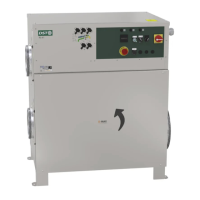

 To Next Page
