11
RL-61, 61L EN.033 24.01 Seibu Giken DST
EN
4 INSTALLATION
4.1 UNIT INSTALLATION
Follow the directions regarding installation of heavy and medium weight dehumidiers.
Note: Use the installation guidelines as a reference only.
4.1.1 FORK LIFTING
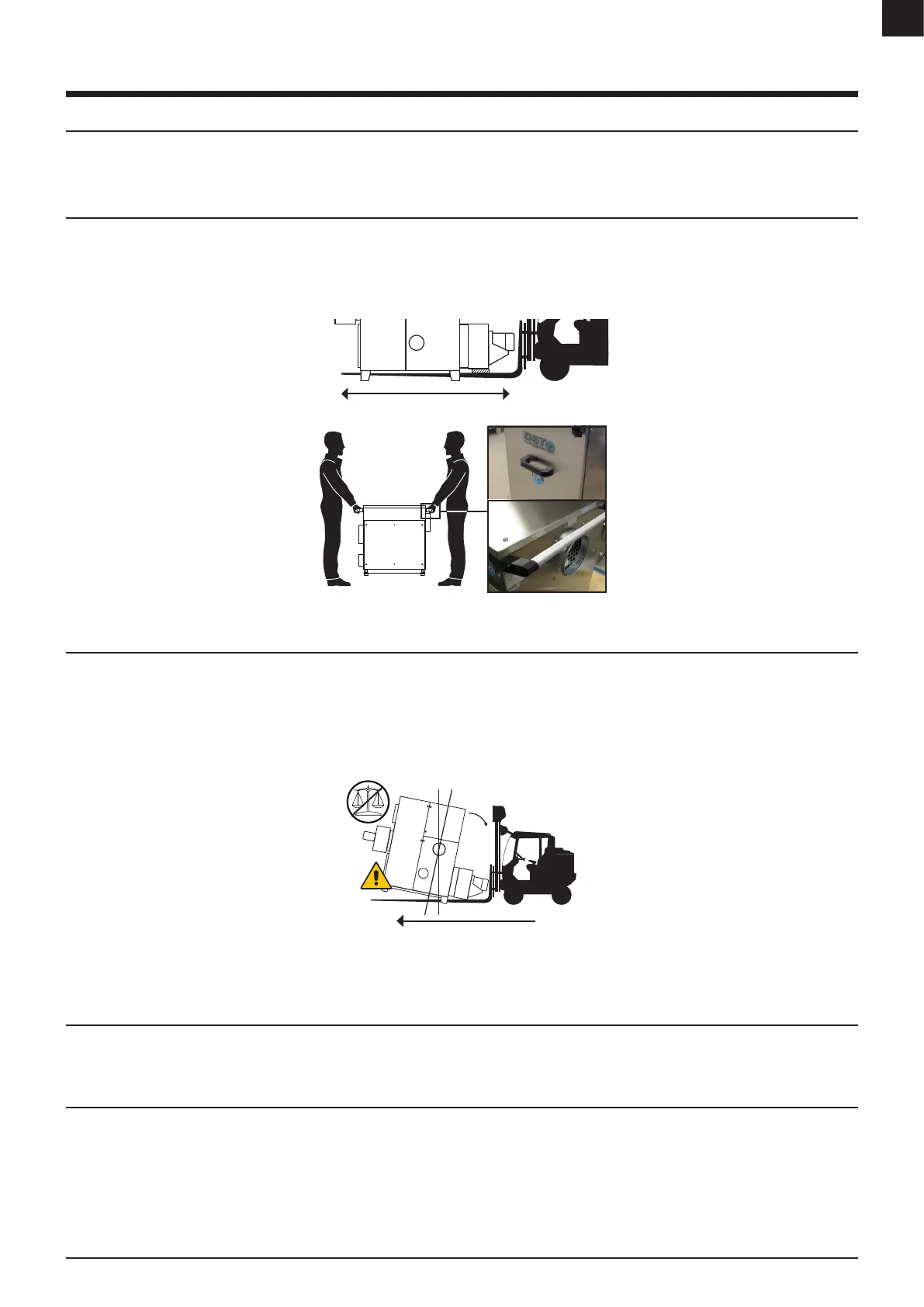
The unit can be o-loaded and positioned using a fork lift by lifting between the feet of the unit, alt., on some dehumidiers, lift the unit using the built-in handles.
• The forks must be of sucient length to be in contact with both sides of the base frame.
• The forks should be initially positioned centrally across the middle sections of the unit but must be checked for balance prior to nal lifting.
• Units equipped with handles are very heavy. Do not lift the unit single-handedly! Always ask for assistance or use lifting aid!
FIGURE 6: Forks in contact with both sides of the frame.
FIGURE 7: Units with handles
4.1.2 TRANSPORT
Dehumidiers with external fans or a high centre of gravity runs the risk of tipping. Use caution when lifting and moving the dehumidier.
Note:
• Secure any panels, doors or loose equipment.
• Keep the unit balanced at all times when moving the unit.
• See safety chapter regarding lifting safety.
FIGURE 8: Exercise caution when lifting and transport a unit
If not balanced, the unit may run the risk of tipping during transport.
See “11 Technical data” for weight information.
4.1.3 POSITIONING
Position the machine with adequate working space around the unit to allow inspection and service. Size of unit and the position of the access panels/doors vary depending on
the model. To avoid incorrect positioning, see the dimensional drawing in the appendix for service space and foot bolt-hole dimensions.
4.2 GENERAL DUCT WORK INSTALLATION
The guidelines are to assist the installers and operators to adjust the duct/dehumidier installation. Consult a DST representative or local mechanical installation company
for more information.
• Avoid recirculation from the separate airows, direct entering and exiting airow away from each other.
• Check if the dry air is well distributed in the dehumidied area.
• The regeneration air in and wet air out has to be connected to the outside of the dehumidied area, preferable outdoor.
• To increase the lifetime of the lter, it is recommended taking air from a higher level where dust and other particles are kept at minimum.


 To Next Page