11
User GuideRG-1000e Remote Gateway
3 Operating principles
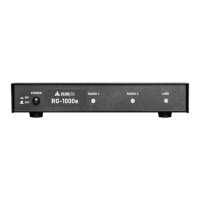
The simplest system configuration includes the remote RG-1000e GATEWAY with one connected control station,
SmartPTT radioserver and the dispatch console.
The dispatch console does not interact directly with the RG-1000e GATEWAY. Instead, the dispatch console
transmits data and audio to the radioserver, which then transmits them to the RG-1000e GATEWAY.
The interaction between the dispatch console and the radioserver is not considered in this document, as it is
described in detail in the corresponding SmartPTT software documentation.
The operating principle of the RG-1000e GATEWAY is based on the following elements:
1. Receiving and transmitting radio control commands intended for the management of the control station.
2. Receiving and transmitting the audio signals.
3. Transforming the radio control commands and audio signals into the asynchronous flow of digital data.
4. Encoding of the asynchronous flow of digital data and its transmission to the radioserver via IP network.
To work through the IP network, the RG-1000e GATEWAY and radioserver must be given static IP addresses.
After the connection is made, the IP communication channel is established that provides the transmission of the
following data via the UDP protocol:
· radio control commands between the control station and the radioserver;
· audio signals from the radio receiver and from the microphone of the dispatch console.
The radioserver may host multiple RG-1000e GATEWAY gateways. Their number is limited only by the license
conditions or by the technical constraints of the communication channels.
To establish the IP communication channels between the RG-1000e GATEWAY and radioserver, the TCP protocol
and UDP/RTP protocols are used. The TCP protocol serves to transmit the radio control commands. The RTP
protocol is used to transmit audio, registration messages (ARS), short text messages (TMS), etc.
To separate the channels on the RG-1000e GATEWAY, each channel is assigned a corresponding IP address
and UDP/TCP port number from a range of 1024...65536. When the IP channels of the RG-1000e GATEWAY have
equal values of IP address and UDP port, the connection is performed in tandem on idle IP channels.
To process the signals of the radio audio path, compression is used in the RG-1000e GATEWAY. The built-in
compressor receives and transmits audio signals using 64 kbps Mu-Law PCM encoding.
Below you will find examples of network topologies and configurations when the RG-1000e GATEWAY and
radioserver are connected. The details about how to connect the radioserver to other equipment or to the dispatch
console are not shown in the examples.
The RG-1000e GATEWAY network interface meets the 10BASE-T (IEEE 802.3) / 100BASE-TX (IEEE 802.3u)
specifications and may be connected to external equipment that meets the same network interface specifications.
Below you will find examples of network topologies and configurations when the RG-1000e GATEWAY and
radioserver are connected. The details about how to connect the radioserver to other equipment or to the dispatch
console are not shown in the examples.


 To Next Page