11
VFOs A and B
The KX3 provides two VFOs (see glossary, pg. 49).
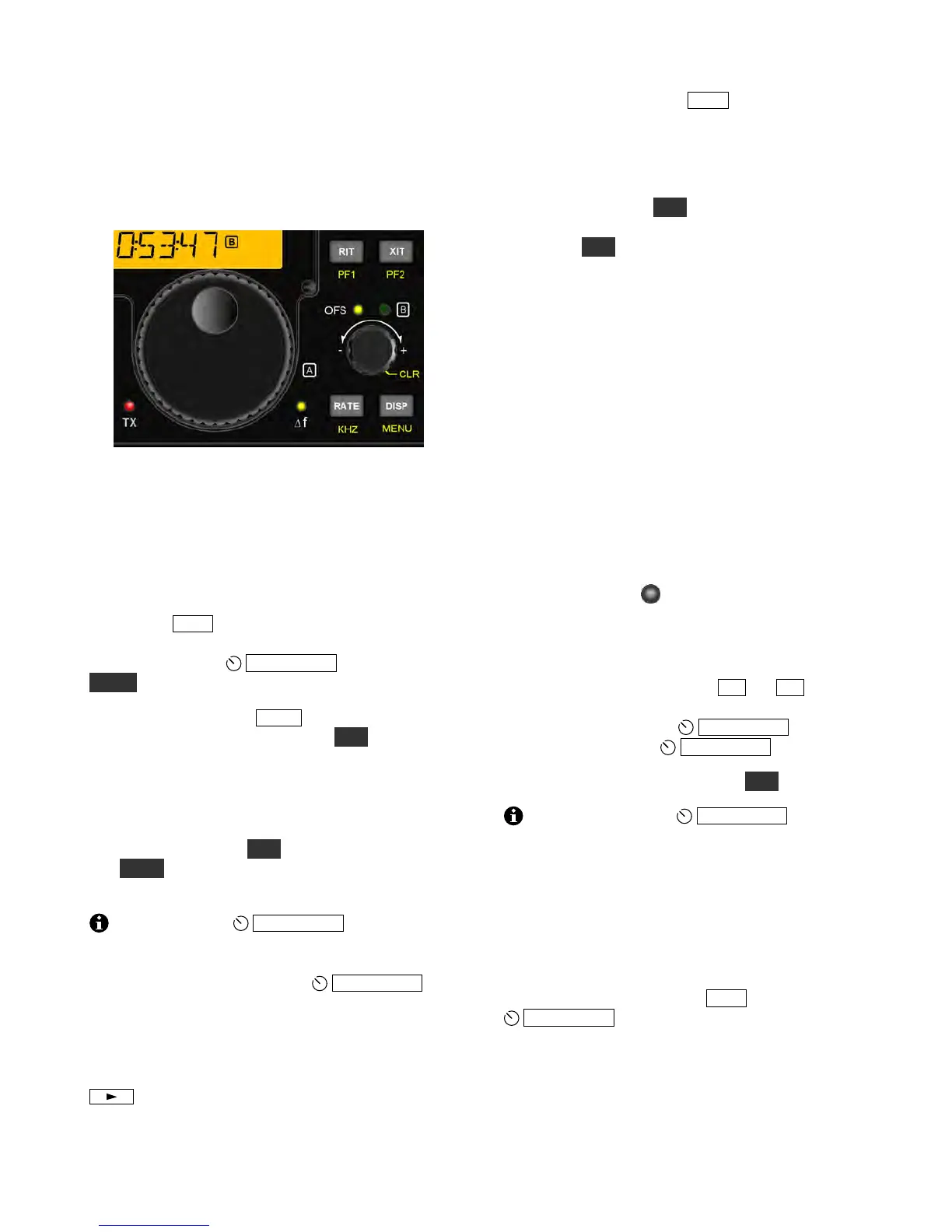
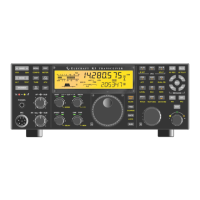
Use of VFO B is optional. The VFO knobs are
located in the area shown below. Each VFO has
independent frequency, mode, and filter settings.
VFO A normally controls both the receive and
transmit frequency. Most contacts occur between
stations tuned to about the same frequency, so if
you use VFO A to tune in a signal clearly, there’s a
good chance they’ll hear you when you transmit.
VFO B can serve as a holding register for a second
frequency of interest, then swapped with VFO A as
needed (see A / B at right). To tune VFO B
directly, first make sure the B LED above the knob
is lit. If not, tap the
OF S / V FO B knob. Also see
SP L IT (pg. 19) and Dual Watch (pg. 20).
Tuning rates: Tapping R A T E selects either 1 Hz
or 10 Hz VFO tuning rate. Holding KH Z selects a
per-mode coarse tuning rate (see MENU:VFO
CRS, pg. 30). SSB stations often align on 0.5 or 1.0
kHz boundaries. AM broadcast stations are
typically spaced at 5, 9, or 10 kHz.
To lock VFO A: Hold K HZ for about 3 seconds.
Tap RA T E to unlock. To lock VFO B, swap it with
A first, lock, then swap back.
You can use the
OF S / V FO B control to
tune VFO A in coarse steps, while the VFO A
control itself is still set up for fine steps. First, make
sure the OFS LED is lit (tap the
OF S / V FO B
knob one or two times). RIT and XIT (described at
right) must also be turned off. To disable the VFO
offset-tuning feature, see MENU:VFO OFS.
To copy VFO A’s frequency to VFO B: Tap
A B . Tapping a second time copies VFO A’s
mode and filter settings to VFO B as well.
VFO A and B swap: Tap A / B to exchange VFO
frequencies, modes, and all other settings.
VFO A/B temporary reverse: Sometimes you’ll
want to swap the VFOs temporarily to look for an
open transmit frequency when operating split (pg.
19). In this case, hold R EV . The VFOs will be
swapped back as soon as you release the switch. In
FM mode, RE V swaps receive/transmit frequencies
and the repeater offset direction (pg.15).
Incremental Tuning (RIT and XIT)
RIT, or receive incremental tuning, provides a
means of adjusting the receive frequency without
affecting your transmit frequency. This control is
sometimes called a clarifier since it can be used to
tune in SSB voice signals. But RIT can also be used
in CW and DATA modes, in the event that a station
calls you slightly off-frequency. RIT and XIT use
the tuning rate (1/10 Hz) selected for the VFOs.
XIT, or transmit incremental tuning, adjusts the
transmit frequency without affecting the receive
frequency. See Split and XIT, pg. 19.
∆ F (Delta-F) LED : Whenever an RIT or XIT
offset is in effect, or during split operation, the ∆ F
LED turns on as a reminder that your receive and
transmit frequencies are different.
To use RIT or XIT: First, tap R IT or X IT . This
turns on the RIT or XIT icon on the display, as well
as the OFS LED (above
OF S / V FO B ). Then
adjust the offset using
OF S / V FO B .
To zero the RIT/XIT offset: Hold C L R .
You can still use the
OF S / V FO B control
to tune VFO B, even if RIT or XIT is turned on.
Just tap the knob to switch its function back to VFO
B (the B LED will turn on). The RIT/XIT icons on
the LCD will retain their current states.
Special VFO B Displays
The VFO B display area can show several useful
parameters. To see these, tap D ISP , then rotate the
OF S / V FO B control. This will cycle through
several displays including time, supply voltage,
current drain, power amplifier temperature,
synthesizer temperature, audio voltmeter, and
relative audio (dBV) meter. For details see pg. 22.


 To Next Page