18
Data Modes
The KX3 supports data operation via a computer
and special software. But it can also receive and
transmit in RTTY and PSK31 modes without a
computer. All data modes are described below.
5.0 watts or lower is recommended in data
modes. The KX3 will reduce power, if necessary,
to maintain a safe operating temperature.
FSK D Mode (RTTY)
FSK D (RTTY
1
) is the easiest data mode to use:
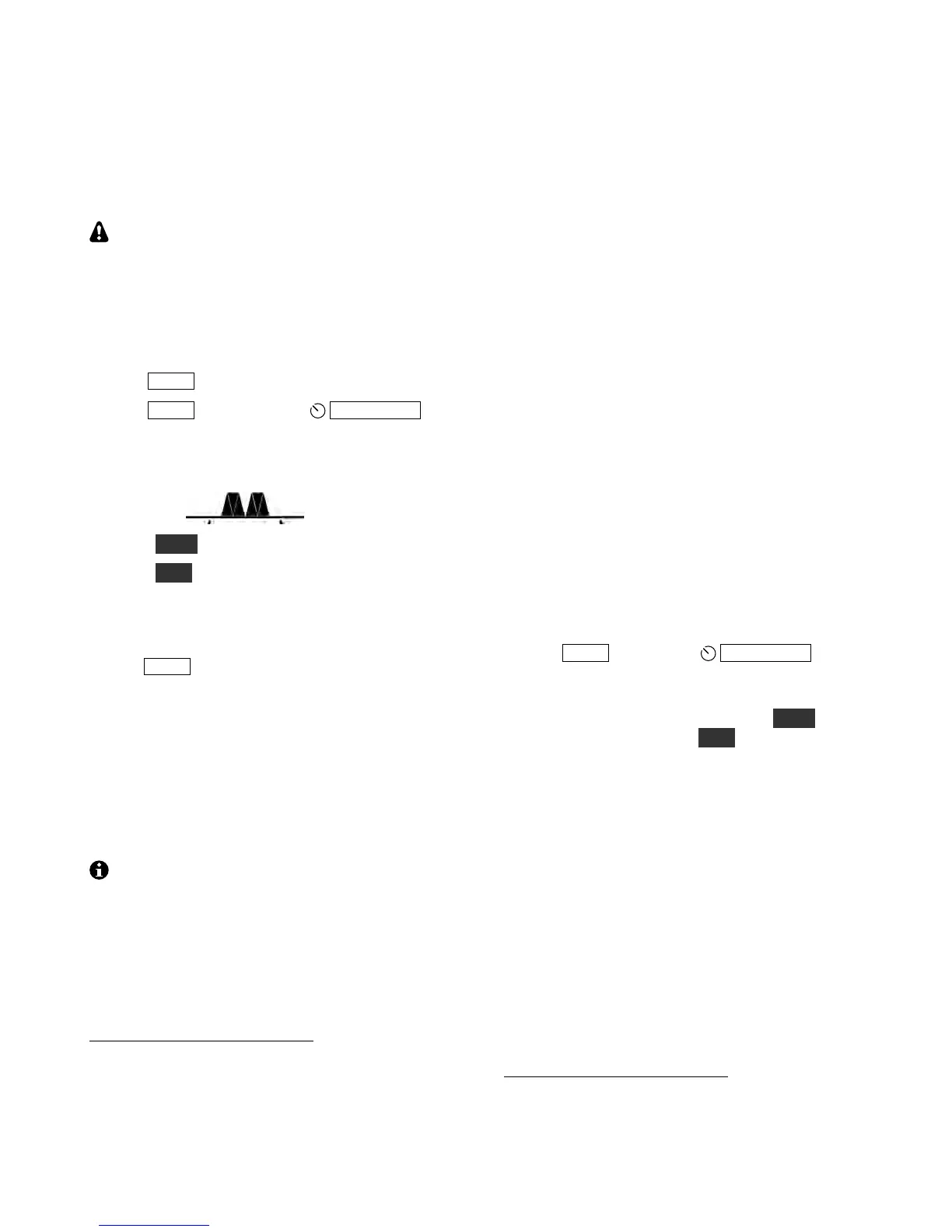
Tap D AT A to select data mode.
Tap D AT A again and rotate
OF S / V FO B to
select the FSK D sub-mode. Tap the switch
again to exit the sub-mode display. A dual-
passband (mark/space) filter will appear:
Hold TE X T to turn on text decode.
Hold CW T to turn on the tuning aid (pg. 13).
You’ll now be able to copy RTTY signals. RTTY
can often be found on 20 meters from 14080-14090
kHz. (If you see only numbers and punctuation, try
tapping D AT A twice to restore “letters” mode.)
To transmit in FSK D mode (CW-to-Data): Plug
a keyer paddle into the KEY jack, or attach a
KXPD3 paddle. (See the CW KEY1 and CW
KEY2 menu entries.) When you send CW, the KX3
will convert it to RTTY. (You’ll hear the CW
sidetone as well as the RTTY tones.) You can use
CW message memories in FSK D mode, as well as
KX3 Utility’s Terminal function (pg. 28).
The KX3 adds a 4-second “idle time” (giving
you time to decide what to say next) after you stop
sending. At the end of this period, the receiver is re-
enabled. To terminate the idle period quickly, send
the character
. .
- - in CW. This “IM” prosign can
also be inserted at the end of message buffers.
1
FSK stands for frequency-shift keying, the modulation
method used with RTTY (radioteletype). The KX3 uses
the most common shift, 170 Hz. RTTY signals are
encoded using a 5-level code called baudot, at a baud
rate of 45 baud, or about 60 words per minute.
PSK D Mode (PSK31)
PSK D is the KX3’s implementation of PSK31
2
, a
narrow-band data mode which is reliable even at
very low power levels. 5 watts or less is strongly
recommended to keep distortion low.
To use PSK D, set up the KX3 as described at left
for FSK D, but select the PSK D sub-mode. Before
attempting to transmit in this mode, you should
practice tuning in signals. Try 14070-14073 kHz.
CWT can be used in this mode (see pg. 13).
DATA A and AFSK A (Audio Data Modes)
Many audio-based data modes can be heard on the
bands, including Pactor, Olivia, MFSK, JT65, etc.
A computer, sound card, and appropriate software
is required to use these modes. DAT A A disables
compression and RX/TX EQ, and optimizes
transmit ALC for low bit error rate. Upper sideband
is the default.
For audio-based RTTY, you can use AFSK A,
which provides the same dual-passband RTTY filter
as FSK D, as well as text decode. The VFO displays
the mark frequency. Lower sideband is the default.
To use these audio data modes:
Tap D AT A twice; rotate
OF S / V FO B to
select the DA T A A or AFSK A . Tap the
switch again to exit the sub-mode display.
In AFSK A mode, optionally hold T EX T to
turn on text decode, and C W T to turn on the
CW/data tuning aid.
Connect your computer’s audio output to the
MIC jack. (You can either wire the plug to
activate the PTT line on transmit, or use VOX.)
Connect the KX3’s PHONES jack to your
computer’s audio input. High-quality shielded
cables should be used. You may need an
attenuator if the drive levels are too high.
Refer to your data communications software
manual to determine how to set up the KX3’s
VFO for accurate frequency display.
While transmitting audio data, adjust MIC gain
for 4 to 5 bars of ALC indication.
2
PSK stands for phase-shift keying. 31 refers to the baud
rate, 31.25 baud. PSK31 signals are encoded using a very
efficient representation called varicode.


 To Next Page