21
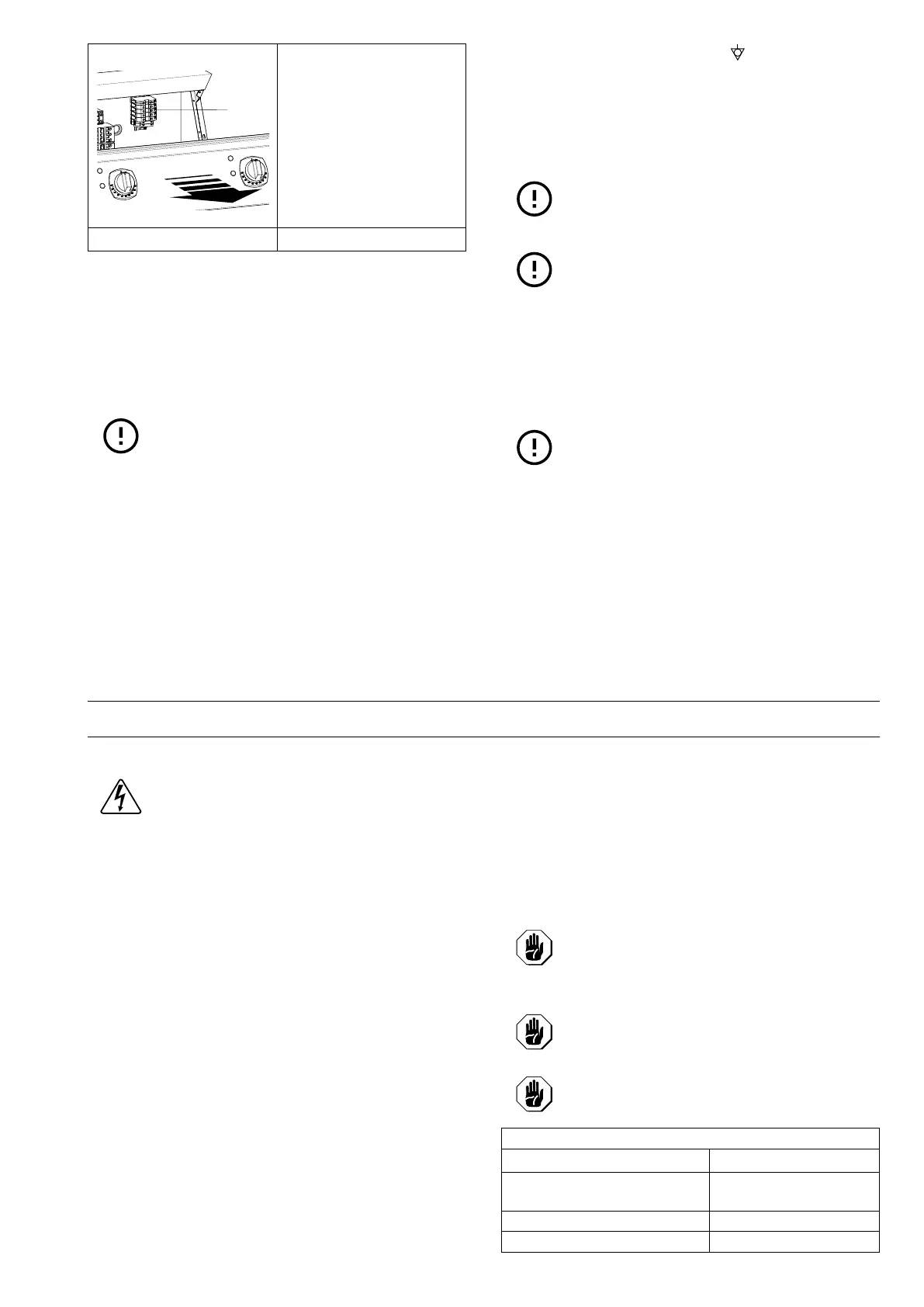
23 L Fryers — Fig. 9
To access the terminal block:
1. Undo the fixing screws (see 15 L Fryers — Fig. 7, 18 L
Fryers — Fig. 8 or 23 L Fryers — Fig. 9);
2. Remove the front panel of the appliance;
3. Connect the power cable to the terminal block “M“ as
shown in the pictures and in the wiring diagram attached
to the appliance;
4. Secure the power cable with the cable clamp;
IMPORTANT
The manufacturer declines any liability if the safety
regulations are not respected.
F.12 Circuit breaker
Verify that a safety circuit breaker is installed between the
power cable of the appliance and the mains electric line.
The contact opening max. distance and leakage current must
comply with the local safety regulations.
F.13 Equipotential node and Earth
connection
Connect the appliance to an earth; it must be included in an
equipotential node by means of the screw located under the
frame.
The screw is marked with the symbol .
F.14 Safety thermostat
Appliances equipped with safety thermostat (overheating
safety thermostat) that trips off automatically when temper-
atures exceed a set value, shutting off the gas supply (gas
appliances) or the electricity (electric appliances).
IMPORTANT
Resetting of the safety thermostat must be carried
out by specialised personnel; contact the Customer
Care.
IMPORTANT
“Positive trip“ effect of the safety thermostat (used
on some equipment type as per norms prescrip-
tions) interrupts the unit operability (heating) even
in case the capillary is cut.
Similar effect, but with no damage for the safety
thermostat, can happen if the machine body
temperature drops below -10℃: in such cases, it is
required to reset the safety thermostat while instal-
ling the machine, hence before connecting it to the
mains.
IMPORTANT
On electric heated machines, only reset safety
thermostat after disconnecting from the mains.
Failure to disconnect from the mains causes the
safety thermostat to brake and the unskilled person
to risk electrocution.
Tampering with the safety thermostat invalidates
the original manufacturer warranty.
F.15 Fuse replacement
The electrical system protection fuse is located inside the
panel. To replace the fuse simply remove it from the terminal
block.
G INSTRUCTION FOR THE USER
G.1 Fryer use
DANGER
Do not use exausted oil or fat
cause due to a low flash point
and easily reach boiling point.
General precautions
• The appliance is intended for commercial use by trained
personnel.
• These appliances are intended for use in commercial
applications such as kitchens, restaurants, hospitals or in
commercial businesses such as bakeries, butchers etc. but
not for continuous massive production of food.
• Do not use the appliance for long periods when empty or in
conditions that compromise its optimum efficiency.
• This appliance must only be used for its expressly designed
purpose; i.e. for frying foods in oil or solid fat;
Any other use is to be considered improper.
• Before introducing oil in the tank, make sure it does not
contain water;
• Pour the oil in the tank up to the maximum level indicated by
the special reference notch situated on the rear wall of the
tank;
• When using solid fat, melt the fat separately and then pour
in the tank.
Do not leave fat in the tank at the end of cooking.
• Particularly bulky and wet foods can cause sprays of hot oil.
• Place the basket with food to be cooked, slowly in the
boiling oil, making sure that the froth formed does not spill
over the edge of the tank;
If this occurs, stop dipping the basket for a few seconds.
• The maximum recommended load is:
– for 23–litre models – 4 kg (2 per basket) with fresh potatoes
and 3 kg (1.5 x 2) with frozen potatoes;
– for 15–litre models – 2 kg (fresh) and 1.5 kg (frozen);
– for the 23–litre tube fired model – 3 kg with fresh potatoes
and 2 kg with frozen potatoes.
CAUTION
Top-up the oil bath whenever it falls below
the minimum level, marked by the special
reference notch (danger of fire).
CAUTION
Tank emptying must be done when the oil
is cold.
CAUTION
Do not use the appliance when empty.
FRYER TEMPERATURE SETTING
Type of frying Set the temperature to:
Foods that do not disperse
pollutant substances in the oil
180℃ / 185℃
Breaded foods 175℃ / 180℃
Floured foods 170℃



 To Next Page