23
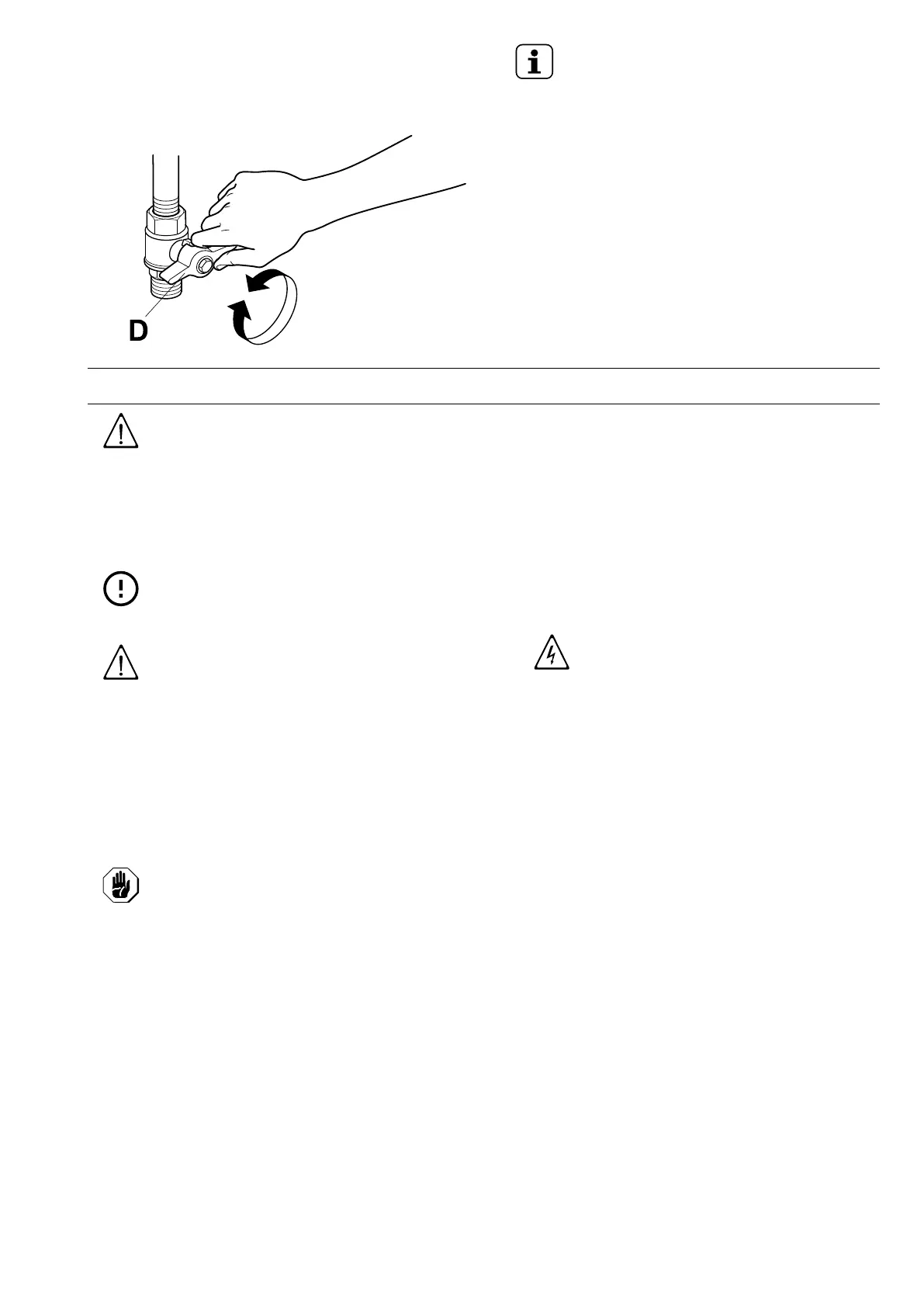
• Open the drain tap slowly turning the handle “D“
anticlockwise;
• Pay maximum attention to avoid coming into contact with
the hot oil;
• Close the drain tap by turning the handle “D“ clockwise.
NOTE!
For better appliance performance, regularly
change the used oil. Overusing an oil reduces its
flashpoint and increases its tendency to boil
suddenly.
H MACHINE CLEANING AND MAINTENANCE
WARNING
Refer to “Safety Information“.
H.1 Ordinary maintenance
H.1.1 Care information
The following care operations have to be carried out by the
owner and/or user of the appliance.
IMPORTANT
Problems resulting from poor or lack of care as
hereinafter described will not be covered by the
warranty.
WARNING
Before carrying out any cleaning
or maintenance, disconnect the
appliance from the power supply.
H.1.2 Cleaning the appliance and accessories
Before using the appliance, clean all the internal parts and
accessories with lukewarm water and neutral soap or products
that are over 90% biodegradable (in order to reduce the
emission of pollutants into the environment), then rinse and dry
thoroughly.
CAUTION
Do not use solvent-based detergents (e.g.
trichloro-ethylene) or abrasive powders
for cleaning.
H.1.3 External parts
SATIN-FINISH STEEL SURFACES (daily)
• Clean all steel surfaces: dirt is easily removed when it has
just formed.
• Remove grime, fat and other cooking residuals from steel
surfaces when cool using soapy water, with or without
detergent, and a cloth or sponge.
Dry the surfaces thoroughly after cleaning.
• In case of encrusted grime, fat or food residuals, go over
with a cloth or sponge, wipe in the direction of the satin
finish and rinse often:
Rubbing in a circular motion combined with the particles of
dirt on the cloth/sponge could spoil the steel’s satin finish.
• Metal objects can spoil or damage the steel: damaged
surfaces become dirty more easily and are more subject to
corrosion.
• Restore the satin finish if necessary.
SURFACES BLACKENED BY HEAT (when necessary)
• Exposure to high temperatures can cause the formation of
dark marks.
These do not constitute damage and can be removed by
following the instructions given in the previous section.
H.1.4 Other surfaces
Heated tanks/containers (daily)
• Clean the appliance tanks or containers using boiled water,
adding soda (degreasing) if necessary.
• Use the accessories (optional or supplied) specified in the
list to eliminate encrustations or food deposits.
WARNING
With electrical equipment,
make sure no water comes
into contact with electrical com-
ponents: water entering can
cause short circuiting and dis-
sipation, tripping the
appliance’s protection devices.
Tanks and collection drawers (even several times a day)
• Remove any grease, oil, food residuals, etc., from trays,
drawers and containers in general used for collection.
Always clean these containers at the end of the day.
• While using the appliance, empty them when they are
nearly full.
H.1.5 Filters
Use of filters for the oil increases its life and guarantees better
cooking of the food in the event of reuse.
For cleaning (not suitable for disposable filters)
1. remove the filter from its housing;
2. if the filter is dirty with grease, wash with degreasing soap;
3. rinse and dry;
4. then refit the filter in its housing.
Replace the filter if deteriorated.
H.1.6 Periods of non-use
If the appliance is not going to be used for some time, take the
following precautions:
• Close the valves or main switches ahead of the appliances;



 To Next Page