DPSI RV Family Operating Instructions Version 2.0
Page 7 of 48
Voltage Regulation:
Until now, the receiver set was supplied directly by the connected
battery (or a corresponding battery switch). The output voltage
depends heavily on the current discharge state. Because virtually
always 5-cell NiCad or NiMH batteries are being used in large model
airplanes, a fully charged battery reaches up to 7.5 volts after the
charger shuts off (depending on the charging current and the internal
resistance). This peak voltage drops relatively fast, but can cause
reduced lifetime of the servos in unfavorable cases, because the
manufacturers usually allow only up to 6 volts. Due to the increased
usage of Lithium-Polymer batteries (e.g. LONGGO) voltage regulation
is mandatory, because the batteries nominal voltage is 7.4 volts.
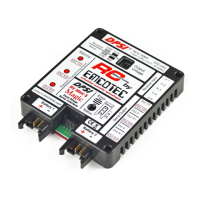
The electronics of the DPSI RV systems make sure, that the voltage of
the batteries is reduced to an acceptable value, independent of the
provided input voltage of the batteries. Using a jumper (a small
connector), the output voltage can be adjusted in four steps (except for
the DPSI 2001 RV – here the voltage is fixed). Thus, the power
requirements can be adjusted to the pilots needs.
Low voltage warning:
In order to inform the user about the discharging state of his batteries,
a microcontroller using an intelligent algorism is integrated into the
DPSI RV systems, to monitor all voltages. Errors (e.g. battery voltage
too low) are unambiguously communicated through a built in buzzer
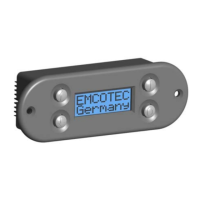
acoustically and in the switch transmitter by the central LED optically.
Additionally, the DPSI RV allows for direct connection of external LED
displays (battery controllers). In order to use different battery types, a
DPSI RV can be “programmed” for the battery being used. Thus,
through simple programming you can select between 5-, 6-, 7-cell
NiCad/ NiMH batteries or LiPo batteries (e.g. LONGGO).



 To Next Page