10.6.2 Calibration — Total Chlorine
T
otal chlorine is the sum of free and combined chlorine. The continuous determination of
total chlorine requires two steps. First, the sample flows into a conditioning system (TCL)
where a pump continuously adds acetic acid and potassium iodide to the sample. The acid
lowers the pH, which allows total chlorine in the sample to quantitatively oxidize the iodide
in the reagent to iodine. In the second step, the treated sample flows to the sensor. The
sensor is a membrane-covered amperometric sensor, whose output is proportional to the
concentration of iodine.
Because the concentration of iodine is proportional to the concentration of total chlorine,
the analyzer can be calibrated to read total chlorine. Because the sensor really measures
iodine, calibrating the sensor requires exposing it to a solution containing no iodine (zero
standard) and to a solution containing a known amount of iodine (full-scale standard). The
Zero calibration is necessary because the sensor, even when no iodine is present, generates
a small current called the residual current. The analyzer compensates for the residual current
by subtracting it from the measured current before converting the result to a total chlorine
value. New sensors require zeroing before being placed in service, and sensors should be
zeroed whenever the electrolyte solution is replaced. The best zero standard is deionized
water. The purpose of the In Process Calibration is to establish the slope of the calibration
curve. Because stable total chlorine standards do not exist, the sensor must be calibrated
against a test run on a grab
sample of the process liquid. Several manufacturers offer portable test kits for this
purpose.
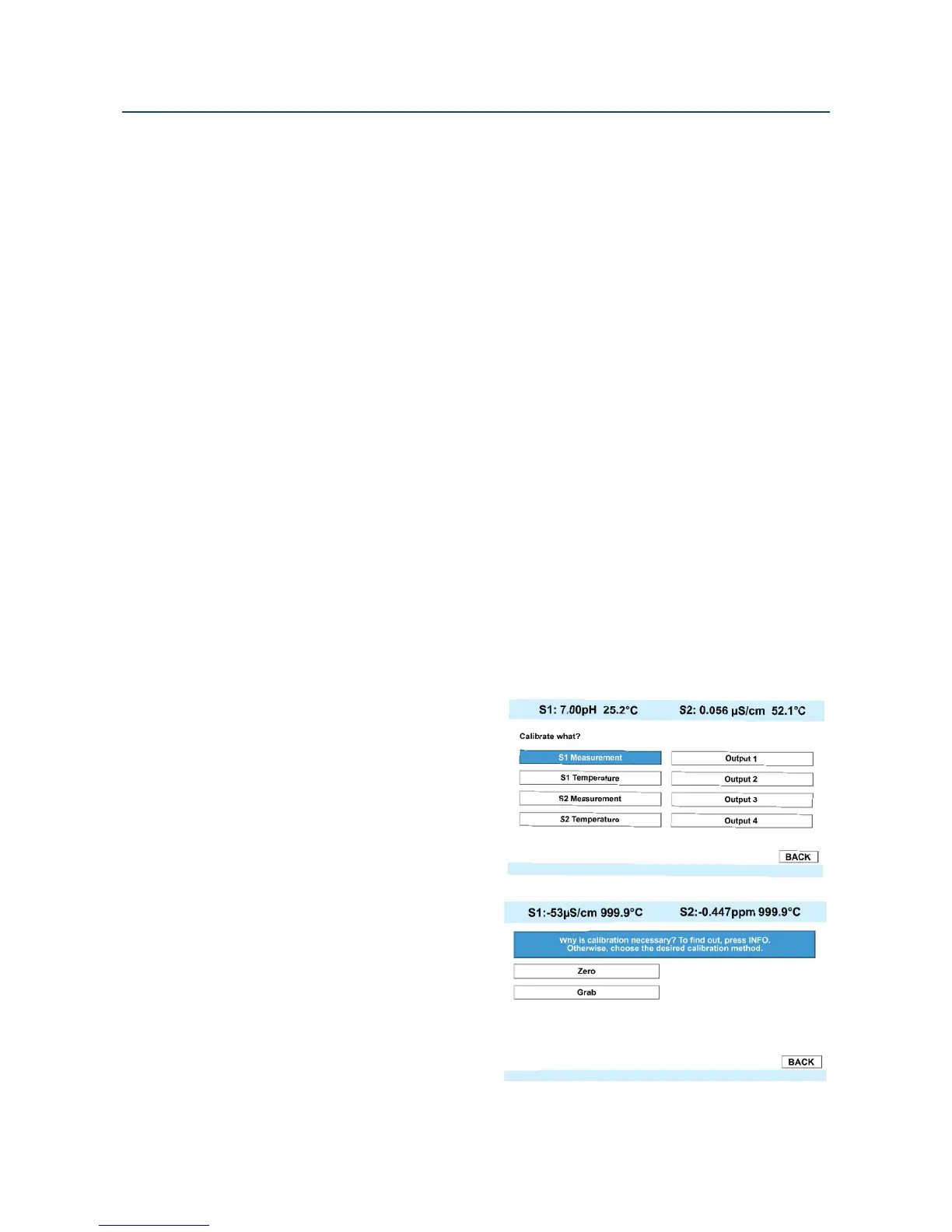
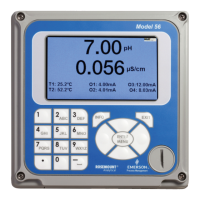
To calibrate the chlorine sensor, access the Calibration screen by pressing ENTER/MENU from
the main screen, select S1 or S2 Measurement and press ENTER/MENU. Press INFO at any
time to learn more about this procedure. A yellow screen will appear with detailed
instructions and information.
The following calibration routines are covered:
1. Zero Cal Zeroing the sensor in solu-
tion with zero total chlorine
2. Grab Cal Standardizing to a
sample of known total chlorine con-
centration
1. To Zero Calibrate the analyzer with
the sensor attached, follow the step-
by-step procedures
displayed on-screen.
2. To perform a Grab Calibration by
Standardizing the sensor, follow the
step-by-step procedures
displayed on-screen.
80 Calibration
Section 10: Calibration Instruction Manual
April 2017 LIQ-MAN-56






 To Next Page