Instruction Manual Section 11: HART Communications
LIQ-MAN-56 April 2017
HART Communications 89
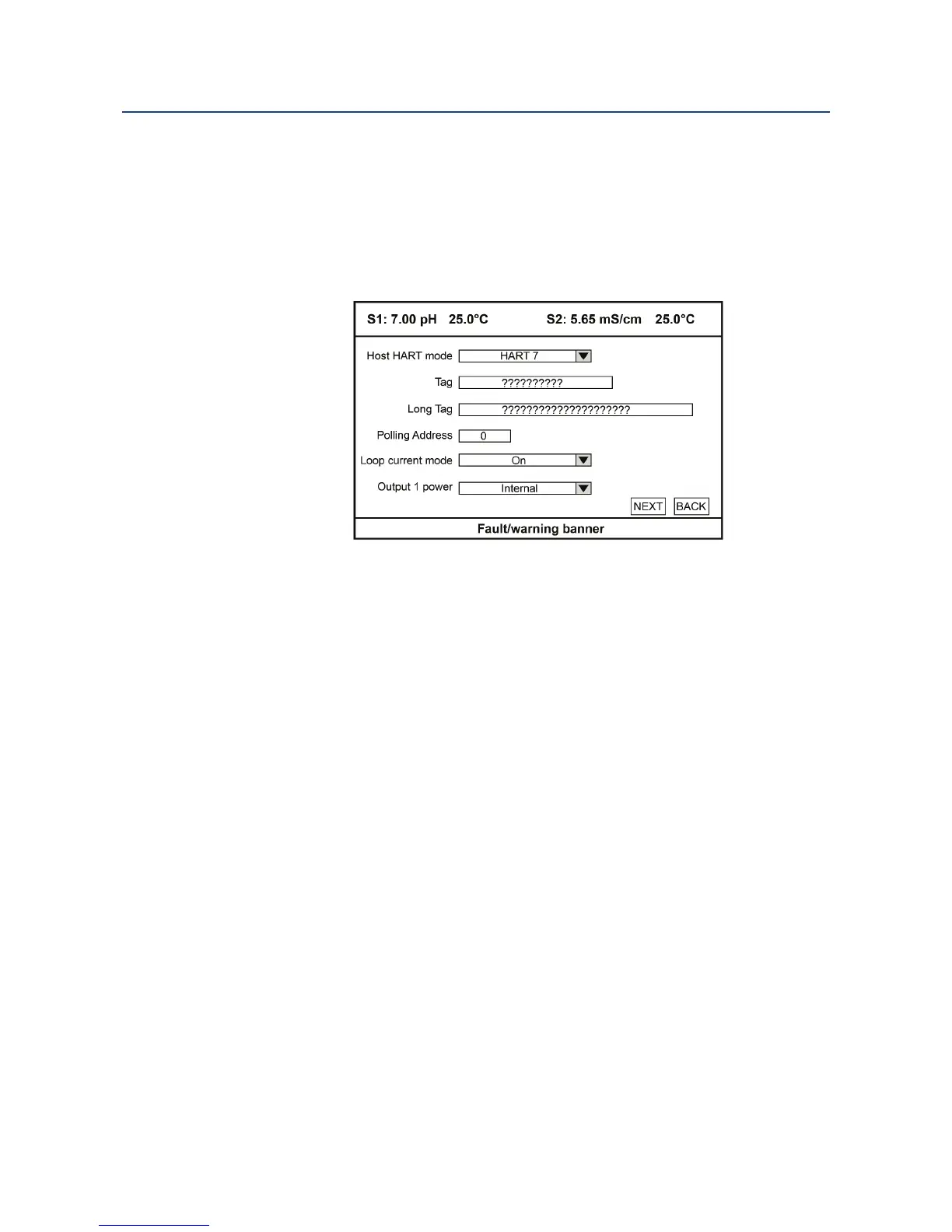
• Output 1 Power – Select “Internal” to power Output 1 with the 56. Select “External”
to power the current loop with an external power supply, e.g. a host I/O that provides
p
ower (source) to the transmitter (sink).
HART Configuration Screen 2 Basic Definitions
• Burst command:
Off – Turns burst mode off
Cmd 1 – Bursts the Primary Value
Cmd 2 – Bursts Loop Current + % of range of the Primary Value
Cmd 3 – Bursts Dynamic Variables (PV, SV, TV, & QV) + Loop Current
Cmd 9 – Bursts up to 8 Device Variables with time stamp and status (HART 7 only)
Cmd 33 – Bursts 4 Device Variables
Cmd 48 – Bursts Additional Transmitter Status Bits (HART 7 only)
Cmd 93 – Bursts Trend Data (HART 7 only)
• Find device cmd – Setting Find Device to “On”, enables the 56 to be indentified by the
host. The transmitter returns identity information including device type, revision level,
and device ID.
• Response preambles – Preambles synchronize the receiver to the incoming data. Re-
sponse preambles are the number of bytes of preambles (2 to 20) sent by the 56 at the
start of a response packet.
11.3 Measurements Available via HART
A number of live measurements are made available by HART in addition to the main
measurements such as pH or Conductivity. All of these measurements are called Device
Variables, which can be mapped to the Dynamic Variables PV, SV, TV, and QV for regular
reading by the typical HART host.
The 56 assigns the Dynamic Variables PV, SV, TV, and QV to Analog Outputs 1, 2, 3, and 4
respectively. Conversely, measurements assigned to Outputs 1 through 4, will automatically
be assigned to PV through QV.
Each measurement board will have its own set of Device Variables, based on the secondary
measurements used in making the main measurement. Appendix 1 shows the Device
Variable for the each sensor boards used in the 56, and the Dynamic Variables, which they
can be mapped to.






 To Next Page