XF Rev: 7, 2008-10-14 Page 31
10.2.2 Battery connection
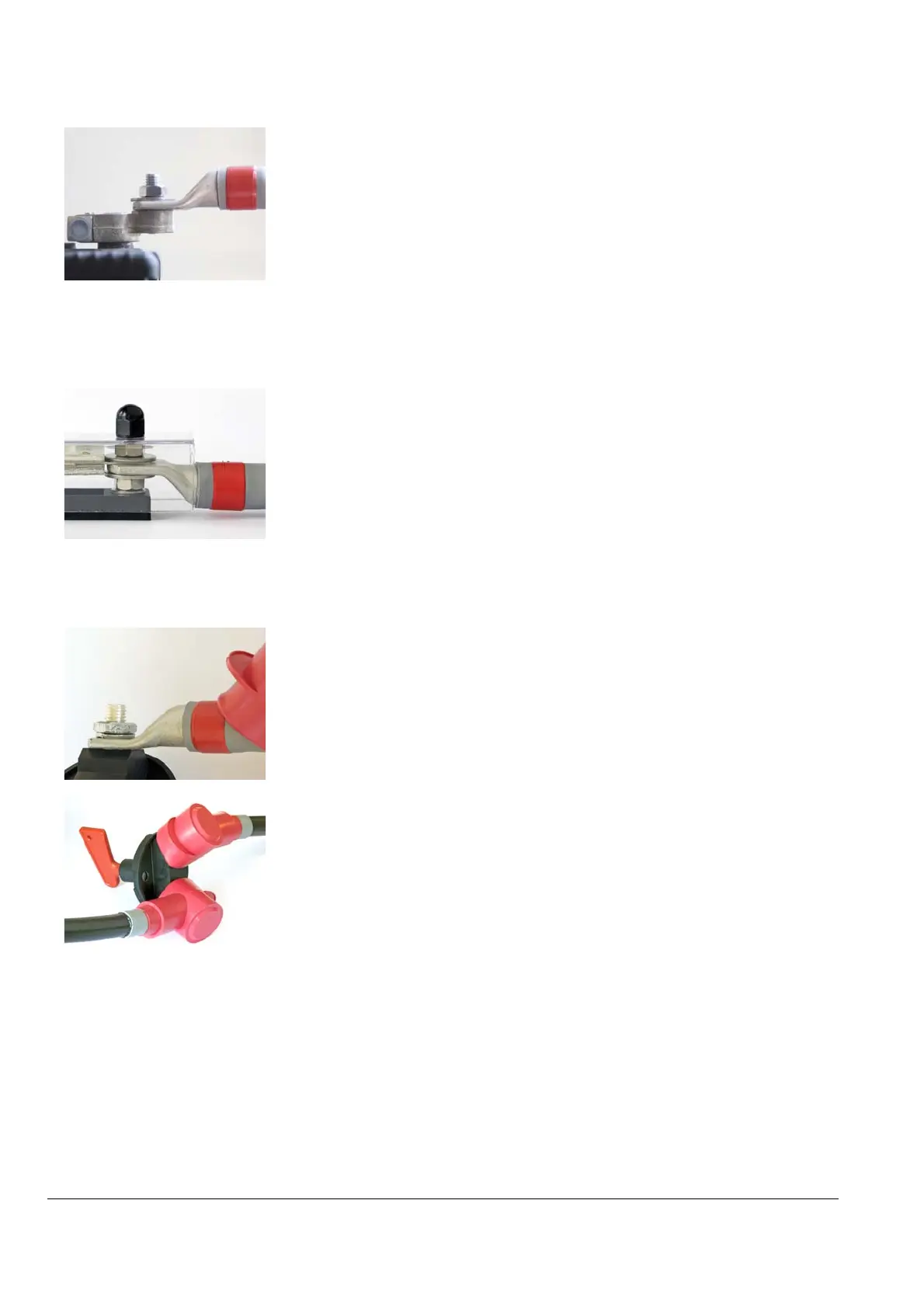
• The pictures show a correct connected batterycable. Notice that the
cable-lug is mounted onto the batterypost with washer and nut only
on the overside of the cable-lug. Nothing must be placed between
the battery terminal clamp and cable-lug.
• It excists different kinds of battery connections. Use only a type with
bolts, and not any kind of ”spring” or ”clip-on” solutions.
• If more than one cable/cable-lug has to be mounted on the same
battery-post, the one with the greatest current shall always be the
lowest or closest to the battery.
• Follow the instructions for applying the correct torque on the bolts.
• After the cables have been mounted, protective and isolating
rubber-cap shall be mounted.
10.2.3 Fuse connection
• The bolt itself is not an active current conductor, and its only
function is to assure a tight fit between the fuse and the cable-lug.
• The picture shows a correct connected cable to the fuseholder.
Please note that fuse and cable-lug is in direct contact with a big
washer over the fuse and under the cable-lug. There must be
nothing between the fuse and the cable-lug.
• Correct torque for a Stainless Steel bolt, (A4), is 20 Nm.
10.2.4 Main switch connection
The bolt itself is an active current conductor.
• The pictures show a correct main switch connection.
• Please note that the cable-lug is mounted directly onto the terminal
post, washer and nut is on top of the cable-lug.
Different kinds of main switches with different kinds of terminals excist.
Correct torque is;
• M8 Brass/copper: 10 Nm
• M10 Brass/copper: 15 Nm
The picture shows isolating rubber-caps mounted on both terminals. (For
improved understanding, the interrupter is not mounted on the bulkhead.)


 To Next Page