ESAB ES 95i
OPERATION 4-6 Manual 0-5458
4.13 Arc Welding Technique
A Word to Beginners
For those who have not yet done any welding, the simplest way
to commence is to run beads on a piece of scrap plate. Use mild
steel plate about 6.0mm thick and a 3.2mm electrode. Clean any
paint, loose scale or grease off the plate and set it firmly on the
work bench so that welding can be carried out in the downhand
position. Make sure that the work clamp is making good
electrical contact with the work, either directly or through the
work table. For light gauge material, always clamp the work lead
directly to the job, otherwise a poor circuit will probably result.
4.14 The Welder
Place yourself in a comfortable position before beginning to weld.
Get a seat of suitable height and do as much work as possible
sitting down. Don’t hold your body tense. A taut attitude of mind
and a tensed body will soon make you feel tired. Relax and you
will find that the job becomes much easier. You can add much to
your peace of mind by wearing a leather apron and gauntlets. You
won’t be worrying then about being burnt or sparks setting alight
to your clothes.
Place the work so that the direction of welding is across, rather
than to or from, your body. The electrode holder lead should be
clear of any obstruction so that you can move your arm freely
along as the electrode burns down. If the lead is slung over your
shoulder, it allows greater freedom of movement and takes a
lot of weight off your hand. Be sure the insulation on your cable
and electrode holder is not faulty, otherwise you are risking an
electric shock.
4.15 Striking the Arc
Practice this on a piece of scrap plate before going on to more
exacting work. You may at first experience difficulty due to the tip
of the electrode “sticking” to the work piece. This is caused by
making too heavy a contact with the work and failing to withdraw
the electrode quickly enough. A low amperage will accentuate it.
This freezing-on of the tip may be overcome by scratching the
electrode along the plate surface in the same way as a match
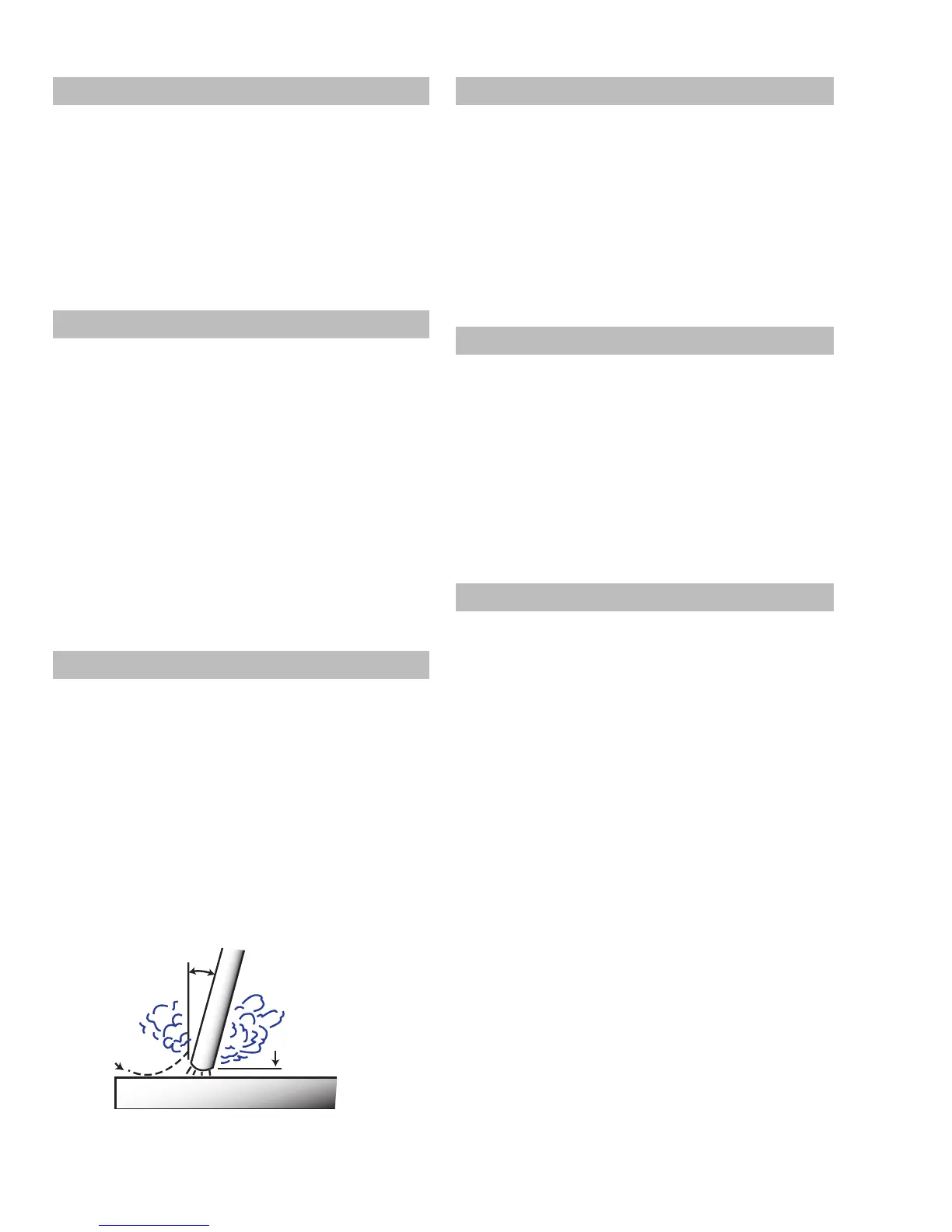
is struck. As soon as the arc is established, maintain a 1/16"
(1.6mm) to 1/8" (3.2mm) gap between the burning electrode end
and the parent metal. Draw the electrode slowly along as it melts
down.
Another difficulty you may meet is the tendency, after the arc is
struck, to withdraw the electrode so far that the arc is broken
again. A little practice will soon remedy both of these faults.
Art # A-07696_AB
1.6 mm (1/16”)
Figure 4-11: Striking an arc
4.16 Arc Length
The securing of an arc length necessary to produce a neat weld
soon becomes almost automatic. You will find that arc produces
a crackling or spluttering noise and the weld metal comes across
in large, irregular blobs. The weld bead is flattened and spatter
increases. A short arc is essential if a high quality weld is to be
obtained although if it is too short there is the danger of it being
blanketed by slag and the electrode tip being solidified in. If
this should happen, give the electrode a quick twist back over
the weld to detach it. Contact or “touch-weld” electrodes such
as E7014 electrode do not stick in this way, and make welding
much easier.
4.17 Rate of Travel
After the arc is struck, your next concern is to maintain it, and
this requires moving the electrode tip towards the molten pool
at the same rate as it is melting away. At the same time, the
electrode has to move along the plate to form a bead. The
electrode is directed at the weld pool at about 20° from the
vertical. The rate of travel has to be adjusted so that a well-
formed bead is produced.
If the travel is too fast, the bead will be narrow and strung out
and may even be broken up into individual globules. If the travel
is too slow, the weld metal piles up and the bead will be too
large.
4.18 Making Welded Joints
Having attained some skill in the handling of an electrode, you
will be ready to go on to make up welded joints.
A. Butt Welds
Set up two plates with their edges parallel, as shown in Figure
4-12, allowing 1/15" (1.6mm) to 3/32" (2.4mm) gap between
them and tack weld at both ends. This is to prevent contraction
stresses from the cooling weld metal pulling the plates out of
alignment. Plates thicker than 1/4" (6.0mm) should have their
mating edges beveled to form a 70° to 90° included angle. This
allows full penetration of the weld metal to the root. Using a 1/8"
(3.2mm) E7014 electrode at 120 amps, deposit a run of weld
metal on the bottom of the joint.
Do not weave the electrode, but maintain a steady rate of travel
along the joint sufficient to produce a well-formed bead. At first
you may notice a tendency for undercut to form, but keeping the
arc length short, the angle of the electrode at about 20° from
vertical, and the rate of travel not too fast, will help eliminate this.
The electrode needs to be moved along fast enough to prevent
the slag pool from getting ahead of the arc. To complete the joint
in thin plate, turn the job over, clean the slag out of the back and
deposit a similar weld.



 To Next Page