ESAB ES 95i
Manual 0-5458 5-3 SERVICE
5.03 GTAW (Lift TIG) Welding Problems
Weld quality is dependent on the selection of the correct consumables, maintenance of equipment and proper welding technique.
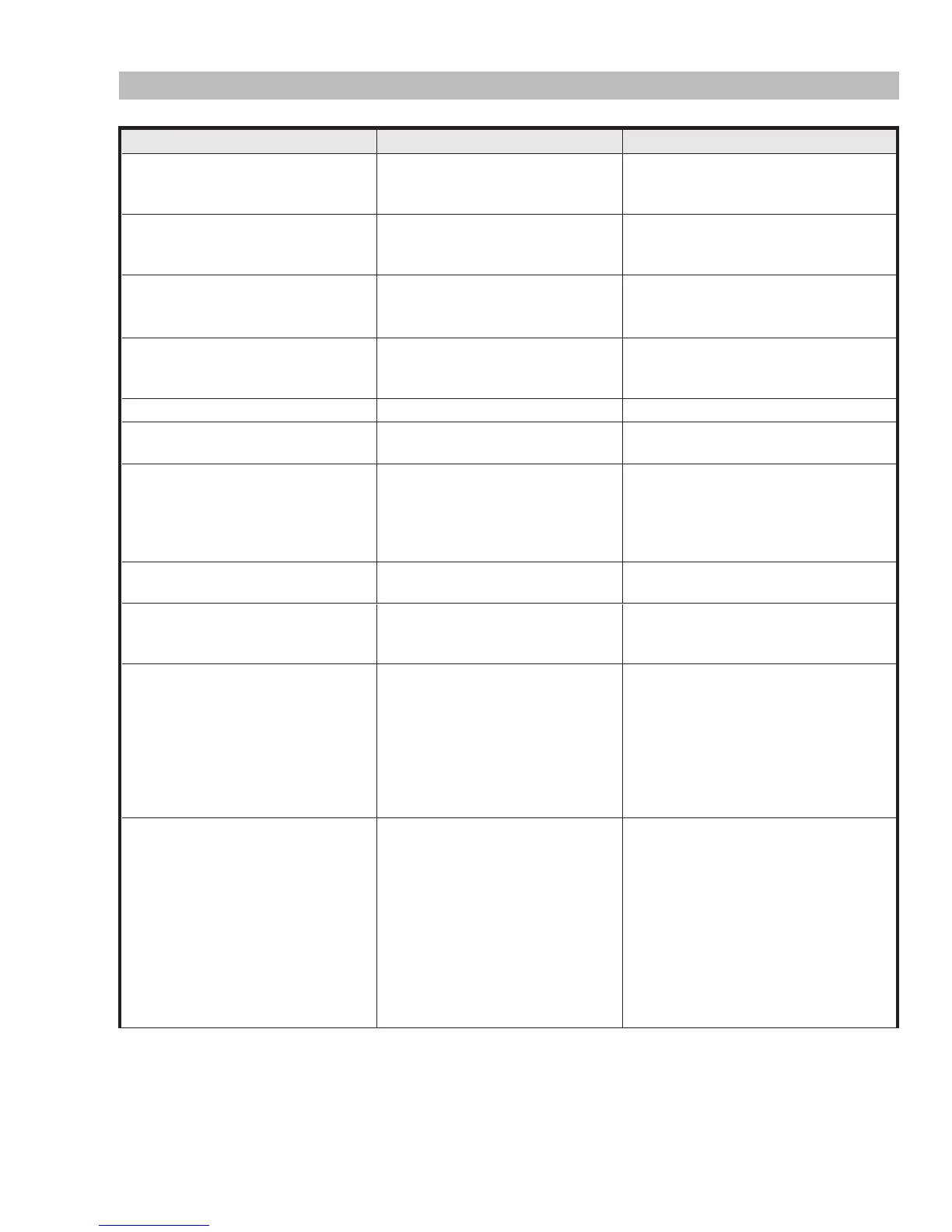
Description Possible Cause Remedy
1. Excessive beard build-up or poor
penetration or poor fusion at
edges of weld.
Welding current is too low Increase weld current and/or change
joint preparation.
2. Weld bead too wide and flat or
undercut at edges of weld or
excessive burn through.
Welding current is too high. Decrease welding current.
3. Weld bead too small or
insufficient penetration or ripples
in bead are widely spaced apart.
Travel speed too fast. Reduce travel speed.
4. Weld bead too wide or excessive
bead build up or excessive
penetration in butt joint.
Travel speed is too slow. Increase travel speed.
5. Uneven leg length in fillet joint. Wrong placement of filler rod. Re-position filler rod.
6. Electrode melts when arc is
struck.
Electrode is connected to the "+"
Positive Output Terminal.
Connect the electrode to the
"-" Negative Output Terminal.
7. Dirty weld pool. A. Electrode contaminated through
contact with work piece or filler
rod material.
B. Gas contaminated with air.
A. Clean the electrode by grinding
contaminates off.
B. Check gas lines for cuts and loose
fitting or change gas cylinder.
8. Poor weld finish. Inadequate shielding gas. Increase gas flow or check gas line
for problems
9. Arc flutters during TIG welding. Tungsten electrode is too large
for the welding current.
Select the right size electrode. Refer
to section Tungsten Electrode Current
Ranges.
10. Welding arc cannot be
established.
A. Work clamp is not connected to
the work piece or the work/torch
leads are not connected to the
correct welding terminals.
B. Torch lead is disconnected.
C. Gas flow incorrectly set, cylinder
empty or the torch valve is off.
A. Connect the work clamp to the work
piece or connect the work/torch leads
to the correct welding terminals.
B. Connect it to the "-" Negative Output
Terminal.
C. Select the right flow rate, change
cylinder or turn torch valve on.
11. Electrode melts or oxidizes when
an arc is struck.
A. No gas is flowing to welding
region.
B. Torch is clogged with dust.
C. Gas hose is cut.
D. Gas passage contains impurities.
E. Gas regulator turned off.
F. Torch valve is turned off.
G. The electrode is too small for the
welding current.
A. Check the gas lines for kinks or
breaks or cylinder contains gas.
B. Clean torch.
C. Replace gas hose.
D. Disconnect gas hose from torch
then raise gas pressure and blow out
impurities.
E. Turn on.
F. Turn on.
G. Increase electrode diameter or reduce
the welding current.



 To Next Page