Operating Instructions
Non-Contact Safety Switch CES-A-.5
12
(translation of the original operating instructions) 2096580-16-11/22
9.1. Notes about
Important!
Ì For use and application as per the requirements of
1)
a power supply with the feature “for use in
Class 2 circuits” must be used.
Alternative solutions must comply with the following requirements:
- This device shall be used with a suitable isolating source in conjunction with a fuse in accordance
with UL 248. This fuse should be designed for max. 3.3A and should be integrated into the 30VDC
voltage section.
Ì For use and application as per the requirements of
1)
a connecting cable listed under the UL
category code CYJV2 or CYJV must be used.
1) Note on the scope of the UL approval: the devices have been tested as per the requirements of UL508 and CSA/ C22.2 no. 14 (protection against electric shock and re).
9.2. Safety in case of faults
Ì The operating voltage U
B
is reverse polarity protected.
Ì The contacts LA/LB and -LA/-LB are short circuit-proof, but they are not reverse polarity protected.
Ì A short circuit between LA and LB can be detected only by external pulsing.
Ì A short circuit in the cable can be excluded by laying the cable with protection.
Ì The device meets the necessary EMC regulations even with an unscreened connecting cable. For applications that are
particularly sensitive to interference, a screened cable can be connected to the shield spring. This can be electrically
connected to the machine ground via the xing screws. The shield at the open end of the cable must also be connected
electrically to the machine ground.
9.3. Requirements for connecting cables
CAUTION
Risk of damage to equipment or malfunctions as a result of incorrect connecting cables.
Ì Use connection components and connecting cables from EUCHNER.
Ì On the use of other connection components, the requirements in the following table apply. EUCHNER
provides no warranty for safe function in case of failure to comply with these requirements.
Observe the following requirements with respect to the connecting cables:
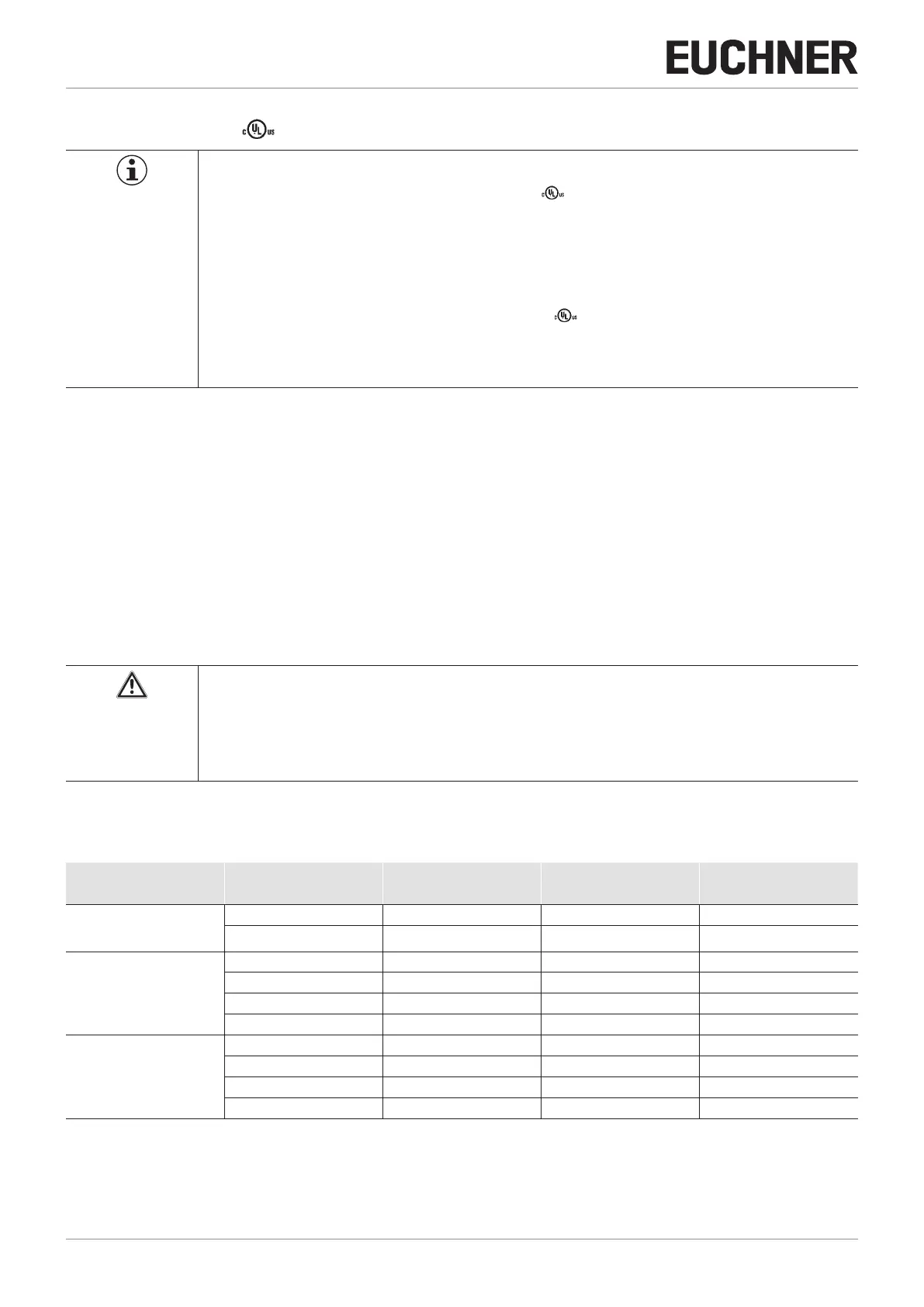
Table 2: Voltage drop as a function of switching current and cable length (examples)
Switching current Cable length “l” Voltage drop Max. voltage drop Max. voltage drop
[mA] [m] Output [V] Cable [V] Total [V]
6
(safety control system with
pulsed signals)
1 -100 1.4 0.1 1.5
101 - 300 1.4 0.4 1.8
50
(safety relay)
1 - 15 1.5 0.2 1.7
16 - 50 1.5 0.5 2.0
51 - 100 1.5 1.0 2.5
101 - 300 1.5 3.0 4.5
400
(e.g. small contactor)
1 - 15 1.7 1.2 2.9
16 - 50 1.7 4.0 5.7
51 - 100 1.7 8.0 9.7
101 - 300 1.7 - -




 To Next Page