44 45
General
Information
Securing Your Child Restraint in
Aircraft
The Federal Aviation Administration (FAA) recommends
that you secure your child for air travel in an appropriate
child restraint based on your child’s weight and size.
Turbulence can happen with little or no warning. When
turbulence occurs, the safest place for your child is
in a properly installed child restraint, not in an
adult’s lap or on the aircraft seat with its seat
belt. Keeping your child in a child restraint during the
flight will help ensure your family arrives safely at your
destination.
The FAA recommends that a child weighing:*
• more than 18 kg (40 lbs) use an aircraft seat belt;
• less than 9 kg (20 lbs) use a rear-facing child
restraint; and
• from 9 to 18 kg (20 to 40 lbs) use a forward-facing
child restraint.
* Please note that these FAA recommendations
may vary from those applicable to the use of
your child restraint in a motor vehicle.
Installing Child Restraint Rear-facing
in Aircraft
1
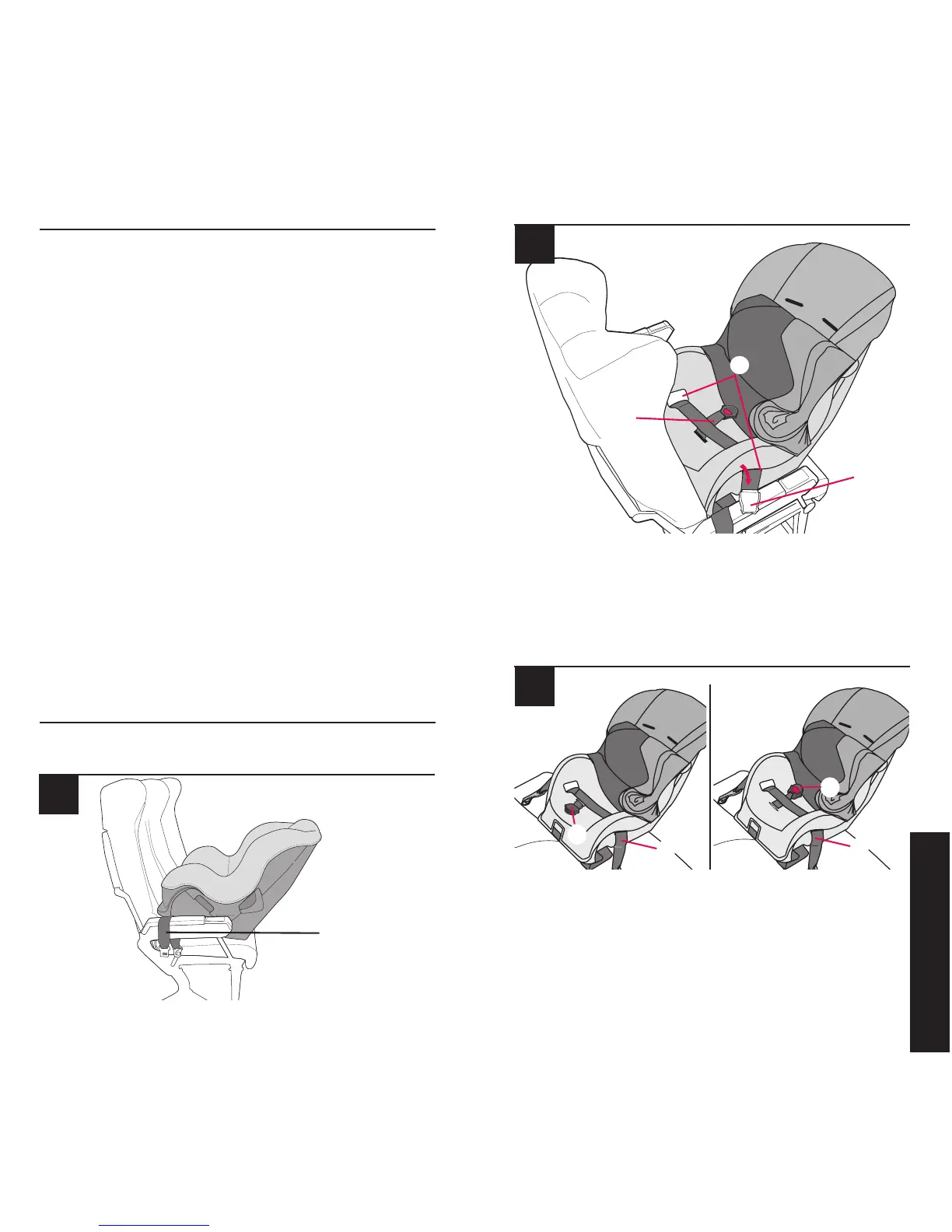
Adjust the child restraint to its recline position (page
18), then place it on the aircraft seat rear-facing, as
shown above
.
IMPORTANT: Before installing the child restraint, make
sure the aircraft seat is in a fully upright position.
IMPORTANT
You must use the internal harness when installing the
child restraint in aircraft.
Aircraft
Seat Belt
Installing Child Restraint Rear-facing
in Aircraft
Pull the seat pad off the front of the child restraint.
Route the aircraft seat belt
A
through the rear-facing
belt path
B
opening on one side and continue
through the belt path opening on the opposite side
of the child restraint, as shown above.
A
B
C
2
When the crotch strap
E
is in the front slot, route
aircraft seat belt
C
behind
the crotch strap, as shown.
C
D
E
E
3
When the crotch strap
E
is in the rear slot, rout
aircraft seat belt
C
in
front of the crotch strap,
as shown.









 To Next Page