EN 10
Planning
FZRR 5650-A, FZRR 5950-A
Movement Pattern
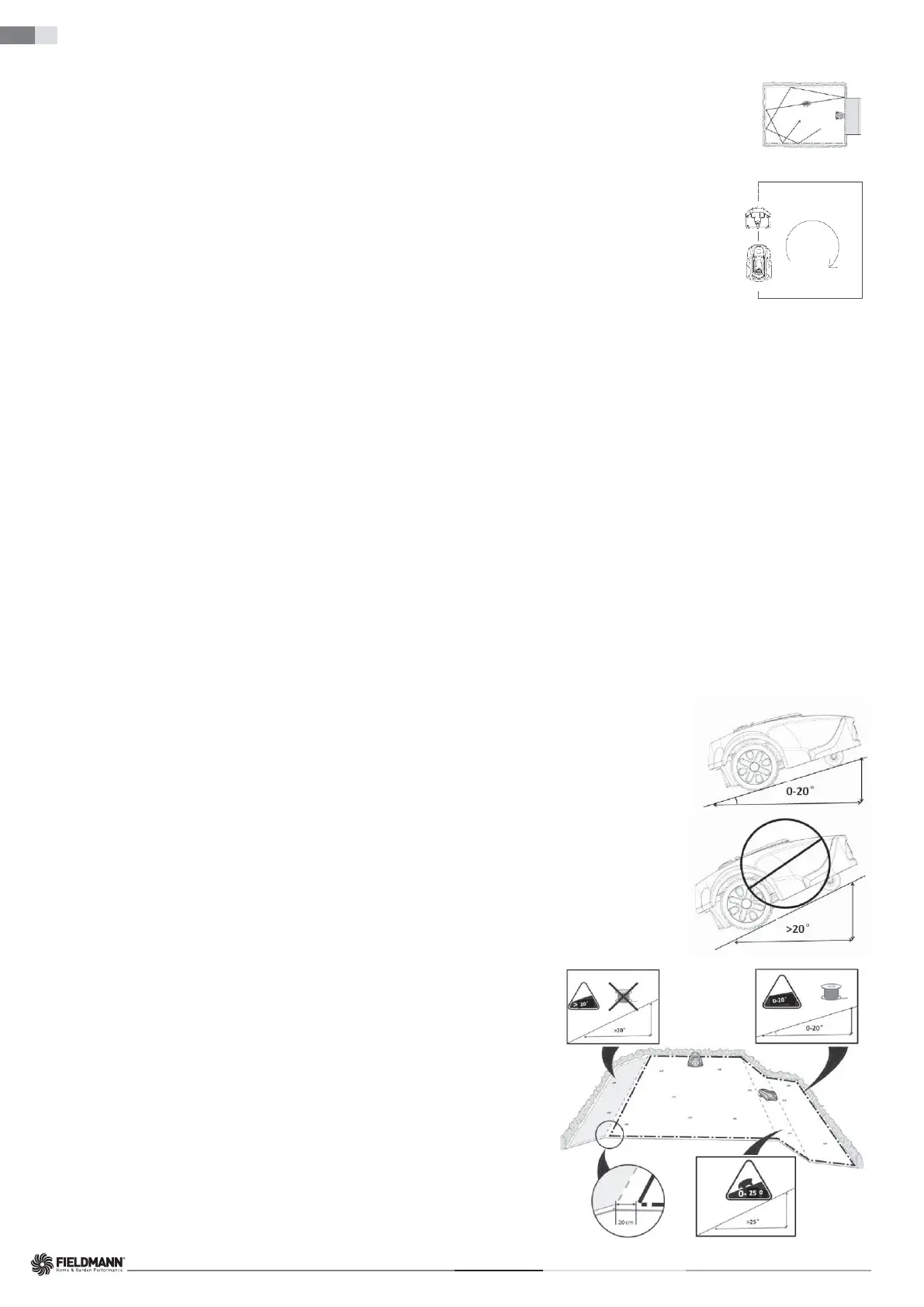
The movement pattern of the robotic lawn mower is irregular and is determined by the robotic lawn mower itself. The pattern of movement never
repeats.
Thanks to the cutting system, the lawn is evenly mowed without traces of the lawn mower's movement.
Search Method
The robotic mower moves irregularly until it fi nds the perimeter wire. It then follows the perimeter wire clockwise to the charging base and
parks properly into it.
3. PLANNING
The layout and texture of each lawn is different, so we recommend that you familiarise yourself with the set-up process before installing your robotic lawn mower.
Planning will be more straightforward if you create a layout sketch of the working area, including all obstacles. This will make it easier for you to choose the ideal
position for the charging base and for laying the perimeter wire.
PLANNING THE LAYING OF THE PERIMETER WIRE
The perimeter wire acts as an "invisible wall" for the robotic lawn mower. It defi nes the boundaries of the lawn zones and encloses specifi c areas where the robotic lawn
mower should not enter.
The perimeter wire is secured to the ground with the stakes supplied with the robotic lawn mower. Soon after laying, the wire with the stakes will become overgrown and
will not be visible.
Once the lawn mower starts, it emits a signal through the perimeter wire. This signal keeps the robotic lawn mower within its working zones and outside the pre-defi ned
restricted areas.
Objects within the Lawn
• Objects such as fl ower beds, small trees, ponds or large trees with raised roots can be protected by setting up "perimeter islands".
• Vertical, relatively fi rm obstacles higher than 15 cm, such as trees, telephone or electrical poles, or a pool, don't need specifi c boundary settings. The robotic lawn
mower automatically turns around when it encounters these obstacles.For gentle and quiet operation, create perimeter islands around these objects.
• If the obstacle areas are close together, it is better to confi ne them within a single continuous perimeter island.
For more details on how to create perimeter islands, see the section “Boundaries within the Working Area” on page 16.
Slopes
The perimeter wire can be laid across slopes with an incline of less than 20°.
The perimeter wire should not be laid across slopes steeper than 20°. The robotic lawn mower may have problems with turning.
The lawn mower might then stop, beep, and display Error 8 message. The risk is higher in wet conditions when the wheels may slip
on wet grass.
However, the perimeter wire can be laid across slopes steeper than 20° if there is an obstacle, such
as a fence or dense hedge, where the lawn mower could collide.
The robotic lawn mower can handle lawns with a slope of up to 25° inside the working area. Areas
with steeper slopes should be separated by a perimeter wire.
If the outer edge of the working area is inclined by more than 20°, the perimeter wire must be laid on
the plane before the start of the slope at a distance of about 20 cm from its edge.
The robotic lawn mower handles uneven lawns well. However, fi ll deeper holes with soil to prevent the
lawn mower from getting stuck.




 To Next Page