EN 16
Installation
FZRR 5650-A, FZRR 5950-A
IMPORTANT INFORMATION
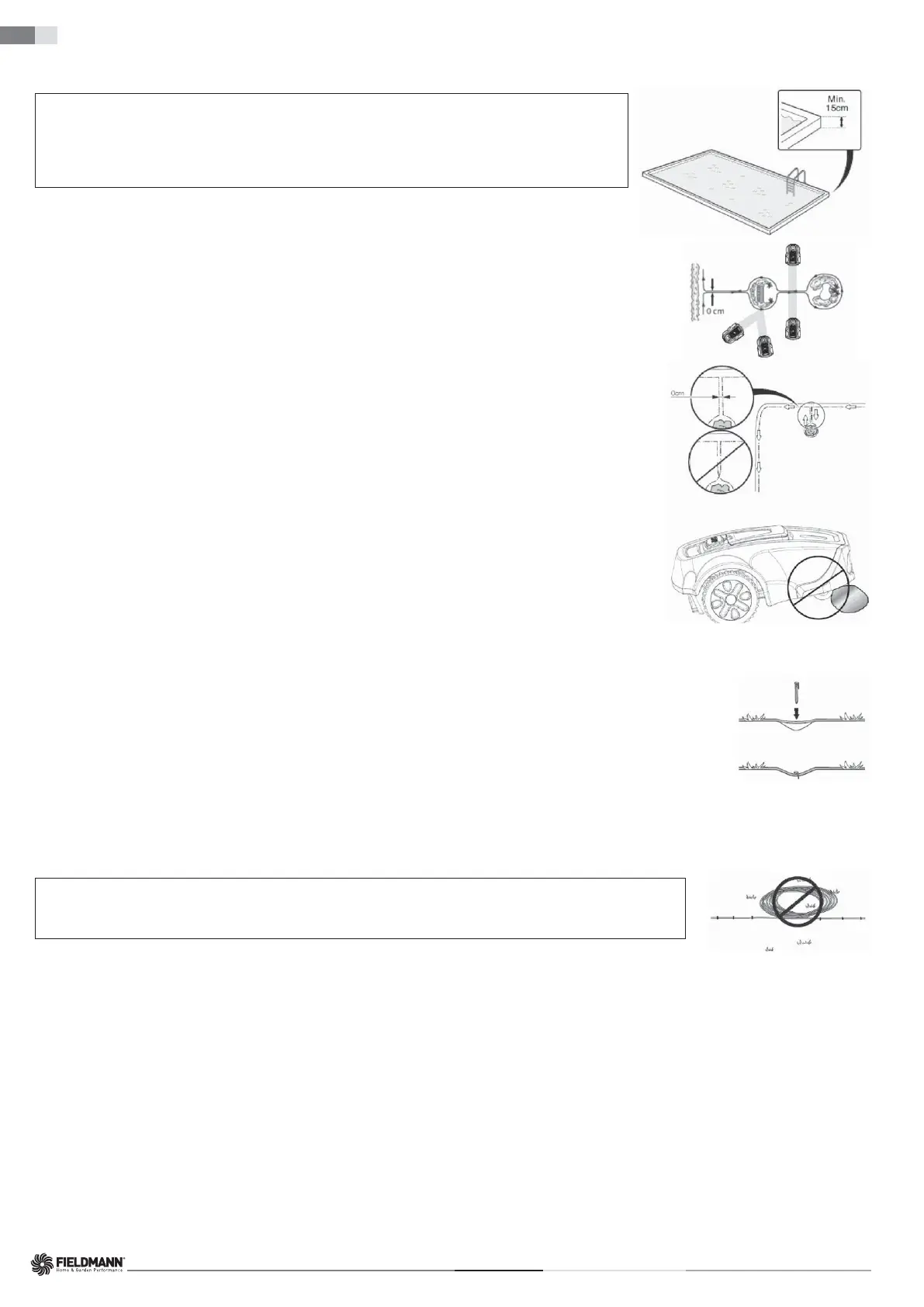
If the working area is adjacent to water bodies, slopes, precipices or public roads, the
perimeter wire should be supplemented with a kerb or something similar. The height must be
at least 15 cm. This ensures that the robotic lawn mower never leaves the working area under
any circumstances.
Boundaries within the Working Area
Use perimeter wire to delineate areas within the working area by creating perimeter islands around obstacles that are not
collision resistant, such as fl ower beds, shrubs, fountains, etc.
Obstacles that resist collisions, such as trees, telephone or electrical poles, or a pool with a wall higher than 15 cm, do not
need to be defi ned by perimeter wire.
The robotic lawn mower automatically turns when it encounters these obstacles.
Lay the wire towards the area to be delimited and around it, then return it the same way. If using stakes, the wire should be
laid on the return path under the same stakes. When the sections of perimeter wire leading to and from the island are close
together, the robotic lawn mower can cross them.
However, the perimeter wires must not intersect on the path to and from the island.
Obstacles with a slight slope, such as stones or large trees with raised roots, must be separated by an island or removed.
Otherwise, the robotic lawn mower may slip on this type of obstacle, leading to blade damage or the mower getting stuck.
Mowing Passages
Long and narrow passages and areas narrower than 50–70 cm should be avoided. When the robotic lawn mower mows,
there is a risk that it will spend too much time in such areas. This may result in excessive wear on the lawn.
Laying the Perimeter Wire
To secure the perimeter wire using stakes:
• Mow the grass very short with a standard lawnmower or trimmer and place the wire close to the ground to reduce the risk of the robotic lawnmower cutting the wire
or damaging its insulation.
• Lay the perimeter wire just above the ground, ensuring that the distance between it and the ground is less than 1 cm in case the robotic
lawn mower needs to pass over it. Place the stakes close together, approximately 1 metre apart.
Hammer the stakes into the ground. Be careful when hammering the stakes and make sure that the wire is not too tight. Avoid sharp bends in
the wire.
To bury the perimeter wire:
• The perimeter wire must be laid a minimum of 1 cm and a maximum of 5 cm deep in the ground. Use an edge aligner or straight spade for burying.
When laying the perimeter wire, use the supplied gauge as a guide. It will help you easily determine the correct distance between the perimeter wire and the boundary or
obstacle. The gauge is supplied separately, outside the box.
IMPORTANT INFORMATION
Excess wire shall not be stored in spools.
It could interfere with the robotic lawn mower.
The perimeter wire starts at one of the connectors on the rear of the charging base and leads under its bottom part. Then gradually lay the perimeter wire in a
counterclockwise direction, as indicated by the arrows in the fi gure below. Lay the cable loosely along the boundaries. If you encounter an area or object that requires
care or special containment, be sure to carefully lay perimeter wire as needed. (See “Working Area Boundaries” on page 15 and “Boundaries within the Working
Area” on page 16).







 To Next Page