Ø
Negative pull-down to 0 V on the OC terminal, that is,
if it is programmed to signal Alarm status.
+
The Control panel will activate the DL output when
the programmed Alarm Signalling delay expires.
During Alarm status, Key and PIN Code users (Access
Level 2 — refer to “Access to signalling and com
-
mands”) will be able to:
Ø
stop the Silenceable outputs by pressing the Silence key.
During Silence status (Silence LED glowing), it is pos
-
sible to use the Silence key to release the Silenceable
outputs, and the Reset key to restore standby status.
+
If the Control panel is in Night Mode (Night Mode
LED glowing), the Control panel will exit Silence
status when the programmed Night mode Silence
time expires.
Trouble This Control panel can detect and signal the
following Trouble:
Ø
Input zone shorted or open;
Ø
Supervised zone shorted or open;
Ø
Control panel blocked;
Ø
Output 24V or 24R shorted;
Ø
Low battery, battery trouble or disconnected battery;
Ø Ground fault;
Ø Communication trouble with peripherals;
Ø Mains failure.
Fault conditions will be signalled by:
Ø a slow intermittent beep (at 1 second intervals);
Ø glowing on the Fault LED;
Ø fast blinking on the LED of the “component” concer-
ned (the Logic Unit LED will glow to signal “Control
panel blocked”);
Ø
activation of the Fault output (TROUBLE terminals);
Ø
Negative pull-down to 0 V on OC terminal, that is, if it
is programmed to signal Fault.
The Fault output (TROUBLE terminals) and OC out
-
puts (if duly programmed by your Installer) will restore
to standby automatically when fault conditions clear.
Under certain circumstances, fault conditions may clear
spontaneously, if this occurs, the event will be stored in
the memory until the Control panel Resets.
Stored Fault events will be signalled by:
Ø
slow blinking on the LEDs of the “component” con
-
cerned.
Silence This Control panel provides a Silence key
which can be used to restore the Silenceable outputs to
standby status:
Ø
R1, R2, ..., R8
Ø
NAC1 and NAC2
Ø
ALARM
Ø
TROUBLE
Silence status will be signalled by:
Ø
an audible signal (lasting 1 second) followed by a
long pause (lasting 5 seconds);
Ø
glowing on the Silence LED.
Silence status will be held until the Silence key is pres
-
sed again or, if the Control panel is operating in Night
Mode, until the programmed Night mode Silence time
expires, or until a new Alarm or Trouble condition is de
-
tected.
+
ONLY Key and PIN Code Users (Access Level 2)
can SILENCE the Silenceable outputs.
Disable This Control panel provides keys which can
be used to disable the bypassable inputs and outputs:
Ø
Z1, Z2, ... Z24 can be used to bypass (exclude) their
respective zones;
Ø
Disab./Fault NAC can be used to bypass outputs
NAC1 and NAC2;
Ø
Disab./Fault Telecom can be used to bypass the DL
output.
DISABLED zones cannot generate alarms or warnings
of any kind, and DISABLED outputs cannot be activa
-
ted.
Disabled status will be signalled by:
Ø
glowing on the Disab. LED;
Ø
glowing on the LED of the respective zone or output
(see LEDs: Disabled/Fault/Test, Disab./Fault NAC
and Disab./Fault Telecom).
+
ONLY Key and PIN Code Users (Access Level 2)
can DISABLE zones and/or outputs.
Reset Resetting the Control panel will restore the out-
puts to standby status, delete the memory, and interrupt
the power supply to terminals Z1, Z2, ..., Z8 and 24R for
the programmed Reset Time.
+
ONLY Key and PIN Code Users (Access Level 2)
can Reset the system. Fire alarms must be Silen
-
ced (via the Silence key) before Reset.
Fault conditions can be Reset directly (via the Re
-
set key).
n
Interface
Visual Signalling The system status will be signalled
on the Control panel LEDs as follows:
GREEN indicates normal operating conditions;
AMBER indicates specific operating modes (for exam
-
ple Day or Night mode), and/or Fault conditions;
RED indicates Alarm conditions.
Memory The Control panel will signal Alarm/Fault
events until the system Resets, even if the event clears
in the meantime.
Stored events will be signalled by:
Ø
slow blinking on the LED concerned.
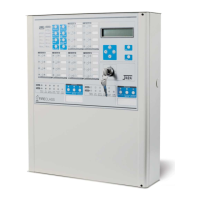
Display The J424 Control panel can house the
J400-LCD Module. This module provides written infor
-
mation regarding the system status, and the cause of
faults on inputs and outputs (short-circuit, interruption
etc.).
INTRODUCTION 7



 To Next Page