162 163
EN
For a suspension fork with correctly set rebound, the
front wheel must not lift off the ground when the fork
is compressed with the cycle at rest and then sud
-
denly released. If in the course of this test the front
wheel should lift off the ground, the rebound must
be tightened one further click and the test repeated.
Suspension and chassis components
are vital parts of your FLYER. Service
and check your FLYER suspension at
regular intervals. Have your FLYER in
-
spected by your FLYER specialist retail-
er at regular intervals. The chassis will
be more effective and last longer if it is
cleaned on a regular basis. Warm water
with a light cleaning agent is suitable for
cleaning this part of the bicycle.
Full suspension bicycles are not suitable
for use with trailers and child bike trail
-
ers! The bearings and attachments are
not designed to withstand this sort of
force. This could result in strong wear
and breaks with serious consequences.
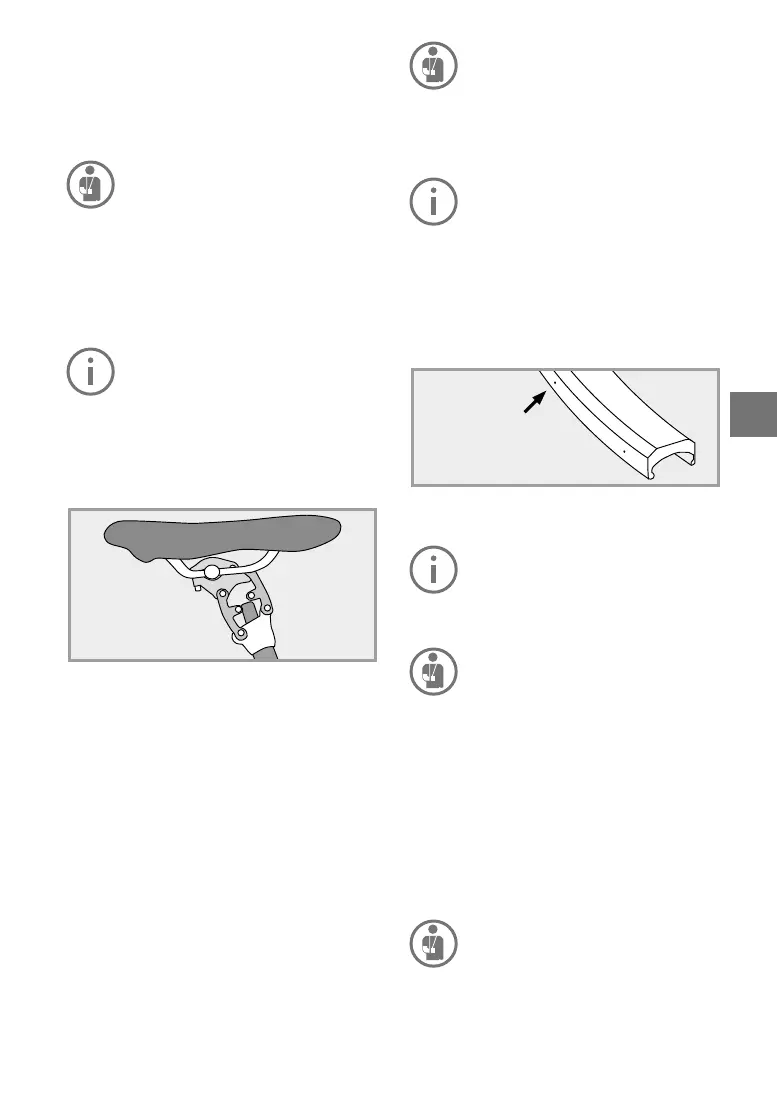
Suspension seat posts have proven their value in
both daily use and on tours.
Some suspension seat posts can be individually
adjusted to t the driver. Ask your FLYER special
-
ist retailer for details.
12. Wheels and tyres
The wheels are subject to a great deal of strain
through the uneven characteristics of the ground
and the weight of the rider.
• After the rst 200 kilometres, the wheels must be
checked by a specialist and re-centred if necessary.
• The tension of the spokes must be checked at
regular intervals. Loose or damaged spokes
must he retightened or replaced by a FLYER
specialist retailer.
12.1 Checking the rims
The rim is subject to wear when a rim brake is
installed.
A severely worn rim is less stable and
more prone to damage. A bent, torn or
broken rim may lead to major accidents
and severe falls. Do not continue to use
your FLYER if you notice damage to one
of the rims. Please allow a FLYER spe
-
cialised retailer to check the rims.
The rims for rim brakes are marked to
show where the brakes rub against the
rim. On the rim surface there are points
or grooves which help you gauge the
level of wear.
The rim must be changed when the
points or grooves can no longer be seen
in one or several places. Have the rims
regularly inspected by a FLYER special
-
ist retailer, especially when replacing/
exchanging brake pads.
12.2 Tyres and inner tubes
Tyres, like many other parts, are subject
to wear and tear. Check the prole
depth, tyre pressure and state of the lat
-
eral tyre surfaces at regular intervals
and take note of signs of brittleness or
wear.
Do not exceed the maximum tyre pres-
sure recommended when inating the
tyres. Otherwise this could lead to a tyre
exploding.
The tyres must be pumped up with at
least the stated minimum tyre pressure.
The tyre might detach from the rim if the
tyre pressure is too low.
The values for the permitted maximum
and minimum pressure are imprinted on
the lateral tyre surface.
Tyres may only be changed for identi
-
cal, original tyres. The bicycle’s handling
could otherwise be negatively affected.
This may lead to accidents.
You should only replace damaged parts
with original spare parts.
Rim with points to
indicate wear


 To Next Page