Franka Emika GmbH ©October 2018
35
Sensivity
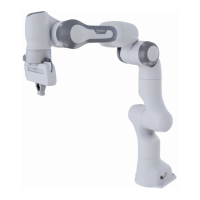
The Arm has real torque sensors in all 7 joints. These enable, among other things,
to recognize and react to even the smallest forces acng on the Arm. This sensi-
vity facilitates numerous funconalies and capabilies, which are not possible
with convenonal industrial robots, such as impedance, guiding of the robot or
collision detecon. It should be noted that for achieving maximum sensivity it
is absolutely necessary to best possibly compensate addional forces acng on
the robot (e.g. a mounted end eector). This is why the end eector to be used
should be congured as precisely as possible in the admin secon of Desk.
Impedance is a behavior of the robot, which imitates the ability of a mechanical
spring. This behavior can be used to interact gently with the environment, for
example as not to damage fragile objects. The ability of changing impedance can
be seen as similar to that of a human arm, which tenses the muscles in order to
change rigidity and can adapt depending on the situaon, in order to increase
robustness when execung a task.
We have incorporated torque sensors in all seven axes. These provide informa-
on on the currently applied torques per axis at any given me. In combinaon
with our model-based control, deviaon between the expected torque and the
actual torque can be idened and the Arm can respond to it. For example, if
a user reaches into the moon path of the roboc arm when it is moving, this
will be recognized in real-me by one or several torque sensors. Such a torque
magnicaon is classied as a collision and can for example stop the robot’s
movement.
If the Arm is in intended contact with its surroundings, sensor signals of the
seven torque sensors can be used to generate a dened force on the point of
contact.
Impedance
Collision detecon and reacon
Generang forces


 To Next Page