Franka Emika GmbH © October 2018
34
The FCI package - the bonus
for researchers
The Panda research package allows for real-me, bidireconal connecon
between a workstaon PC and the Arm. Also commanding the Hand is possible.
This interface (FCI) enables the user to implement specially created controllers
and applicaons with the robot. The package consists of libfranka, a C++ program
library, and franka_ros, an ROS interface with ROS Control and MoveIt integra-
on, which can be accessed at hps://www.github.com/frankaemika/. Detailed
informaon can be found in the corresponding API descripons and quick start
guides.
Some features
Joint space
Cartesian space
Redundancy
A joint space is the descripon of a robot pose using the rotaon angles of
the robot’s individual joints. In contrast to most industrial robots, which have
6 joints, our Arm has 7. This allows for an extremely high exibility. A certain
pose can be uniquely idened with 7 values in units of degrees. Movements
in the joint space move all joints simultaneously from the current posion to a
dened target joint pose. Here it is important to noce that the movement of
the end eector results from the rotaon of the joints and does not follow a
specic path (e.g. a line).
The Cartesian space allows an alternave descripon of the robot pose. Here, the
posion and orientaon of the end eector are the main focus. The representa-
on of Cartesian poses in three-dimensional space usually consists of three
values (in meters) for determining the posion and three values (in degrees) for
orientang the end eector. For a robot with 7 joints this representaon is not
complete for dening a certain robot pose. For more informaon, see the secon
“Redundancy”.
Movements in Cartesian space allow the exact tracking of predened paths in
space, such as straight lines. The changing of posion is called translaon, while
the changing of orientaon is called rotaon. The Cartesian movement of a robot
always depends on the reference coordinate system, which can be congured for
Panda via the conguraon of the end eector in the admin secon of Desk.
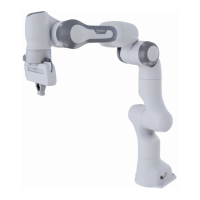
The Arm can reach a certain Cartesian pose with various joint conguraons.
This capability is called redundancy. In Panda this addional moon capability
is oen called elbow, because it matches the moon capability of the elbow in
a human arm. The redundancy of the Arm allows for a greater exibility when
teaching or execung Tasks. For example, it can be used to circumnavigate an
obstacle in order to grip an object located behind it. The behavior of the elbow
can be changed and adapted to each situaon. It can be set to freely movable or
immovable.
THIS IS PANDA


 To Next Page