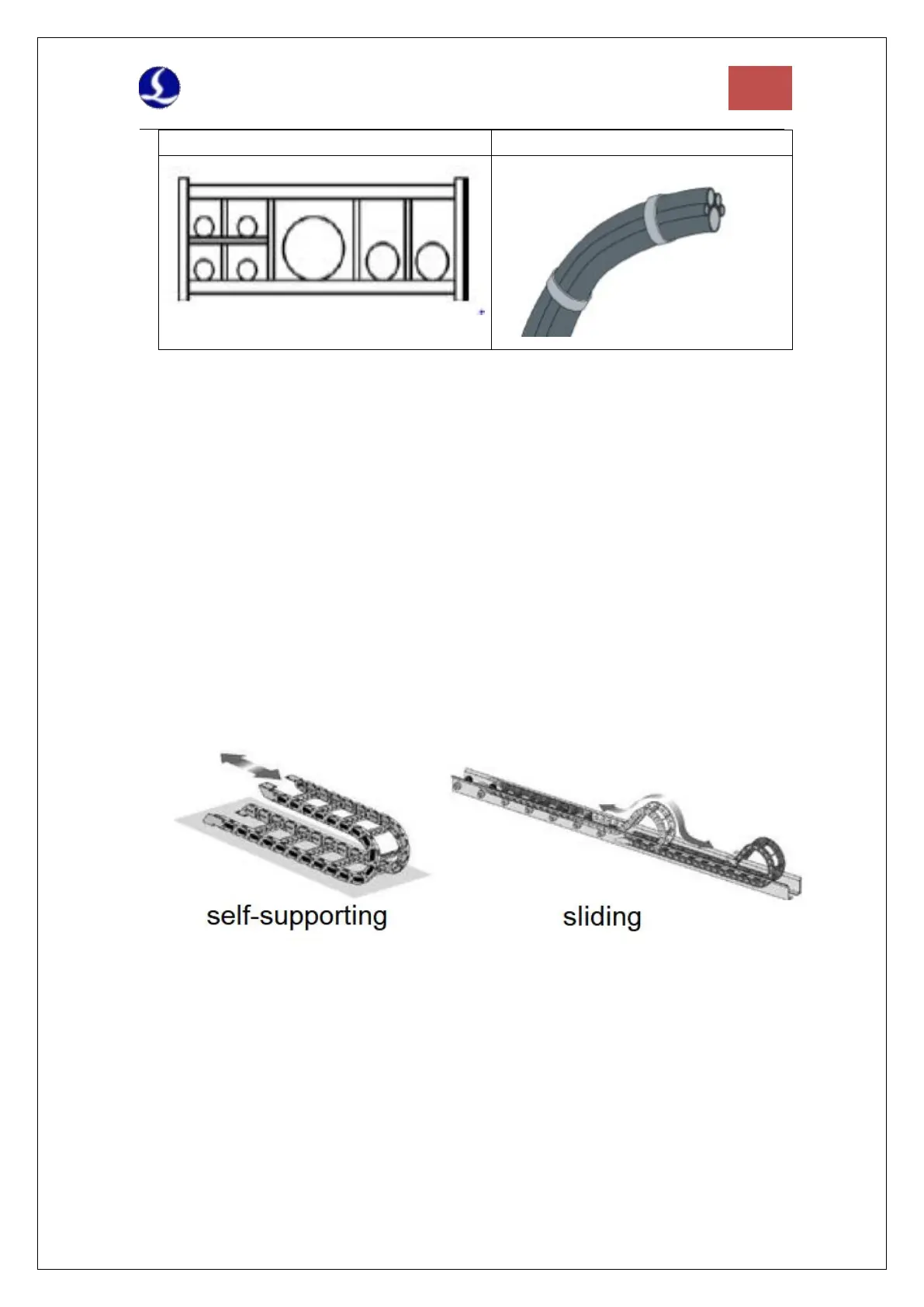
4. The cables should be installed according to the weight and size of the cables. The larger
diameter and heavier cables should be placed outside; the smaller diameter and lighter
cables should be placed inside. The cables can also be placed from the inside to the
outside descendingly by size. Do not place one cable on top of another without using a
spacer.
5. For vertically suspended drag chains, keep more free space for the vertical support,
because the cables will be stretched during operation. After a short run, it is necessary to
check that the cables run along the center area and adjust them if necessary.
6. For self-supporting drag chain, cables are fastened to moving and fixed points. Suitable
cable supports from the supplier are required. Cable ties have very limited applicability
when operating at high accelerations. So you should not bundle multiple cables together.
Cables should not be fixed or tied to any moving parts of the drag chain. The gap
between the fixed point and the bending area should be wide enough.
7. It is recommended to fix the cable on the moving point for sliding drag chains. A small
cable protection zone is required at the fixing point. (Refer to the instructions from the
drag chain supplier)
8. Please ensure that the cable runs along the center area with the desired bending radius.
Do not apply tension to the cable (do not pull it too tightly), otherwise the friction inside
the drag chain will cause the cable sheath to wear; do not let the cable be too loose in the
drag chain, otherwise it will easily cause abrasion of the cable and the inner wall of the
drag chain, or tangled with other cables.



 To Next Page