22
Corrosion of flue pipe
In the case of a combustion flue pipe, acid
may develop over a long period of time per
the following process. Chlorine containing
gases, such as halocarbon refrigerants,
carbon tetrachloride, trichloroethylene, or
perchloroethylene, when drawn into
combustion air are broken down into
elemental chlorine gas which exits up the
flue pipe. If the flue pipe is cold, as it would
be if the combustion process had been off
for some time, the water vapor condenses
in the flue pipe during the first few minutes
of ignition and the chlorine in the
combustion gas dissolves in the water
forming hydrochloric acid. As the
combustion system flue line increases in
temperature, the water vapor no longer
condenses because the flue temperature is
above the dew point of the combustion gas.
The combustion gas then dries out
(dehydrates) the hydrochloric acid solution
leaving behind dry chloride salt.
When the next cold start-up occurs, the
process repeats except that more and more
chloride collects and concentrates along
the flue. As the quantity of chloride
increases it does not dehydrate completely
as the flue heats up and a corrosive poultice
develops which attacks the steel and will
also attack the boiler.
Concentration levels of only a
few ppm of chlorine containing compounds
in combustion air can produce serious
corrosion over long periods of time. High
chlorine containing compounds such as
carbon tetrachloride or perchloroethylene
would be prime suspects.
In addition, normal combustion creates
carbon dioxide which may condense in a
cold flue to form carbonic acid.
Installation Check Points
1. Make sure all piping connections are
complete and tight.
2. Make sure the pressure controls are
adjusted properly.
3. Make sure all electrical connections in
the control panel box, the water column,
and elsewhere are secure.
4. Make sure the door in the boiler room is
closed. Combustion air contaminates
can cause damage to the boiler jacket
and stack.
NOTE
After installation is complete and prior
to operation the pressure vessel should
be cleaned.
VMP IOM
Installation
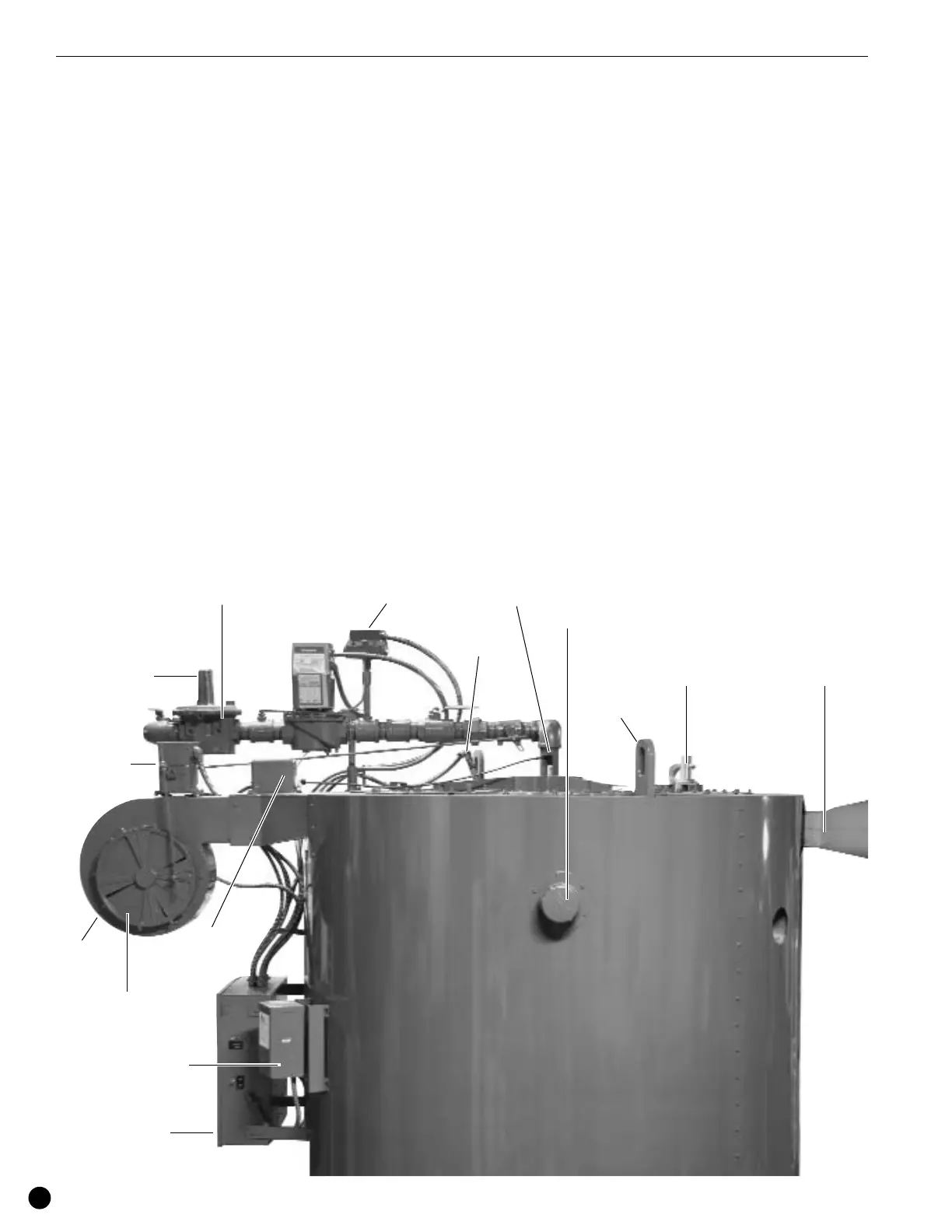
Blower
Air Gate
Electric
Control
Panel
Gas Train Available with Optional
High-Low-Off, or Modulation
Primary steam outlet
(Valve not shown)
Safety Valve(s)
Exhaust stack
adapter
Control circuit
transformer
Gas Valve
Modulation
Motor
Gas Regulator
Scroll
Lifting Lug
Pressure Switch
UV Scanner
Ignition
Electrode
Ignition
Transformer



 To Next Page