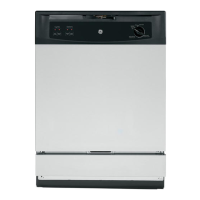
What causes repeated cycles in GE Spacemaker GSM1800J Dishwasher?
- JJamie FosterSep 12, 2025
If your GE Dishwasher is running repeated cycles, the cause might be a defective timer. Replacing the timer should resolve this issue.
What causes repeated cycles in GE Spacemaker GSM1800J Dishwasher?
If your GE Dishwasher is running repeated cycles, the cause might be a defective timer. Replacing the timer should resolve this issue.
Why GE Spacemaker GSM1800J Dishwasher runs with door open?
If your GE Dishwasher runs with the door open, the cause is a defective door safety switch. Replace the door safety switch.
| Brand | GE |
|---|---|
| Model | Spacemaker GSM1800J Series |
| Category | Dishwasher |
| Language | English |
Information for qualified individuals; potential for injury and damage.
Disconnect power before servicing to avoid personal injury.
Ensure grounding wires, screws, and clips are properly reattached after service.
Details the compact size, ENERGY STAR compliance, and available wash cycles.
Provides electrical, component resistance, and water supply requirements for the dishwasher.
Explains the meaning of each part of the model number for identification.
Details how to determine the month and year of manufacture from the serial number.
Describes the dishwasher cycles selectable via the control timer knob.
Explains the function of the door latch and heated dry selector switches.
Identifies external components like the control panel, insulation, and access panel.
Locates switches and the timer on the control panel interface.
Shows the location of racks, detergent module, and static vent inside the tub.
Identifies parts of the detergent and rinse agent dispenser.
Locates spray arm, heating element, filters, and clamp nut within the tub.
Shows fill funnel, pressure switch hose, sump, motor pump, capacitor, and drain pump.
Explains timer function, safety precautions, and voltage check notes.
Step-by-step guide for removing and installing the timer assembly.
Details the switch's role in controlling the heating element for drying.
Provides instructions for removing and installing the heated dry switch.
Explains the latch mechanism and safety switch operation for door closure.
Step-by-step guide for removing and installing the door switch assembly.
Describes how the vent system removes moisture during drying.
Instructions for removing and inspecting the static vent channel cover.
Covers the door panel's role in protecting electronics and the detergent module.
Steps for installing the static vent channel and cover into the door.
Explains how the module dispenses detergent and rinse agent during cycles.
Step-by-step guide for removing and replacing the detergent/rinse module.
Detailed instructions for disconnecting electrical components for door removal.
Guide for disconnecting wires from timer, door switch, and heated dry switch.
Instructions for removing the spring bolt key and lifting the hinge arm.
Details on lifting the hinge arm to expose the hook for removal.
Explains the seal's function in preventing water leakage at the door bottom.
Guide for removing and installing the bottom door seal in its groove.
Details the tub seal's role in preventing leaks around the tub rim.
Explains heating element function, testing, and removal/replacement steps.
Instructions for removing nuts, brackets, clamps, and the heating element.
Details the fill funnel's purpose and how to remove and install it.
Explains the timer-controlled, solenoid-operated water valve and its flow rate.
Step-by-step guide for disconnecting the water line and removing the valve.
Explains the pressure switch's role in monitoring water level via air pressure.
Guide for accessing and removing the pressure switch from the dishwasher frame.
Instructions for removing the capillary tube and float switch from the pressure switch.
Step-by-step guide for disconnecting the drain tube and terminals for the drain pump.
Instructions for removing bolts, lock-washers, nuts, and clamps for the drain pump.
Details the capacitor start induction motor, its rotation, and power draw.
Steps for removing clamps and hoses from the motor sump, washer arm, and main conduit.
Instructions for removing the ground wire screw from the wash pump motor assembly.
Guide to pulling the motor mount, motor tab, and removing the assembly.
Explains the sump assembly's components and their functions.
Steps for removing clamps, hoses, filter assembly, and micro-filter from the sump.
Instructions for removing the clamping nut, gasket, and sump itself.
Procedure to test the door switch for continuity using an ohmmeter.
Schematic showing the door switch's wiring within the appliance circuit.
Guide for testing the heated dry switch using an ohmmeter and wiring diagram.
Procedure to test the heating element's continuity and resistance.
Steps for diagnosing timer faults, including checks for voltage and resistance.
Provides wiring schematics and cycle charts for timer diagnostics.
Diagnosing issues with the wash pump motor not starting or running.
Steps for diagnosing no water, low water, or fill valve not shutting off.
Checks for water not reaching heating element or not shutting off.
Wiring diagram for the water fill valve for diagnostic purposes.
Lists common issues like 'not operating', 'won't heat', 'won't stop'.
Provides remedies for symptoms like 'runs with door open' and 'motor hums'.
Covers issues like 'no heat', 'no water', 'no pump out', and 'water siphons out'.
Addresses water leaks, too much fill, and loose components.
Diagnoses poor washability, poor drying, door latch, and noisy pump assembly.
Troubleshoots detergent left in dispenser and loading problems.
Covers noisy pump assembly and spotting/filming on glasses.
Addresses high/low water temperature and food disposal installation.
Discusses hot water, water level, detergent amount, and rinse agent use.
Covers proper loading, spray arm function, and drying conditions.
Detailed wiring diagram showing all electrical components and connections.
Key for wire colors used in the schematic diagram.
Diagram identifying external and control panel components with part numbers.
Illustrates parts related to the door assembly and wiring harness.
Diagram showing parts of the main dishwasher body, frame, and panels.
Illustrates parts for the lower front section, including toe kick and access panel.
Illustrates the upper rack, lower rack, and silverware basket assemblies.
Shows the studs and rollers used for the rack movement.
Diagram identifying parts related to water inlet, pump, and hoses.
Illustrates filter assemblies, spray arms, and related parts.
Lists parts for main conduit, O-rings, filters, sump, and heating element.
Details parts for the timer, switches, hoses, and control panel.
Lists parts for door hinges, racks, baskets, and related assemblies.
Includes parts like leveling legs, junction box, screws, and toe kick.
Explains what GE will replace and the duration of the warranty.
Lists items not covered by the warranty, such as improper installation and accidental damage.