3
.
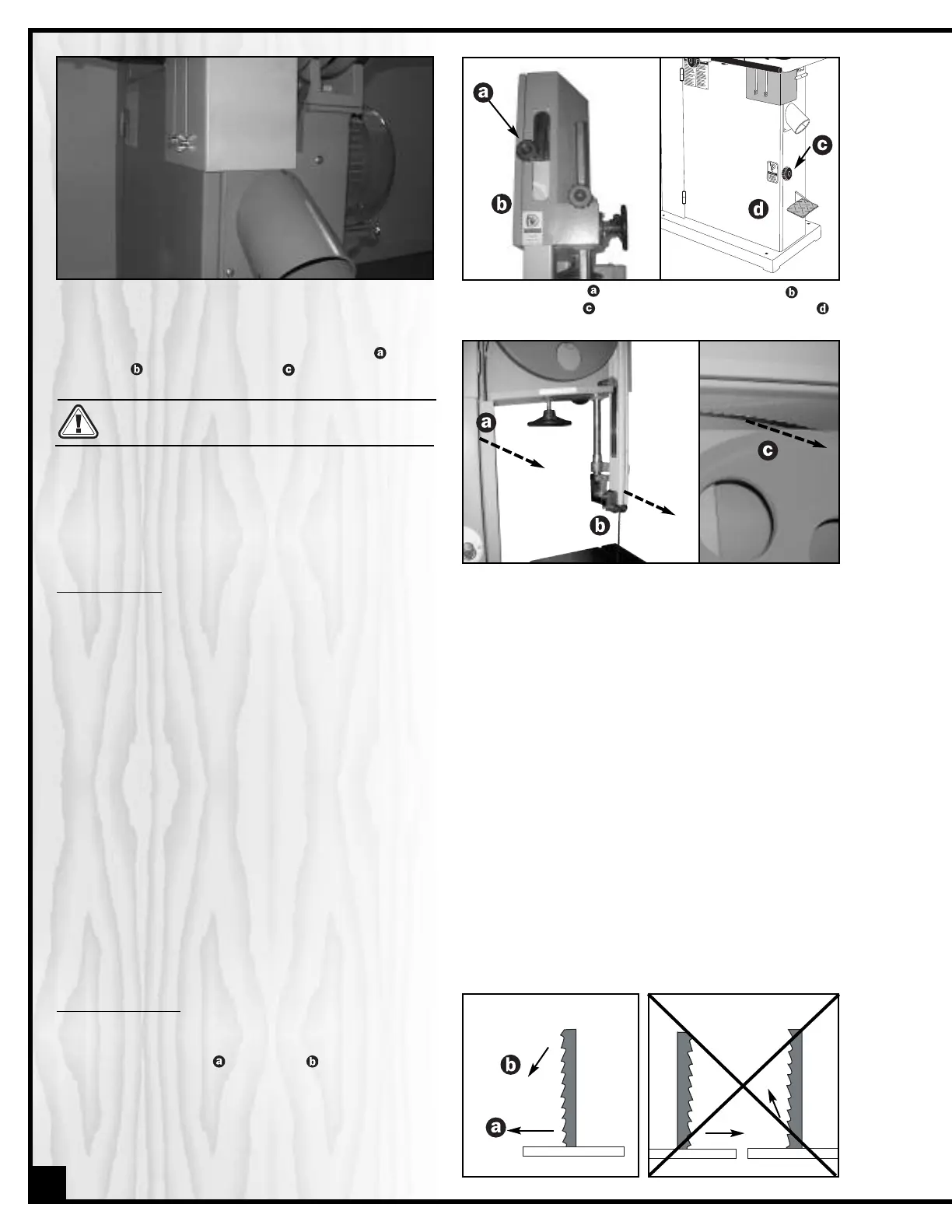
Unscrew and remove the yellow blade guard.
4.
Turn the knob and open the upper door
. Then
turn the knob and open the lower wheel door .
5. Carefully pull the blade from the side slot
, blade
guard , and from the wheels . (Fig. 4)
6. Pull the blade toward you, out of the table slot and
set it aside if it will be re-used or dispose of it safely if
it is worn or damaged.
Fig. 4
Blade teeth are sharp. Use care when handling a
saw blade.
BLADE SELECTION
There are a variety of different types of bandsaw blades on the market to suit various cutting applications. Your
results may vary based on usage, experience and personal preference. Ask your local tool dealer for suggestions
for bandsaw blades (153" for model 90-270 and 168.5" for model 90-270HD) in 1/4" to 1" widths, based on what is
available in your area.
Some general guidelines to consider when choosing bandsaw blades:
•Wider blades with fewer teeth per inch are best suited to cutting straight lines, re-sawing and for sweeping
curves, but will not turn tight radius curves. They will cut quickly and aggressively but do have a tendency to
bind (or get stuck in the cut) if turned too sharply.
•Narrower, thinner blades with more teeth per inch will cut more slowly but can turn much tighter corners for
cutting more intricate work.
Common causes of blade breakage:
• Poor guide bearing alignment and adjustment.
• Forcing or twisting a wide blade around a short radius.
• Feeding the workpiece too quickly.
• Dull teeth.
• Too much blade tension.
•Setting blade guard assembly too high above the work-piece.
•Lumpy or improperly finished braze or weld on the blade.
•Continuous running of blade when not cutting.
To install a blade, repeat the previous steps in reverse
order, making sure that the blade is installed with the
teeth pointing forward and down .
With the blade properly installed, proceed to “BLADE
TENSION ADJUSTMENTS” and “BLADE TRACKING ADJUST-
MENTS”, pages 15 and 16.
Proper installation
Improper installation
BLADE INSTALLATION
14


 To Next Page