23
C. Gerhardt GmbH & Co. KG
9. Programming
In this main menu all relevant parameters for the control of the distillation/titration are defined. There
are 20 programs available. The structure of the program is set. The flow rate of the dosing and
suction pumps is about 13 ml/s, the flow rate of the dosing pump for NaOH depends on the concen-
tration of the alkali (about 10 ml/s for 32 percent sodium hydroxide solution). The amount of distillate
is about 120 ml/4 min at maximum steam power.
The following example refers to a sulphuric acid digestion acc. to Kjeldahl using 20 ml H
2
SO
4
. A
decisive factor for the programming is the residual acid once the digestion is over. This depends on
the type of sample, digestion time, and digestion temperature.
9.1. Programming performance
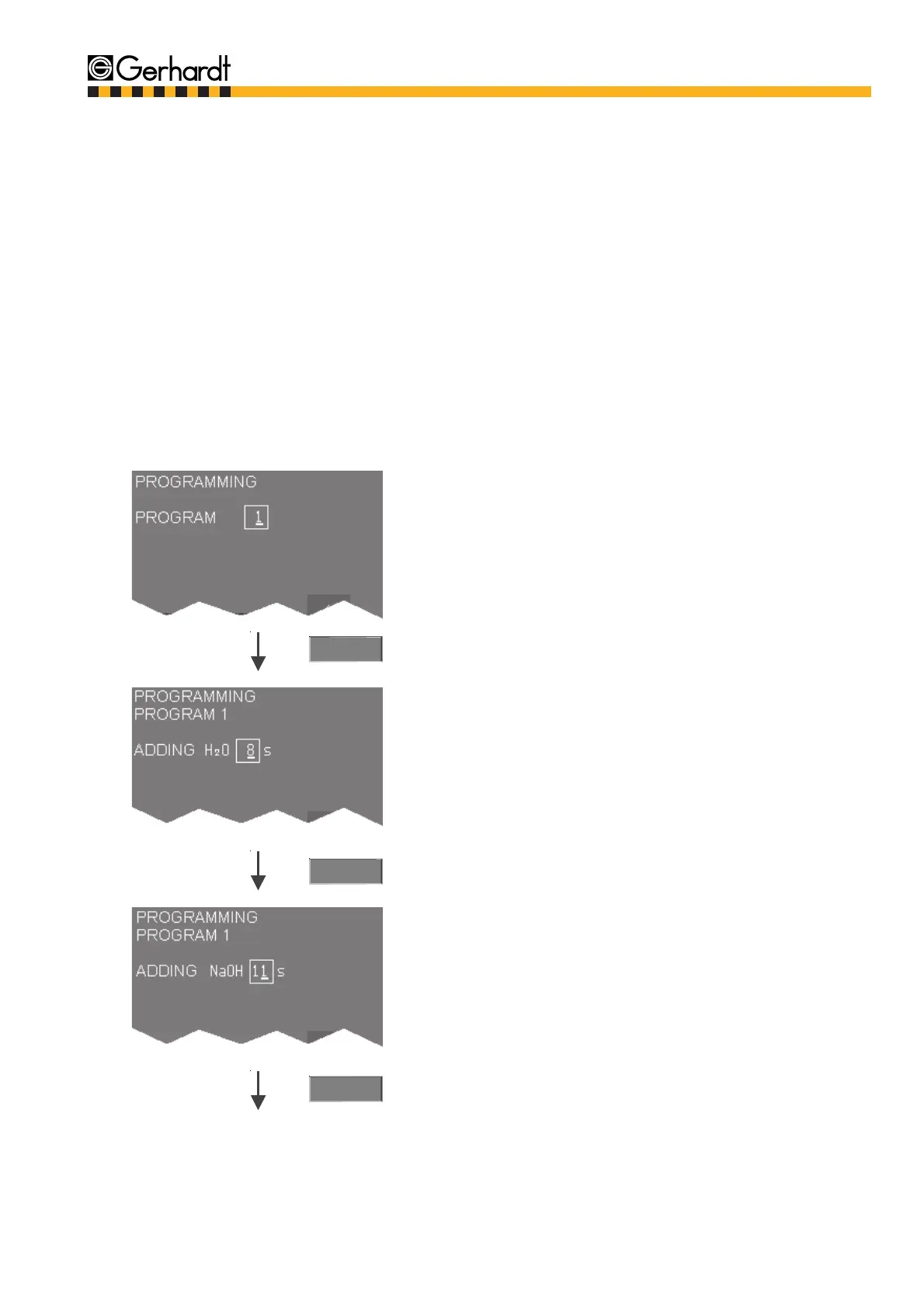
1. Choose the "Programming" key.
Enter program number desired. There are 20
different programs available.
Example:
Program No. 1
Range 1-20
A sufficient dilution of the residual concentrated
sulphuric acid ensures that the subsequent alka-
li addition does not cause a too violent reaction.
The addition of H
2
O depends on the amount of
free (uncombined) sulphuric acid at the end
of the digestion.
Example:
90 ml = ca. 8 s
Range 0-99 s
In order to distil the ammonia over it is important
to create a superalkaline environment. When a
sample containing copper sulphate catalyst is
used the solution will discolour when alkaline.
When using a selenium catalyst an indicator can
be added in order to get a visual control.
The addition of NaOH depends on the amount of
the free (uncombined) sulphuric acid at the end
of the digestion.
Example:
110 ml = ca. 11 s
Range 0 - 99 s
Enter
Enter
Enter
2.
3.
4.
PROGRAMMING



 To Next Page