- 32 -
Evaluation of precision
The specified precision is the limit to the random
error, which is the distribution of the measured
values around a mean value. For pipettes, preci-
sion refers to a within-series group of data, and
therefore to repeatability.
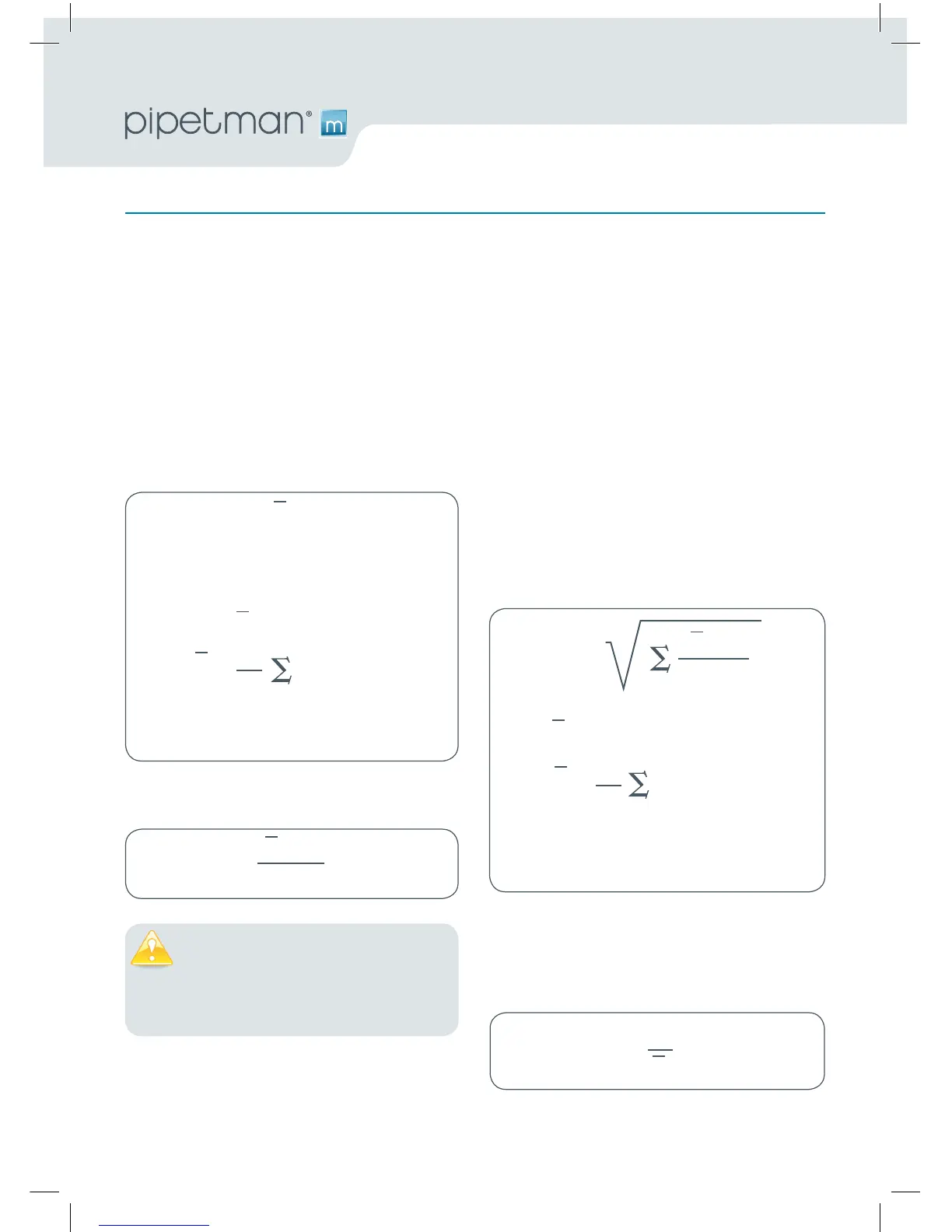
The random error is then quantified by the stan-
dard deviation of measurements performed at a
given volume setting under the same measuring
conditions.
The standard deviation (SD or “s”) can be esti-
mated as follows:
The precision of a pipette can also be expressed
as a percentage of the mean volume. This is
known as relative standard deviation (RSD) or
coefficient of variation (CV), and is estimated
as follows :
Evaluation of accuracy
The specified accuracy is the limit to the system-
atic error, which is the difference between the
mean volume of actual measurements and the
true value of the volume set on the instrument.
The systematic error (E) can be estimated as
follows :
The accuracy of a pipette can be expressed as a
percentage of the nominal volume:
V =
Vi
Vi individually measured volume
n number of measurements
(minimum 10)
1
n
n
i=1
APPENDIX 4 HOW TO CALCULATE VOLUMETRIC ACCURACY AND PRECISION
“Accuracy” and “precision” are qualitative terms. The corresponding quantitative terms are
“systematic error” and “random error”.
E = V - V0
E systematic error
V0 nominal volume
V mean volume
V =
Vi
Vi individually measured volume
n number of measurements
1
n
n
i=1
E% = x 100
V - V
0
V0
(
V - V
i
)
n - 1
SD =
2n
i=1
V mean volume
SD
V
RSD = x 100
The mean value and number of
replicates must be stated, and the
experimental procedure used must
be described in such a way that other
workers can repeat it!



 To Next Page