EasyManua.ls Logo

Gima CONTEC 8000 - User Manual

Gima CONTEC 8000
170 pages
Print Icon
To Next Page IconTo Next Page
Loading...
PROFESSIONAL MEDICAL PRODUCTS
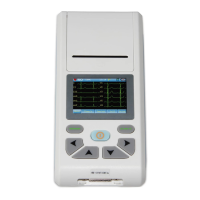
CONTEC 8000 WIRELESS ECG WORKSTATION - 12 CHANNELS
User manual
ATTENTION: The operators must carefully read and completely understand the present
manual before using the product.
M33316-EN-Rev.0-09.23
CONTEC MEDICAL SYSTEMS CO., LTD
No.112 Qinhuang West Street, Economic & Technical
Development Zone, Qinhuangdao, Hebei Province,
PEOPLE’S REPUBLIC OF CHINA
Made in China
CONTEC8000G (Gima 33316)
Gima S.p.A.
Via Marconi, 1 - 20060 Gessate (MI) Italy
gima@gimaitaly.com - export@gimaitaly.com
www.gimaitaly.com
Shanghai International Holding Corp. GmbH (Europe)
Eiffestrasse 80, 20537 Hamburg Germany
0123
%
-40°C
+55°C
0%
95%
500hPa
1060hPa

Questions and Answers

  • J
    Judy GatesAug 17, 2025
    What to do if Gima Desktop equipment connection fails?
    • J
      jessica80Aug 17, 2025
      If your Gima Desktop equipment fails to connect, it could be due to several reasons. The software might not have been properly shut down after the last use, the PC may have recovered from sleep state, the Bluetooth adapter might be damaged, or the Bluetooth equipment might not be connected correctly. To fix this, try connecting the recorder and PC again and restarting the software. Check and replace the Bluetooth adapter if necessary. If the Bluetooth equipment isn't connected correctly, add it again according to the user manual.
  • B
    Barbara LozanoAug 21, 2025
    How to fix unstable baseline on Gima CONTEC 8000?
    • S
      Sylvia LambAug 21, 2025
      An unstable baseline on the Gima Desktop could be due to patient movement or a lead cable falling off. To resolve this, ensure the patient remains calm and check or reconnect the lead cable.
  • G
    Gregory BassAug 25, 2025
    Why Gima CONTEC 8000 has baseline burr?
    • R
      Richard LewisAug 26, 2025
      A baseline burr on your Gima Desktop could be due to large AC interference or EMG interference. To address this, improve the environment by replacing a steel bed if present and ensuring the sampling equipment isn't too close to high-power equipment or the power supply. Also, help patients relax and maintain an indoor temperature above 16 ?.
  • L
    Lynn PierceAug 28, 2025
    How to fix print failure or wrong report format on Gima CONTEC 8000?
    • J
      Jason MartinAug 28, 2025
      Print failures or wrong report formats on the Gima Desktop can occur if there is no printer connected, no printer driver installed, or due to improper print settings. To fix this, have professional technical personnel reinstall the printer and set the printer's accuracy to 600 dpi according to the user manual.
  • J
    joseph18Sep 1, 2025
    What causes small amplitude waveform in some leads on Gima Desktop?
    • M
      Michael WilsonSep 1, 2025
      A small amplitude waveform in some leads on the Gima Desktop indicates that the lead cable is broken. Replace the lead cable to resolve this issue.
  • M
    Megan GriffinSep 5, 2025
    What to do if Gima CONTEC 8000 has no sampling waves?
    • T
      Tammy RichardsonSep 5, 2025
      If your Gima Desktop shows no sampling waves, it could be because the Bluetooth adapter or lead cables are damaged. Check or replace the Bluetooth adapter or lead cables to resolve this.
  • F
    fcoleSep 8, 2025
    How to display the entire software interface of Gima Desktop?
    • S
      stevengonzalezSep 8, 2025
      If the software interface of your Gima Desktop isn't displayed entirely, it's likely because the display resolution is too low. Adjust the display resolution to more than 1366*768 as described in the User Manual.
  • C
    copelandglenNov 12, 2025
    Why Gima CONTEC 8000 shows too large interference and disorderly waveform?
    • T
      Travis JohnsonNov 12, 2025
      The large interference and disorderly waveform on your Gima Desktop could be due to several reasons: the lead cable might not be securely connected, there could be interference from nearby AC electrical equipment, the patient may be too tense, or the electric potential between the body and sampling equipment might be unbalanced. Also, inadequate skin treatment or incorrect electrode placement can cause this issue. To resolve this, check the lead cable, ensure electrical equipment isn't interfering, stabilize the patient before sampling, connect the lead cable securely, and reprocess/reinstall the electrodes, using saline or medical alcohol to wipe each electrode placement, especially in dry conditions. The left and right leg electrodes should not placed on the left leg, then click "Resampl...

Summary

Chapter 1 General Information

1.1 General Overview

Overview of the device's capabilities and applications in diagnosing cardiac conditions.

1.2 Technical Specifications

Detailed technical parameters including operating and storage conditions, sampling frequency, and accuracy.

1.3 Functionality and Specialities

Explains the device's connectivity, software features, and unique functionalities for ECG analysis.

Chapter 2 Safety Precautions

2.1 General Safety Precautions

Essential guidelines for safe operation, placement, power, and avoiding hazardous environments.

2.9 EMC Precautions

Guidelines on electromagnetic compatibility, avoiding interference from external devices and static electricity.

Chapter 4 Device Operation Precautions

4.1 Precautions Before Operation

Instructions for safe setup, including reading manual, checking condition, placement, and lead cable connection.

4.2 Precautions During Use

Guidance for doctors to carefully observe patients and ensure safety during ECG monitoring.

4.3 Precautions After Operation

Steps for safely disconnecting the device, cleaning, and proper storage after operation.

4.4 Device Symbol Interpretation

Explains the meaning of various symbols used on the device and in the manual for user understanding.

Chapter 5 Install and Start

5.1 System Configuration & Software

Specifies required computer hardware and software prerequisites for installation and operation.

5.2 Software Installation Guide

Step-by-step guide on how to install the ECG Workstation software on a computer system.

5.3 Bluetooth Equipment Setup

Instructions for connecting and setting up the Bluetooth adapter for device communication.

5.4 Launching the ECG Workstation

Details on how to launch the ECG Workstation software after installation and configuration.

5.5 Software Uninstallation

Procedures for completely removing the ECG Workstation software from the computer system.

Chapter 6 Electrode Installation

6.1 Wilson Lead System Setup

Details on lead identifiers, colors, and electrode placement for the Wilson lead system.

6.2 Frank Lead System Setup

Information on electrode placement positions for the Frank lead system.

6.3 Electrode Installation Procedures

Guidance and safety tips for correctly attaching electrodes to the patient for accurate ECG readings.

Chapter 8 New Patient Sampling

8.1 New Patient Data Input

Guide on entering patient demographics and essential details before starting an ECG recording.

8.2 ECG Sampling Procedure

Step-by-step process for performing ECG data acquisition, including connection checks and waveform observation.

8.3 ECG Data Analysis

Instructions on how to analyze the acquired ECG data, including setting measurement points and calibration.

Chapter 9 Functions Explanation

9.1 Shortcut Tasks

Covers quick access functions like New Patient, Case Management, and Quick Print for efficient operation.

9.2 Analysis Functions

Details various ECG analysis types including ECG, FCG, HRV, STLE, VCG, and TVCG for diagnostic purposes.

Chapter 10 Maintenance

10.1 Battery Care and Maintenance

Guidelines for charging, using, and replacing the rechargeable lithium battery for optimal performance.

10.2 Post-Operation Maintenance

Procedures for cleaning the device and accessories, and storing them properly after each use.

10.3 Lead Cable & Electrode Care

Instructions for inspecting and maintaining lead cables and electrodes to ensure signal integrity.

10.4 Product Disposal Guidelines

Information on proper disposal methods for the product and packaging materials according to local regulations.

10.5 Additional Maintenance Notes

Additional notes regarding device enclosure, schematic diagrams, and component lists.

Chapter 11 Troubleshooting

11.1 AC Interference Troubleshooting

Identifies causes and solutions for AC interference affecting ECG waveform quality.

11.2 EMG Interference Troubleshooting

Addresses common causes and remedies for EMG interference in ECG readings.

11.3 Baseline Drift Troubleshooting

Explains potential causes of baseline drift and methods to resolve it for clearer waveforms.

11.4 Sampling Failure Troubleshooting

Troubleshooting steps for common sampling issues like 'Don't find relevant USB' or 'Read Data Error'.

11.5 Comprehensive Troubleshooting Guide

A comprehensive table listing phenomena, reasons, and solutions for various ECG equipment malfunctions.

Chapter 12 Packing List

12.1 Package Contents

Lists all items included in the product packaging upon shipment from the factory.

12.2 Unpacking Instructions & Precautions

Instructions and precautions to follow when opening the package and checking the device and accessories.

Chapter 13 Principle and Clinical Application

13.1 ECG Principle and Processing Steps

Explains the ECG signal acquisition, processing, and analysis steps for forming diagnostic curves.

13.2 Clinical Applications of ECG Analysis

Lists various clinical scenarios and diagnoses identifiable using ECG analysis, such as arrhythmias and myocardial conditions.

Appendix I: Device Symbol Explanations

Appendix II: Electromagnetic Emissions Declaration

Appendix II: Electromagnetic Immunity Declaration (ESD)

Appendix II: Electromagnetic Immunity Declaration (RF Separation)

Gima CONTEC 8000 Specifications

General IconGeneral
BrandGima
ModelCONTEC 8000
CategoryDesktop
LanguageEnglish