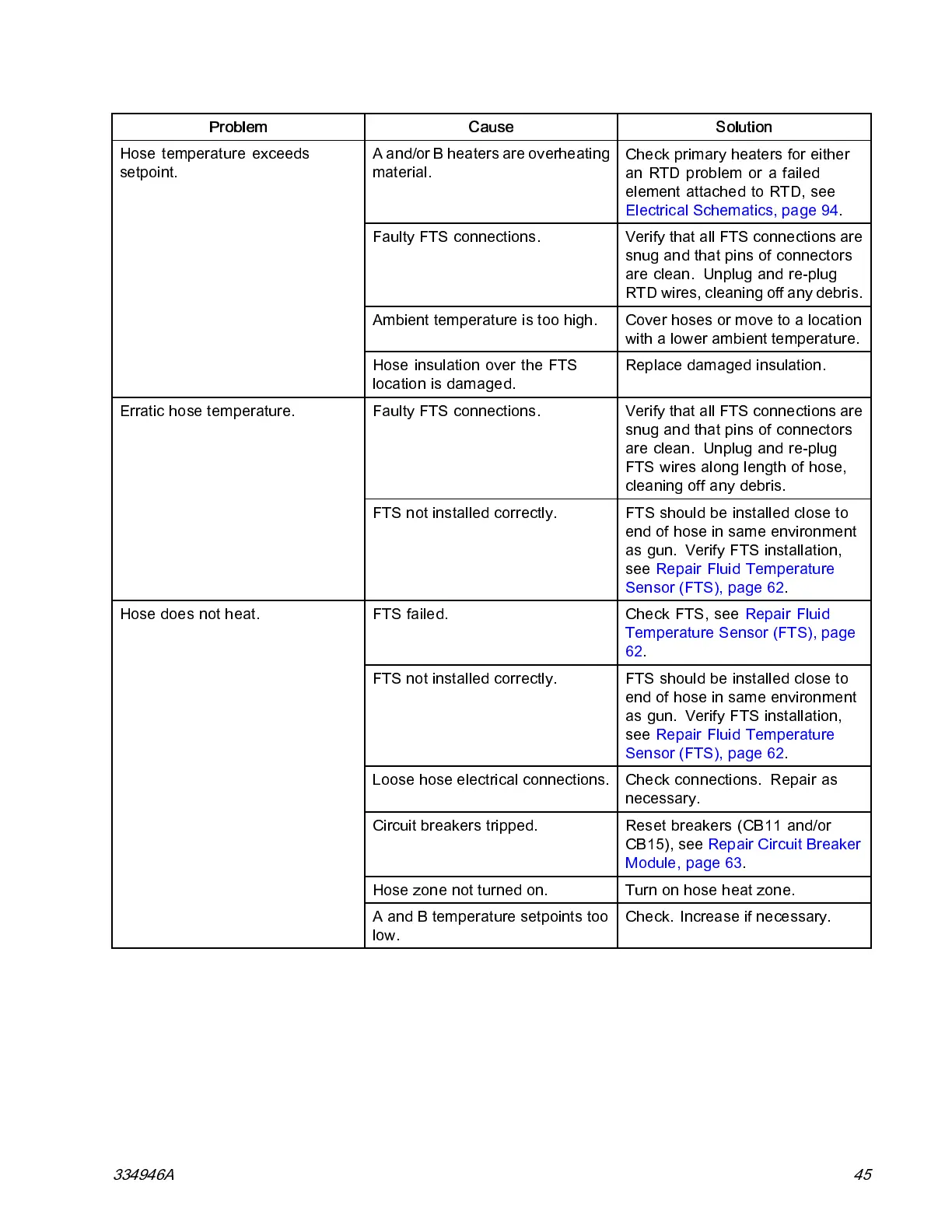
Troubleshooting
Problem
Cause Solution
A and/or B heaters are overheating
material.
Check primary heaters for either
an RTD problem or a failed
element attached to RTD, see
Electrical Schematics, page 94.
Faulty FTS connections. Verify that all FTS connections are
snug and that pins of connectors
are clean. Unplug and re-plug
RTD wires, cleaning off any debris.
Ambient temperature is too high.
Cover hoses or move to a location
with a lower ambient temperature.
Hose temperature exceeds
setpoint.
Hose insulation over the FTS
location is damaged.
Replace damaged insulation.
Faulty FTS connections. Verify that all FTS connections are
snug and that pins of connectors
are clean. Unplug and re-plug
FTS wires along length of hose,
cleaning off any debris.
Erratic hose temperature.
FTS not installed correctly. FTS should be installed close to
end of hose in same environment
as gun. Verify FTS installati on,
see Repair Fluid Temperature
Sensor (FTS), page 62.
FTS failed. Check FTS, see Repair Fluid
Temperature Sensor (FTS), page
62.
FTS not installed correctly. FTS should be installed close to
end of hose in same environment
as gun. Verify FTS installati on,
see Repair Fluid Temperature
Sensor (FTS), page 62.
Loose hose ele ctrical connections.
Check connections. Repair as
necessary.
Circuit breakers tripped. Reset breakers (CB11 and/or
CB15), see Repair Circuit Breaker
Module, page 63.
Hose zone not turned on. Turn on hose heat zone.
Hose does not heat.
A and B temperature setpoints too
low.
Check. Increase if necessary.
334946A 45



 To Next Page