13
was charged.
This timer is automatically reset to “0:00” when the
transmitter battery voltage is signifi cantly higher than
the last time the unit was switched on, i. e. after a
charge process. This is the state shown in the screen-
shot.
Receiver power supply
Various 4.8 V NiMH batteries are available for the re-
ceiver, varying in capacity. For reasons of safety you
should not use dry cells in model aircraft, helicopters
and other high-speed models. For the same reason
do not use individual cells fi tted in a battery holder;
always use ready-made battery packs with welded or
soldered connections.
There is no direct method of checking receiver battery
voltage when operating a model.
Make it a routine to check the state of your batteries
at regular intervals. Charge your batteries in good
time: don’t wait until you notice the servos running
more slowly than usual before recharging the pack.
Please refer to the main GRAUPNER FS catalogue
for full details of batteries, chargers, measuring
equipment and monitoring units for use with rechar-
geable batteries.
Charging the receiver battery
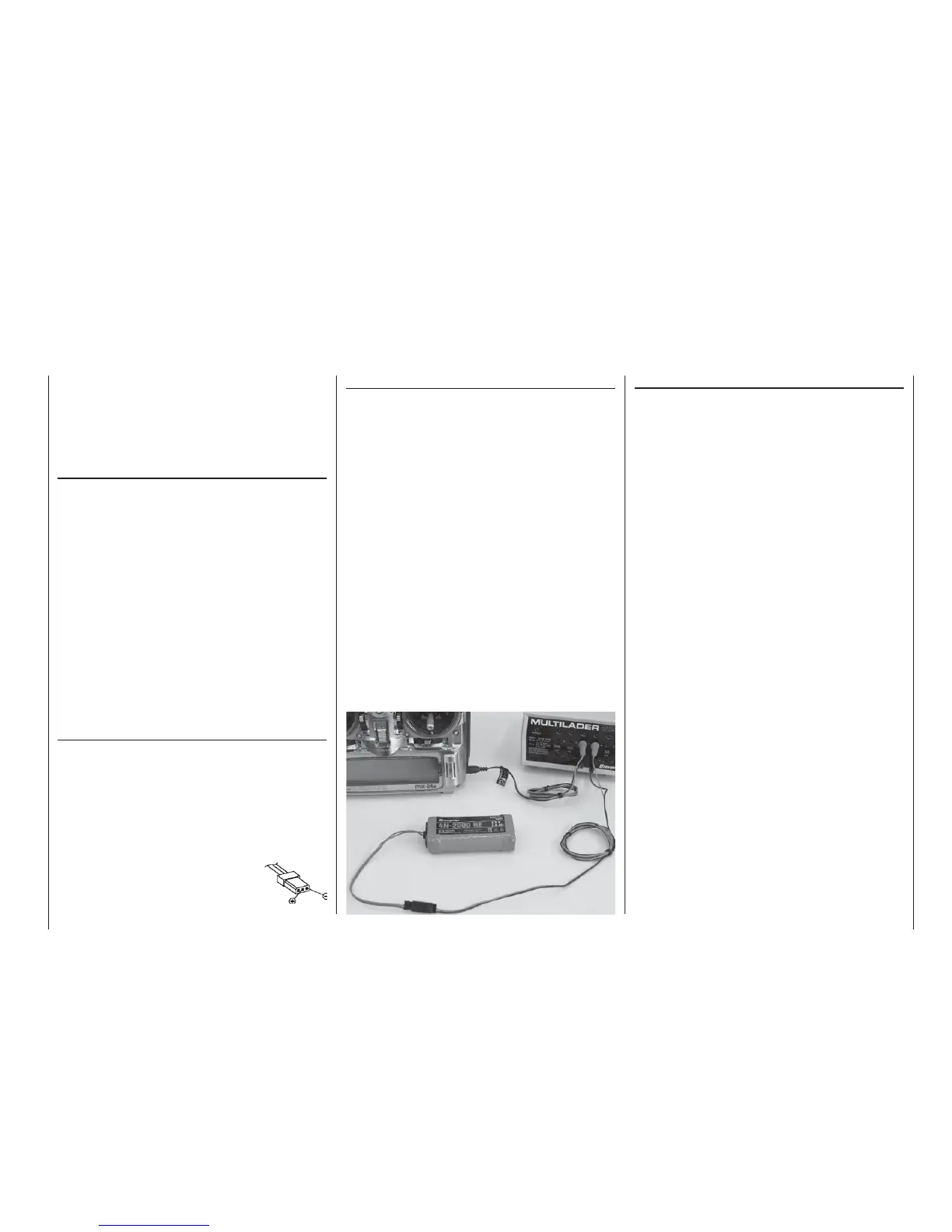
The charge lead, Order No. 3021, can be connected
directly to the receiver battery for charging. If the bat-
tery is installed in a model and you have fi tted one
of the following switch harnesses: Order No. 3046,
3050, 3934 or 3934.3, then the battery can be char-
ged via the separate charge socket or the charge so-
cket which is built into the switch. The switch on the
switch harness must be left at the “OFF” position for
charging.
Operating notes
General notes on battery charging
• Always connect the charge lead to the charger
fi rst, and only then to the receiver or transmitter
battery. This avoids the danger of accidental short-
circuit between the bare ends of the charge lead.
• Observe the recommendations provided by the
charger manufacturer and the battery manufactu-
rer at all times. Keep to the recommended maxi-
mum charge current stated by the battery manuf-
acturer. To avoid damage to the transmitter, the
charge current should never exceed 1.0 A; you
can usually limit the charge current on the battery
charger itself.
• Do not discharge the battery or carry out battery
maintenance programs via the integral charge so-
cket, as the socket is not suitable for this applicati-
on.
• Never leave batteries on charge unsupervised.
Disposal of dry cells and rechargeable batteries
Never dispose of exhausted batteries in the house-
hold rubbish. As end-user you are legally obliged
(“Battery Disposal Directive”) to return old and ex-
hausted dry cells and rechargeable batteries to an
approved disposal centre, e. g. your local toxic waste
collection point or a retail outlet where batteries of the
same type are sold.
Polarity of receiver
battery connector



 To Next Page