153
Program description:
Special functions
For maximum fl exibility in terms of receiver socket as-
signment, the
mx-24s program provides a means of
swapping over the servo outputs 1 to max. 12.
With this option you can distribute the transmitter’s
twelve “control channels” to any of the receiver out-
puts, i. e. to servo sockets 1 … 12 respectively. Ho-
wever, please note that the display in the »Servo dis-
play« menu refers exclusively to the “Control chan-
nels”, i. e. it does not take any interchanged outputs
into account.
RECEIVER OUTPUT
Servo
Servo
Servo
Servo
SEL
Output 1
2
3
4
Output
Output
Output
1
2
3
4
Hold the rotary control pressed in to select the line of
the servo / output combination you wish to change.
After a brief press on the rotary control you can now
assign the desired “servo” to the selected “recei-
ver” output using the rotary control in the highligh-
ted fi eld … or restore the default assignment by pres-
sing CLEAR. Any subsequent changes, such as ser-
vo travel adjustments, Dual Rates / Expo, mixers etc.,
must still correspond to the original receiver as-
signment!
Typical applications:
• If you wish to use a small receiver with six or even
just four servo sockets, it may be necessary to
swap over the receiver sockets in order to operate
a second camber-changing fl ap, a second aileron
servo or a speed controller.
• If you are using a model set up for another make*
of equipment, it may also prove necessary to swap
servos for Trainer mode operations, to avoid ha-
ving to re-connect the servos at the receiver.
• In the helicopter program of the mx-24s the out-
puts for one collective pitch servo and the thrott-
le servo have been interchanged compared to cer-
tain earlier GRAUPNER/JR
mc-systems:
The throttle servo is now assigned to receiver out-
put “6” and the collective pitch servo to output “1”.
You may therefore wish to retain the earlier confi -
guration. In this case you will need to program out-
puts 1 and 6 as shown in the screen-shot printed
below:
Notes:
• If you wish to swap over the receiver outputs, ple-
ase remember that the Fail-Safe programming
“Hold” and “Pos.” in SPCM and APCM mode al-
ways refers to the “outputs”, i. e. the receiver’s so-
cket numbers.
• Note also that the servo position displays in the
»Servo display« menu also refer to the “servo
number” or “control channel number”, and not to
the receiver outputs, which you may have chan-
ged.
* GRAUPNER does not guarantee that GRAUPNER radio cont-
rol systems will work correctly in conjunction with receiving sys-
tems and radio control equipment made by other manufacturers.
Servo 6
Servo 2
Servo 3
Servo 4
Servo 5
Servo 1
6
SEL
RECEIVER OUTPUT
Output 1
2
3
4
Output
Output
Output
5
Output
Output
Rx. output swap
Altering the servo sequence
the Teacher module, and the plug marked “S” (Stu-
dent) to the Pupil module.
The individual functions to be transferred are selected
in the Teacher transmitter’s »Teacher/pupil« menu
(see page 150), which can be operated in any of the
following modes: PPM10, PPM18, PPM24, PCM20,
SPCM20 or APCM24.
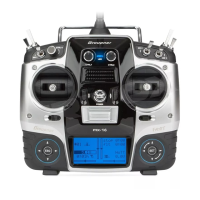
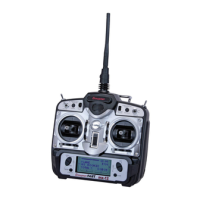
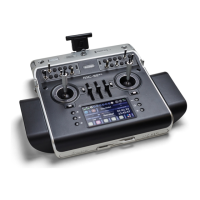
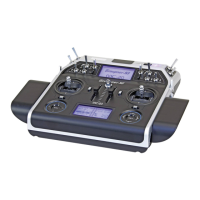
Suitable Pupil transmitters
D 14, FM 414, FM 4014, FM 6014,
mc-10, mc-12,
mx-12 mc-14, mc-15, mc-16, mx-16s, mc-16/20,
mc-17, mc-18, mc-19, mc-20, mc-22, mc-22s,
mx-22, mc-24 and mx-24s.
The Pupil transmitter must always be set to operate in
PPM mode.
If you are using an mc-series or mx-series trans-
mitter, it is best to activate a free model memory and
use that memory in its base setting, with the appropri-
ate model type (“Fixed-wing” or “Helicopter”) selected.
Assign the name “Pupil” to this memory, and set up
the stick mode (Mode 1 … 4) to suit the pupil’s prefe-
rence. All other settings should be left at their default
values. If you select the “Fixed-wing” model type it is
permissible to set “Throttle forward / back” in the “Mo-
tor” line of the »Model type« menu. If you have se-
lected the “Helicopter” model type, you must also set
the throttle / collective pitch direction and idle trim on
the Pupil transmitter. All other settings, including mi-
xer and coupling functions, are entered exclusively at
the Teacher transmitter, which in turn transfers them
to the model.
If you are using one of the following transmitters: D14,
FM414, FM4014, FM6014, FM6014 / PCM 18, you
must also check the direction of servo rotation and
stick mode, and make corrections if necessary by re-
connecting the leads inside the transmitter. All other
mixers must be switched off or set to “zero”.



 To Next Page