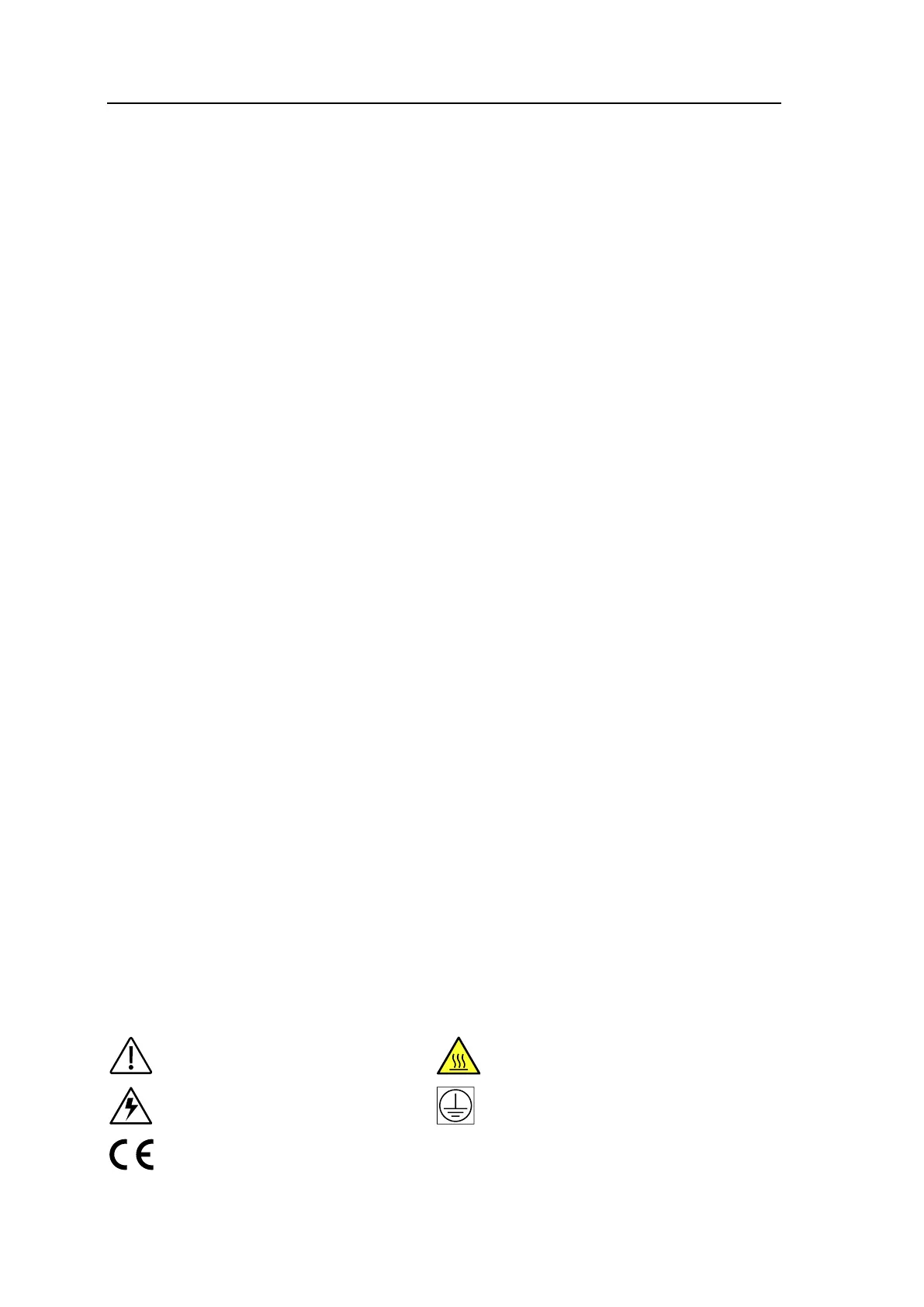
Protective earth!
The analyzer must be connected to protective earth.
Installation and fault finding!
Electrical installation and fault finding on the analyzer should only be undertaken by a
suitably trained and qualified engineer.
EMC!
For compliance with the EMC product standard IEC 60533 (1999), the connection cables
for the main supply, relays, interface, and analog output signals should be shielded or
provided with equivalent protection.
Special precautions have to be taken in connection to "long" signals or control lines of
more than 30 meter.
Sensor!
The sensor must not be exposed to strong mechanical shocks. Otherwise the sensor ele-
ment may crack without visible damage.
The sensor must be connected to the analyzer before the analyzer is powered up (risk of
damage). As soon as the analyzer is under voltage, the connection to the sensor must not
be interrupted. Therefore, please disconnect the power when you need to connect or dis-
connect the sensor.
Connections!
All electrical connections and power supplies are placed inside the analyzer. To gain ac-
cess, unbolt the top cover of the analyzer using a standard 4-6 mm screwdriver.
Poisonous gases!
Both sensor types, SEN1 and SEN9, used for the G
36
Oxygen Analyzer are not suitable
for installation in areas with a high concentration of methane (CH
4
).
Besides, a reduced life time can occur if the sensor is subjected to lead, phosphor, silicon,
halogens or high concentration of sulfur.
Recycling!
Please do not dispose the G
36
Oxygen Analyzer with regular refuse. Disposal should be in
accordance with the requirements of the current statutory regulations.
Symbol identification



 To Next Page