Greenlee / A Textron Company 12 4455 Boeing Dr. • Rockford, IL 61109-2988 USA • 815-397-7070
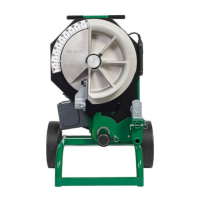
555C Electric Bender Classic
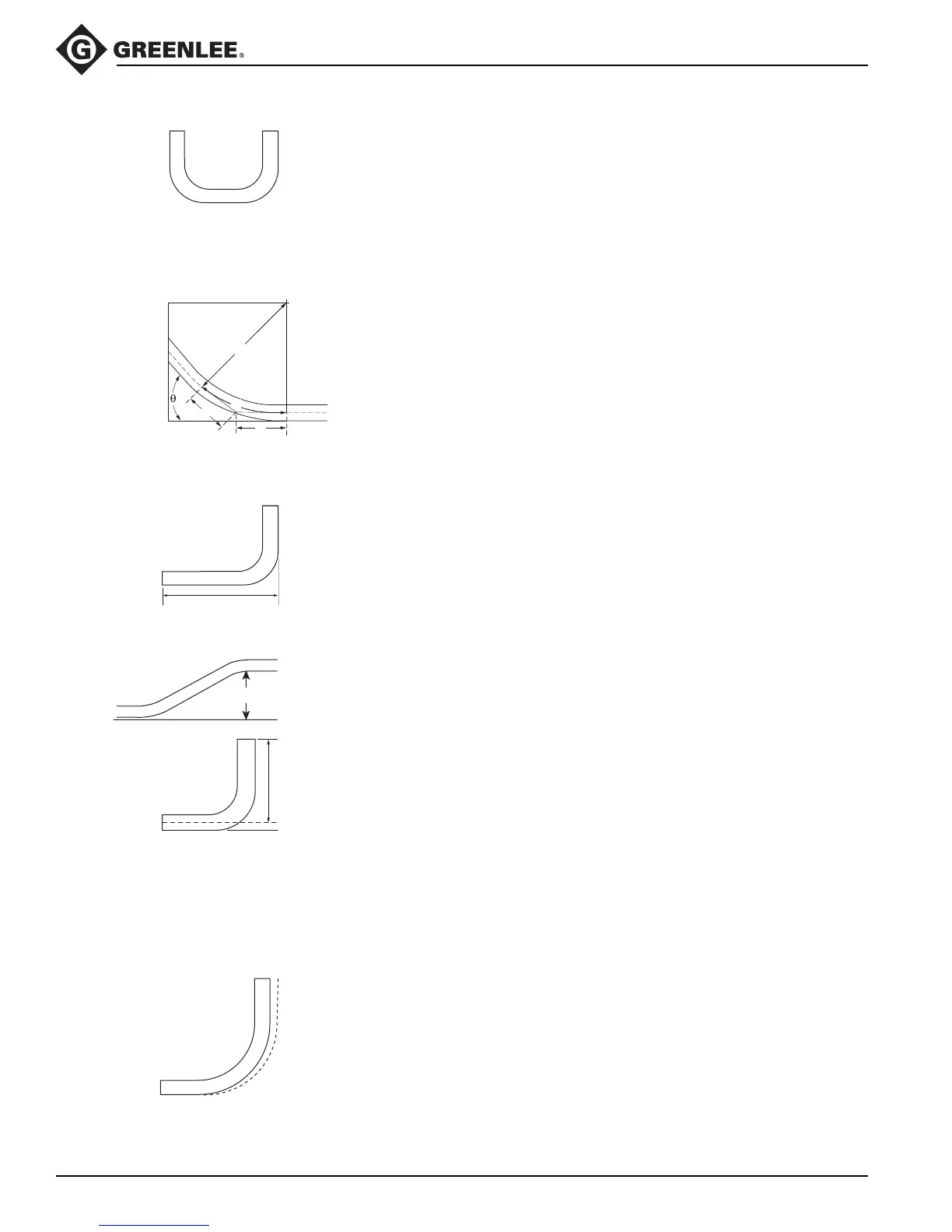
back-to-back bend — any U-shaped bend formed by two
parallel 90° bends with a straight section of conduit or pipe
between the bends.
center-to-center distance — the distance between the
successive bends that make up an offset or a three-bend
saddle.
developed length — the actual length of pipe that will be
bent; see distance “d” in the illustration at left.
gain — the difference between the straight-line distance
(a + a) and the shorter radial distance, (d) where:
θ = angle of bend
r = the centerline bending radius of the bending shoe
kick — single bend of less than 90°
leg length — the distance from the end of a straight
section of conduit or pipe to the bend; measured from the
end to the outside edge of the conduit or pipe.
offset bend — two opposite bends with the same degree
of bend; used to avoid an obstruction.
offset height — the distance between the two legs of
an offset bend, measured perpendicular to the two legs;
also called amount of offset and depth of offset.
rise — the distance from the end of a straight section
of conduit or pipe to the bend; measured from the end
to the center line of the conduit or pipe. Also called stub
or stub-up.
saddle — a three-bend or four-bend combination; used
to avoid an obstruction.
shrink — the amount of conduit “lost” when laying out an
offset bend working toward an obstruction; see the expla-
nation under Offset Bending in this manual.
springback — the amount, measured in degrees, that a
conduit or pipe tends to straighten after being bent.
Illustrated Bending Glossary
a
a
d
r
Offset Height


 To Next Page