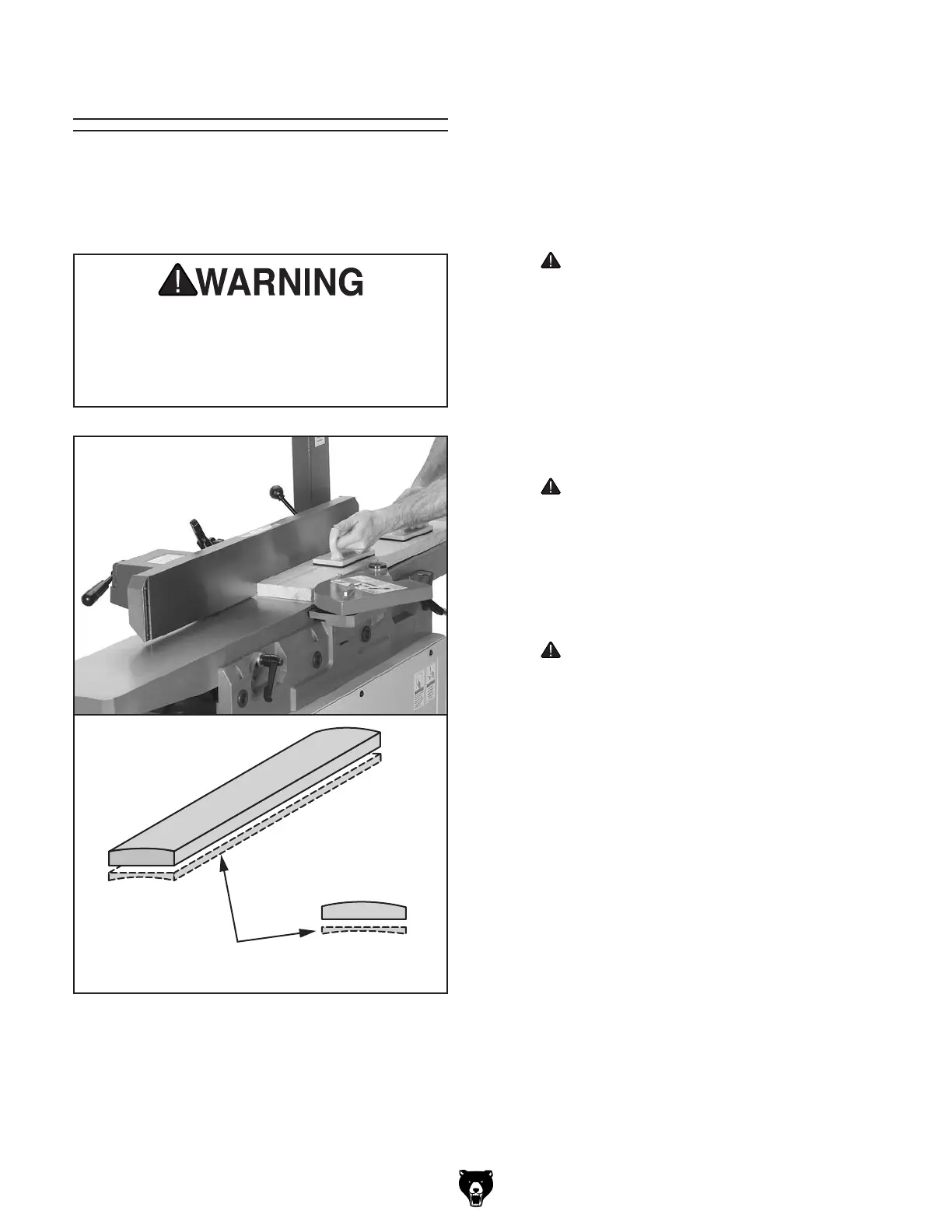
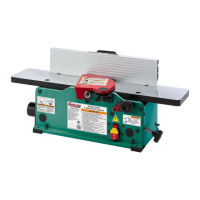
The purpose of surface planing (see example
Figures
below) on the jointer is to make one flat
face on a piece of stock to prepare it for thickness
planing on a planer.
To surface plane on jointer:
1.
Inspect stock to ensure it is safe and suitable
for the operation (see
Requirements section).
Set infeed table height to desired cutting
depth for each pass.
CAUTION:
To minimize risk of kickback,
do not exceed a cutting depth of
1
⁄16
when surface planing.
Feed workpiece completely across cutter-
head while keeping it firmly against fence
and tables during the entire cut.
CAUTION: Keep hands at least 4" away
from cutterhead during the entire cut. Instead
of allowing a hand to pass directly over cut-
terhead, lift it up and over cutterhead, and
safely reposition it on the outfeed side to con-
tinue supporting workpiece. Use push blocks
whenever practical to further reduce risk of
accidental hand contact with cutterhead.
Set fence to 90°.
Start jointer.
Place workpiece firmly against fence and
infeed table.
CAUTION:
To ensure workpiece remains
stable during cut, concave sides
must face toward table and fence.
Repeat Step 6 until entire surface is flat.
Tip:
When squaring up stock, cut opposite
side of workpiece with a planer instead of the
jointer to ensure boths sides are parallel.
Failure to use push blocks when surface
planing could result in your hands contact-
ing rotating cutterhead, which will cause
serious personal injury. ALWAYS use push
blocks when surface planing on jointer!
Removed
Surface
Figure 23. Example of a surface planing
operation.
Model G0945/G0946/G0947 (Mfd. Since 06/21)
-27-
Surface Planing


 To Next Page