19
Operation
2.2.6 Checking the battery plugs
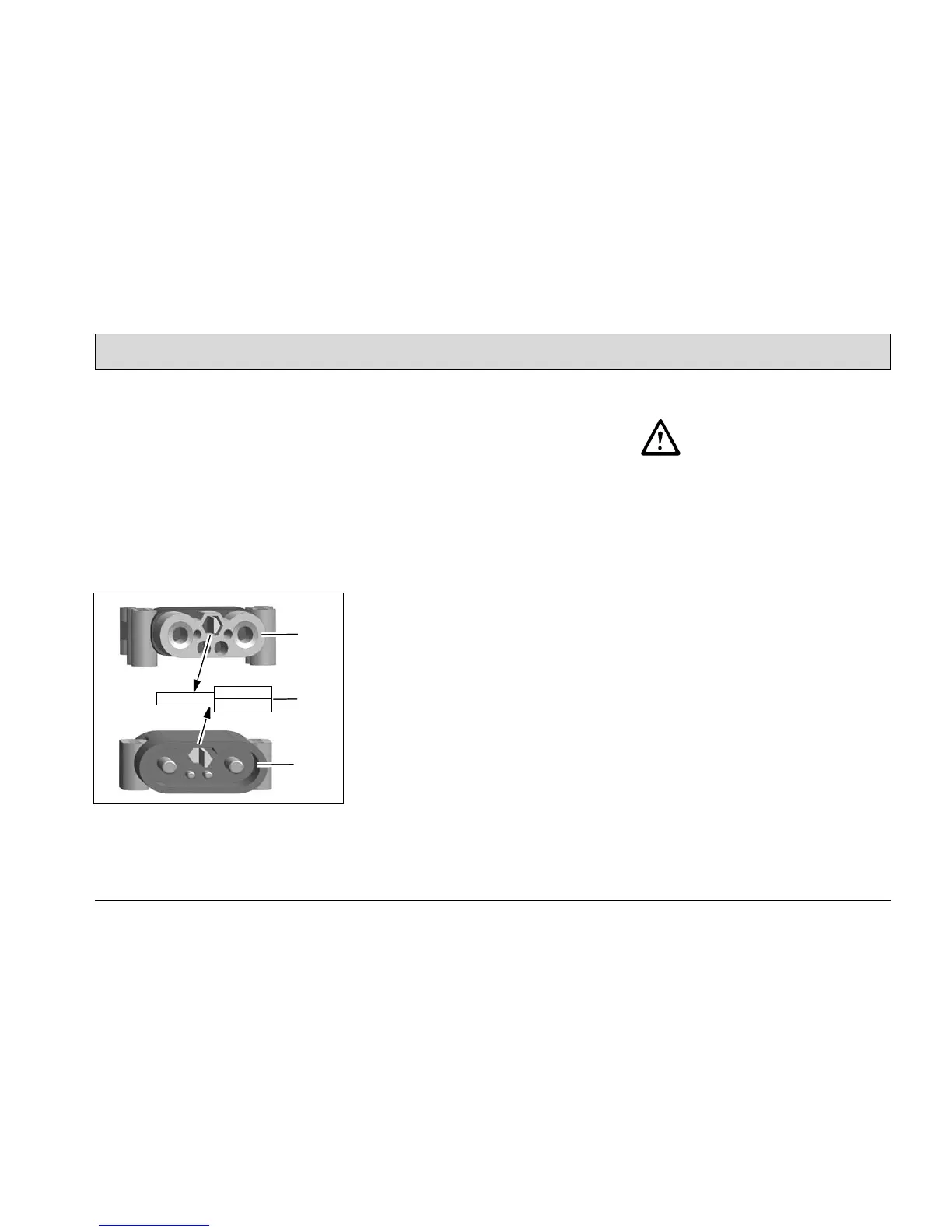
The battery plugs (Fig. 7/1 and 2) on
the vehicle, batteries and stationary
chargers must be coded with the col-
ored coding pins (Fig. 7/3) according to
the battery and nominal voltage. The
connectors on the charger are coded at
the factory according to the charge
characteristic curve so that on changing
the charge characteristic curve (accord-
ing to the battery), the connector coding
must be changed.
Fig.7
Connector coding
Socket housing of the battery:
• Gray for wet batteries
• Green for maintenance-free gel bat-
teries
Connector body on the vehicle:
• Yellow for both battery types
Voltage coding
Insert the coding pin (Fig. 7/3) so that
the nominal voltage can be read
through the window in the housing.
Always select the same nominal volt-
age for the socket and connector.
The following three conditions must be
fulfilled for the complete system:
1. The voltage coding must be the
same for all connectors and sockets.
2. The color of the coding pin in the
vehicle is yellow.
3. The color of the coding pin in the
charger connector (vehicles without
built-in charger) complies with the
battery plug.
2.2.7 Initial battery charge
Before starting the vehicle up
for the first time, the batteries
to be used must be fully
charged, properly, by imple-
menting the initial battery
charge routine. Please pay at-
tention to the operating manual
provided with the charging unit
as well as the manual from the
battery manufacturer. Hako
assumes no liability for dam-
age to the battery caused by a
fault when the battery is
charged for the first time.













 To Next Page