OVERVIEW
-13-
includes adjustable up/down slope & pre/post gas control. The stick welding (MMA)
capability delivers easy electrode welding with high quality results, including cast Iron,
stainless and low hydrogen with hot-start and arc-force adjustment. An additional feature
is the spool gun function that allows the simple connection of Spool Gun for the use of
thin or softer wires that don’t have the column strength to feed through MIG torches, such
as some aluminum and silicone bronze wires. In the JOB mode, 100 different JOB
records can be stored and recalled, improve the quality of welding process.
The DPS series of arc welding machine is an industrial quality machine that is suitable
for all positions welding for various plates made of stainless steel, carbon steel, alloyed
steel etc. Applications applied to automotive, petrochemical, architecture, industrial and
common steel fabrication.
The DPS series of welding machines has built-in automatic protection functions to
protect the machines from over-voltage, over-current and over-heat. If any one of the
above problems happens, the alarm lamp on the front panel will illuminate and output
current will be shut off automatically to protect machine and operator.
§2.4 Duty Cycle and Over-heat
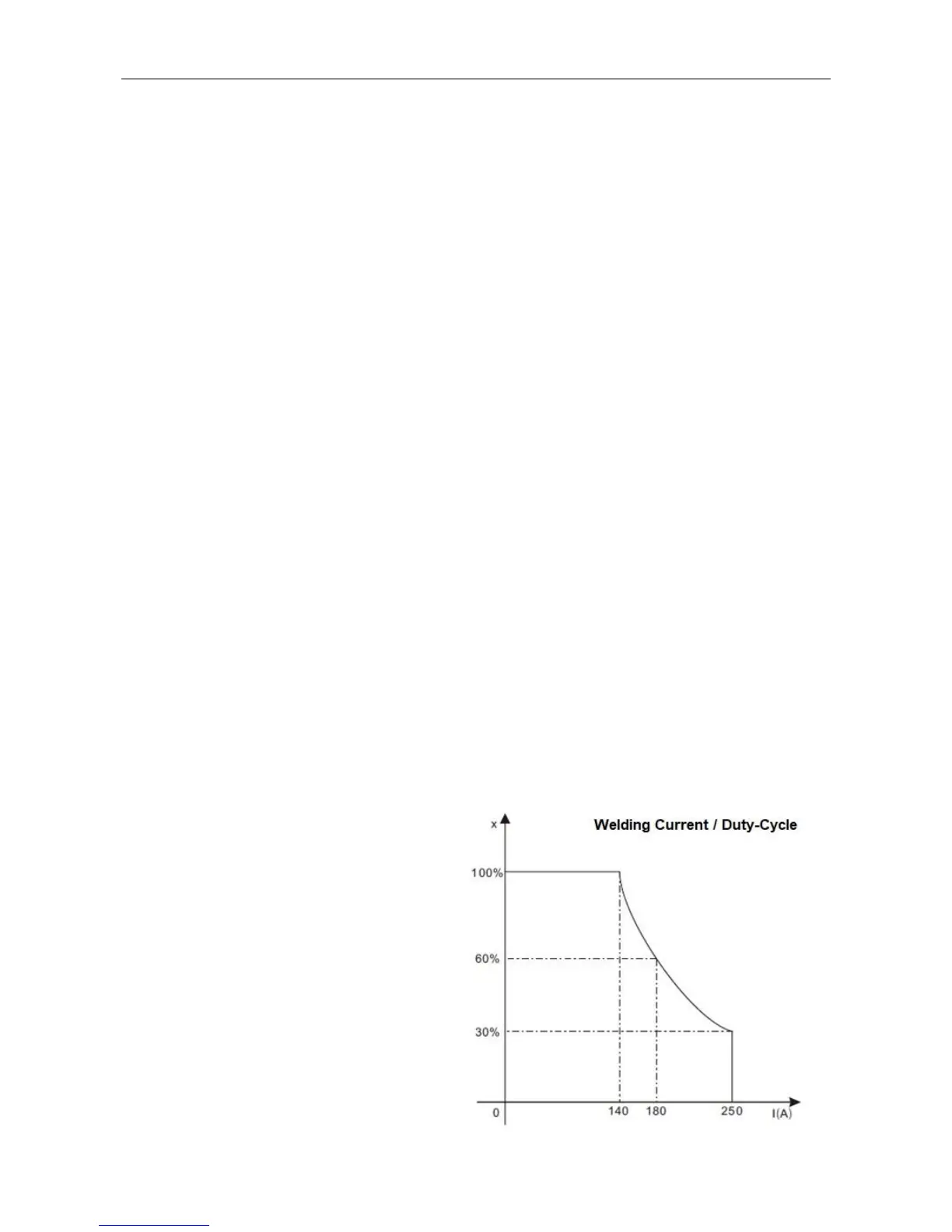
The letter “X” stands for Duty Cycle, which is defined as the portion of the time a
welding machine can weld at maximum rated output current within a 10-minute cycle.
If the welding machine is operated beyond the rated duty-cycle, the IGBT heat sensor
will send a signal to the welding
machine control unit to switch the
output welding current OFF and light
the over-heat. The machine should not
be operated for 10-15 minutes to allow
cool down. When operating the
machine again, the welding output
current should be reduced to match the
duty cycle.


 To Next Page