MA310 | MA510 | MA710 Owner's Manual | rev1.3 20240612
Pg 11 of 42
©2024 Harman International | Features, Specifications, and Appearance subject to change without notice.
Wiring and Connections
NETWORK CONNECTION (Applies to MA510 and MA710 only)
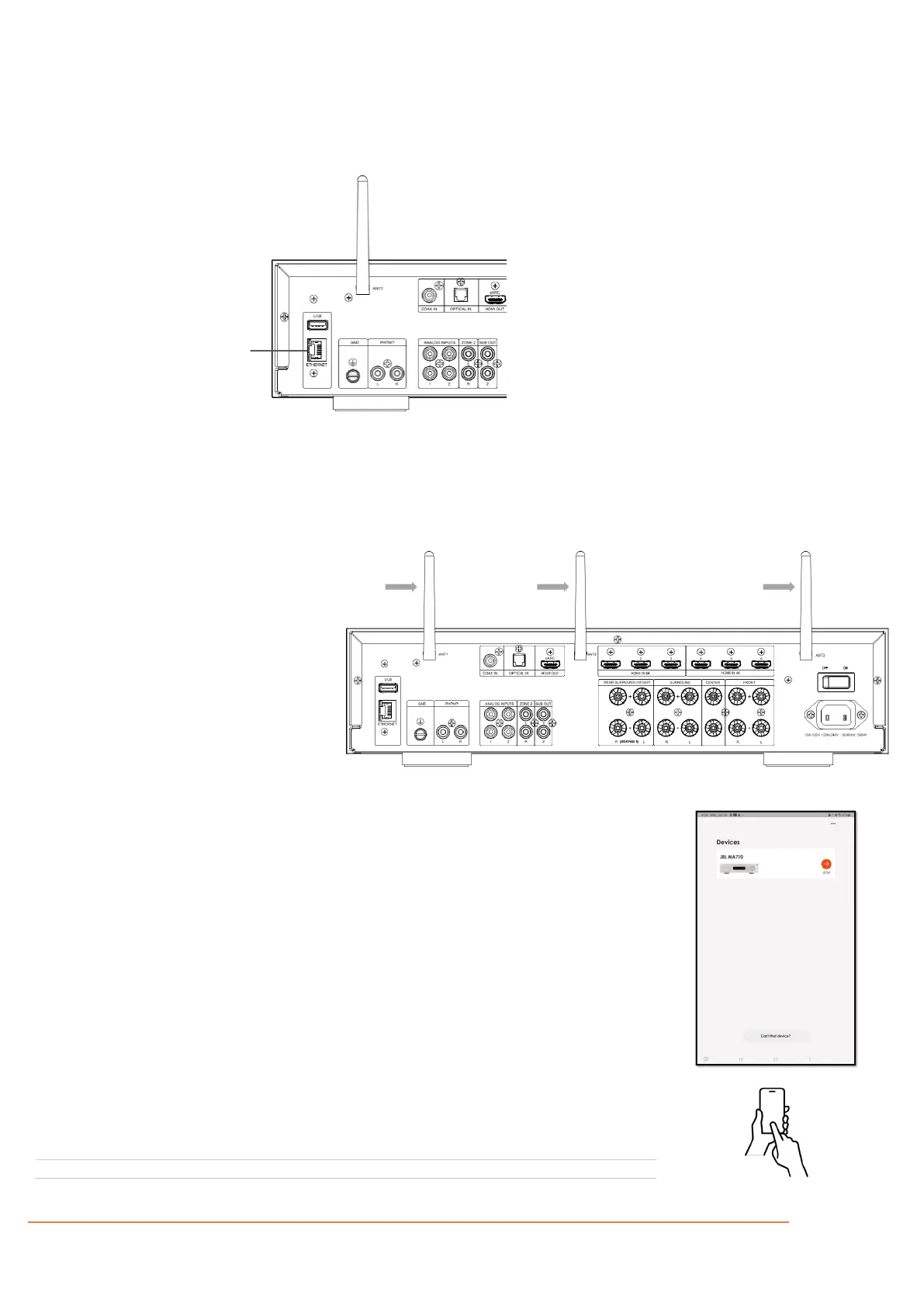
For a Wired Connection
Connect the Ethernet port on the back of the AVR to any of the open ports on your network router using a CAT-5e or higher
cable.
Ethernet Socket
Connect this to your home network
using a Cat 5e or Cat 6 cable
(MA710 shown*)
For a Wi-Fi Connection:
To make a Wi-Fi connection, download the JBL PREMIUM AUDIO app to your smartphone or tablet. QR codes are on the
front page of this manual.
Connect the supplied external antennas for Bluetooth/Wireless connectivity to connectors on the rear panel.
1. Place the external antennas for
Bluetooth/wireless connectivity
evenly over the screw terminal of
rear.
2. Turn clockwise until the antenna
is fully connected.
3. Rotate the antenna upwards for
best reception.
Power on the AVR and open the JBL Premium Audio app to discover it after the AVR is
ready. Select it and follow the prompts to connect it to your Wi-Fi network.
Alternatively, you can connect the JBL AVR to your Wi-Fi network using Apple AirPlay
speaker setup in the Wi-Fi settings of your Apple device.
Network Audio Playback
The JBL AVR can be connected to, and play music from the following apps and services:
• Spotify Connect
• Tidal Connect
• Apple AirPlay
• Chromecast (requires acceptance of Google terms in the JBL PREMIUM AUDIO
app or additional setup steps in the Google Home app)
• Roon (requires additional setup in Roon app)
• Works With SmartThings (requires setup with a SmartThings Hub and the
SmartThings App)
From the JBL PREMIUM AUDIO app, you can access setup favorites and access other
services including but not limited to:
Internet Radio | Podcasts | Connected USB media | Local network storage (UPnP)



 To Next Page