©HBS Bolzenschweiss-Systeme GmbH & Co. KG
All rights reserved – Reprinting, in whole or in part, only with the approval of the manufacturer
24
9 Welding Process
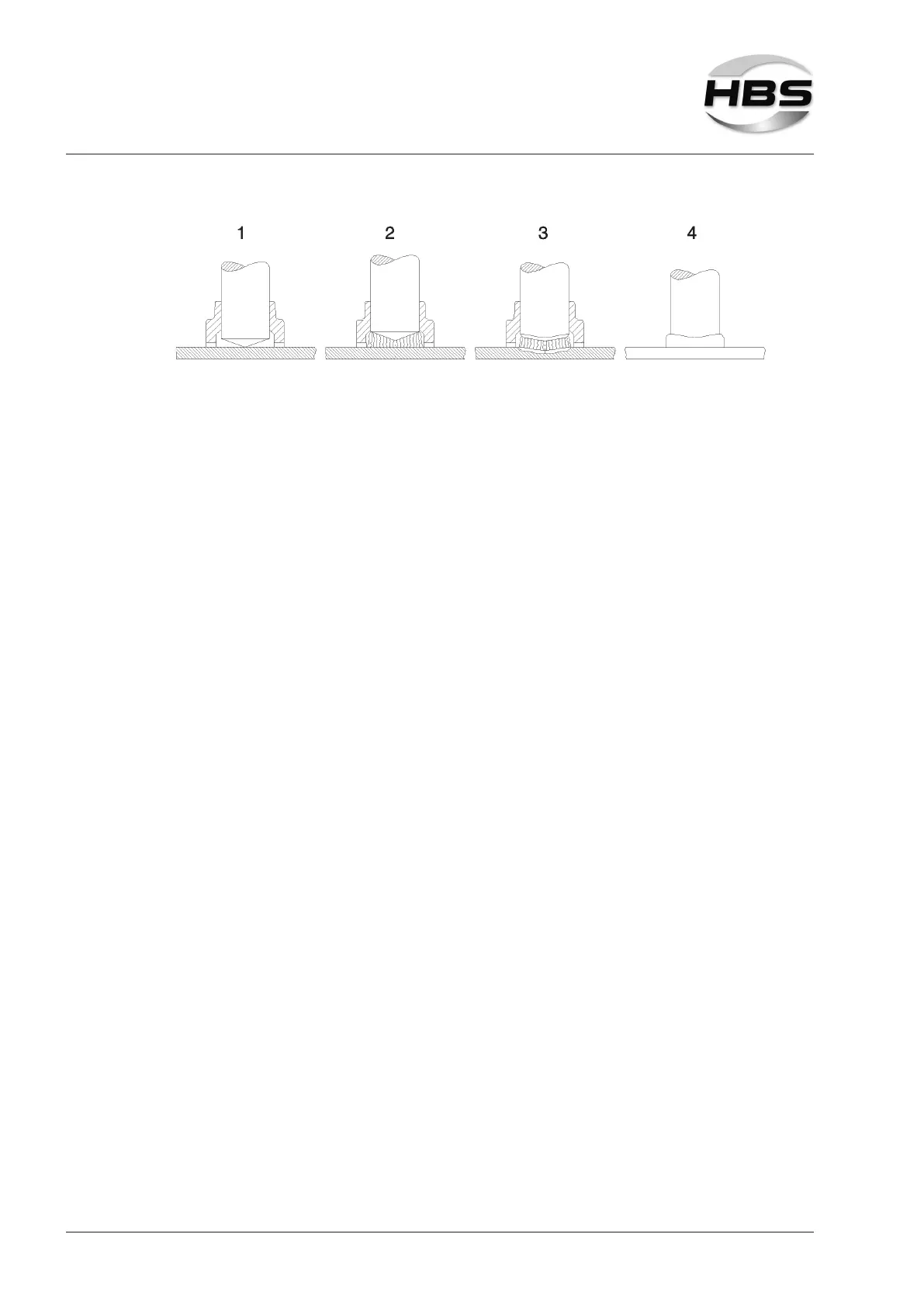
– At the beginning of the welding process, the welding element (stud) in the wel-
ding gun is lifted clear off the workpiece by a lifting device (solenoid). An initial
switched current triggers a pilot arc of a low current power (see gure, positi-
on 2). Then the main arc ignites between the face area of the welding element
and the workpiece.
– The main arc burns at the set current during the welding time preselected at the
stud welding unit. The selected welding energy must match the requirements of
the selected welding element. The energy of the arc melts the face of the welding
element and the workpiece (see gure, position 3).
– At the end of the preset welding time, the stud is mechanically moved to the
workpiece. On plunging into the weld pool, the two weld zones join and solidify.
The contact of stud and workpiece extinguishes the arc in a short-circuit and the
main current is switched off.
– The weld zone solidies and cools down. The welding element is now welded to
the workpiece over its entire cross-section of the welding element (see gure,
position 4). As soon as the weld metal is cooled down, the welding gun can be
carefully withdrawn from the welding element. When using shielding gas, the
shielding gas ow is switched off with the withdrawal of the welding gun. If a cera-
mic ferrule is used, it can be removed by light hammer blows.
The welding range of drawn-arc stud welding is about 3 to 25 mm diameter when
using mild steel/stainless steel. Welding elements with rectangular cross-section
should not exceed a ratio length : width of about 5 : 1. All technical information and
adjustment values are based on the use of welding elements which correspond with
current standards.


 To Next Page