3. UNIT SPECIFICATION
Added-feature programming functions, fixed programs
The control unit is capable of running heating process programs with fixed, preselected
parameters from a database.
The program segment and the parameters are stored in the database.
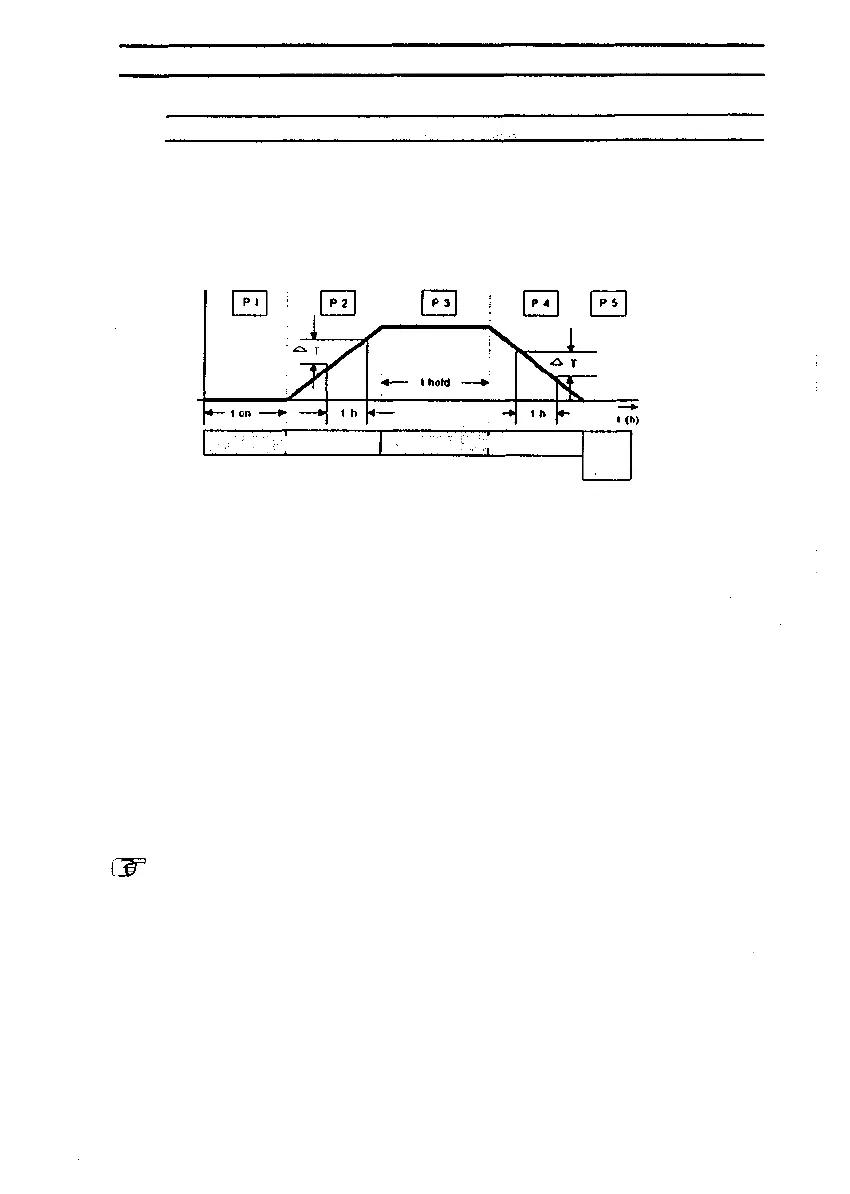
The fixed program contains a maximum of four program segments and a status command.
Fig. 4/3: Example of a temperalure/time process, controlled by the fixed program
t
TfC)
PI.0-PI.9 :j P2.0-P2.9 P3.0.P3.» j.l P4.0-P4.9 P. OF
P.OFI
P. re
Each program segment, P I - P 4, is assigned to a typical temperature / time response. 10
selectable sets of parameters are permanently stored In the database for each program
segment. These sets of parameters can. be assigned within the program.
A status command is provided as the fifth program segment. This determines the subsequent
action with the program selected from the fixed program memory:
* Program on standby, do not execute yet = Select" P. o F'
•• Program on standby, wait for program start • Select" P. o n"
•• Delete program from memory completely • Select" P. r E "
The program memory is erased on delivery. If the operator Interrogates the program segments,
"Parameter set off' appears in the display panel = e.g." P. I -".
When compiling a program, selecting "parameter set off" within the selected program segment
causes the control unit to bypass this segment for the fixed program function.
The selected program always runs from program segment P I. n to program segment P 4. n.
If program segment P 3. n is combined with program segment P 4. n, the heating and blower are
only switched off following termination of segment P 4. n.
If a program is interrupted and started again, the sequence commences at segment P I. n.
The previously selected operating temperature cannot be changed once the program has
started.
The heating is switched off in the event of a power failure (> 20 ms) with subsequent restoration
of the power supply, the temperature inside the unit Is displayed as a flashing value and the
program must be started again.
Issue: May, 1994
50 042 750 13/34



 To Next Page