19
Receiver
The receiver uses LEDs to indicate operational status.
The cover of the receiver must be removed for the
LEDs to be visible. See "Test the Receiver" in the Test
Procedures Section of this manual for specific
information on LED locations.
TRANSMITTER OPTIONS
Each Hetronic radio remote control system is built to
customer specifications. You may have features that
are not described in this manual. Some possible
options are described below. If you have questions,
please contact your dealer or Hetronic.
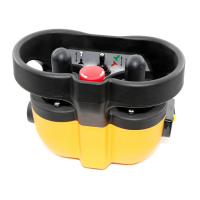
Back-up Transmitter
Spare transmitters are frequently used in the event that
the primary transmitter is damaged or misplaced. Only
one transmitter is allowed to be active at any given
time.
NOTE: If the primary and back-up transmitter are
turned on at the same time, the receiver enters the
Safe Mode.
ADMO Address Plugs
If several radio remote control systems are used,
address plugs can configure a spare transmitter to be
used on any of the cranes/machines. Each address
plug corresponds to a specific crane/machine. When a
specific crane/machine address plug is inserted into
the plug receptacle of the spare transmitter, the
transmitter is automatically configured to operate that
crane/machine.
Optical Low Battery Indicator
This feature is a LED indicator of the low battery
condition. It can be used as an alternative to or in
addition to the buzzer signal.
Advanced Low Battery Indication
This feature is basically a timer that indicates a low
battery condition 10 minutes before the Safe Mode is
entered. This feature is beneficial where placing the
crane or machine in a safe position takes more time
after the low battery is indicated.
Feedback
This feature allows the transmitter to receive and
display information such as crane/machine status,
warnings, etc. The feedback can be displayed as visual
graphics or buzzers.
RF Booster
This feature boosts the RF transmission power for
extended range operation of up to 1 mile. It is to be
used only in applications that are safe to operate
outside of the operator’s visual range.
Priority Transmitters
This feature is the capability to have several
independent cranes/machines controlled by one
transmitter. Priority leves can be set to allow the main
transmitter to override the control of individual
crane/machine transmitters.
RF Units
AUTX - Auto Synthesizer - The function of a transmitter
to automatically search a range to find a frequency
without interference.
SCRX - Scan Synthesizer - The function of a receiver
to respond only to a designated transmitter and finding
the frequency that the transmitter is transmitting on.
CRANE/MACHINE CONTROL WITH
MULTIPLE TRANSMITTERS
Multiple crane/machine applications may require the
use of more than one transmitter. Or a single
transmitter may be required to control several
cranes/machines simultaneously. The common
methods of control for these situations are "Pitch and
Catch" and "Independent/Combined Control."
Pitch and Catch
Multiple (usually two) transmitters control one receiver,
but not at the same time. All transmitters must be
configured with the same address code as the receiver,
but set at a different frequency channel.
The first transmitter turned on controls the
crane/machine. The operator moves the load to a
hand-off location and turns the transmitter off. The
second operator turns his transmitter on and takes
control of the crane/machine. The receiver only
accepts commands from one transmitter at a time.
Independent/Combined Multiple
Crane/Machine Control
This configuration is for applications that require
multiple (usually two) cranes/machines on a single
runway. Each crane/machine can be controlled
independently. The cranes/machines may also be
operated in tandem by one operator.
The transmitters built for these applications contain
Selector switches. These switches select each
crane/machine individually or any combination of
designated cranes/machines.
With transmitter interlocks, each transmitter contains a
different address code and frequency channel. The
receivers have a RF module and decoder set for each
transmitter. A special module inside the receiver
determines which transmitter is requesting control of
each crane/machine. The module locks the transmitter
signal to the receiver and all other transmitter signals
are ignored.




 To Next Page