4
HETRONIC SYSTEM COMPONENTS
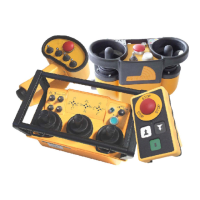
The Hetronic radio remote control system consists of a
receiver and transmitter. Each system is designed to
customer specifications. Some systems contain
multiple receivers and transmitters.
Receiver Standard Features
Start relay, horn relay, E-Stop relay, and option relay
• Up to 32 digital outputs
• Up to 8 proportional channels (0 to 10V, 0 to 20
mA, etc.)
• Self-diagnostics
• 48 V, 115 V or 230 V for AC cranes/machines
• 12VDC or 24VDC for DC cranes/machines
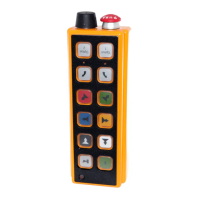
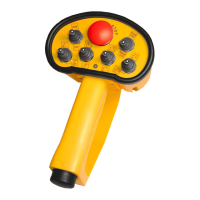
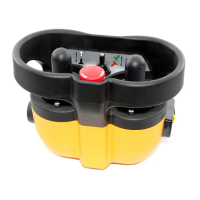
Transmitter Types
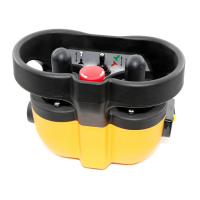
• Nova-M belly box
• Nova-L belly box
• Nova-XL belly box
• GL belly box
• GL-3 belly box
• GR belly box
Transmitter Standard Features
•E-stop
• Sleep mode
• Removable key
• 100 m (300 ft.) range
• Internal antenna
• Start/Horn pushbutton
• Carrying belt or shoulder strap
SYSTEM OVERVIEW
Theory of Operation
The Hetronic radio remote control system includes a
transmitter and receiver. The transmitter electronically
generates a carrier frequency which allows it to
communicate with the receiver. Each system is
programmed with a unique address code. This code
allows the operation of multiple systems in the same
general vicinity. The receiver only accepts commands
from the transmitter with the same address code.
NOTE: The receiver and transmitter have the address
code set at the factory.
E-Stop Function
The most important feature of the radio remote control
system is the E-Stop. The transmitter sends the E-stop
status signal along with the specified crane/machine
function. This method confirms that ongoing operations
are safe. If the E-stop pushbutton is pressed, the relay
module in the receiver causes all crane/machine
motions to stop. The receiver goes into Safe mode.
To restart the system, disengage the E-stop button and
press the Start/Horn button.
The E-Stop responds faster than any other function.
When E-Stop is engaged, the system ignores any other
signal that is transmitted. The problem must be
corrected before the system will respond to any other
signal.
The E-Stop is self-monitoring and redundant in the
transmitter and receiver. The system performs a
self-test to ensure the E-Stop circuit is working
properly. If an error is detected, the system
automatically goes into Safe mode.
When the transmitter is turned on, it performs a
self-test to be sure that communications are within
designated parameters. If an error is detected, the
transmitter will not transmit any signals.
Transmitter Sleep Mode
The transmitter sleep mode is designed to prevent
accidental operation. If the transmitter is not used for
10 minutes, it turns itself off. The controls are not
operational while the transmitter is turned off. To restart
the transmitter, turn the key switch off and then back
on, and press the Start/Horn button. The sleep mode
can be enabled or disabled by the operator.
IMPORTANT: If the transmitter has a selector switch or
latching pushbutton that is engaged, the sleep mode
will not occur. The engaged selector switch or latched
pushbutton is constantly sending a signal to the
receiver.
Receiver Safe Mode
The following conditions cause the receiver to go into
its Safe mode:
• The transmitter goes into Sleep Mode
• Radio signal interference
• Transmitter out of operating range
• E-Stop button is activated
• E-Stop circuit failure
• Low battery sends E-stop after time out
When the transmitter signal is no longer sensed by the
receiver, the Time Out process begins. The Time Out
period is set to 450 msec at the factory. If the receiver
does not establish contact with the transmitter within
that time period, it goes into the Safe Mode. In Safe
Mode, the receiver shuts off power to the output
modules and activates the E-stop function.
To restart the system, be sure the transmitter signal is
active and sensed by the receiver. Then press the
Start/Horn pushbutton.



 To Next Page