OPERATION | PAGE 12
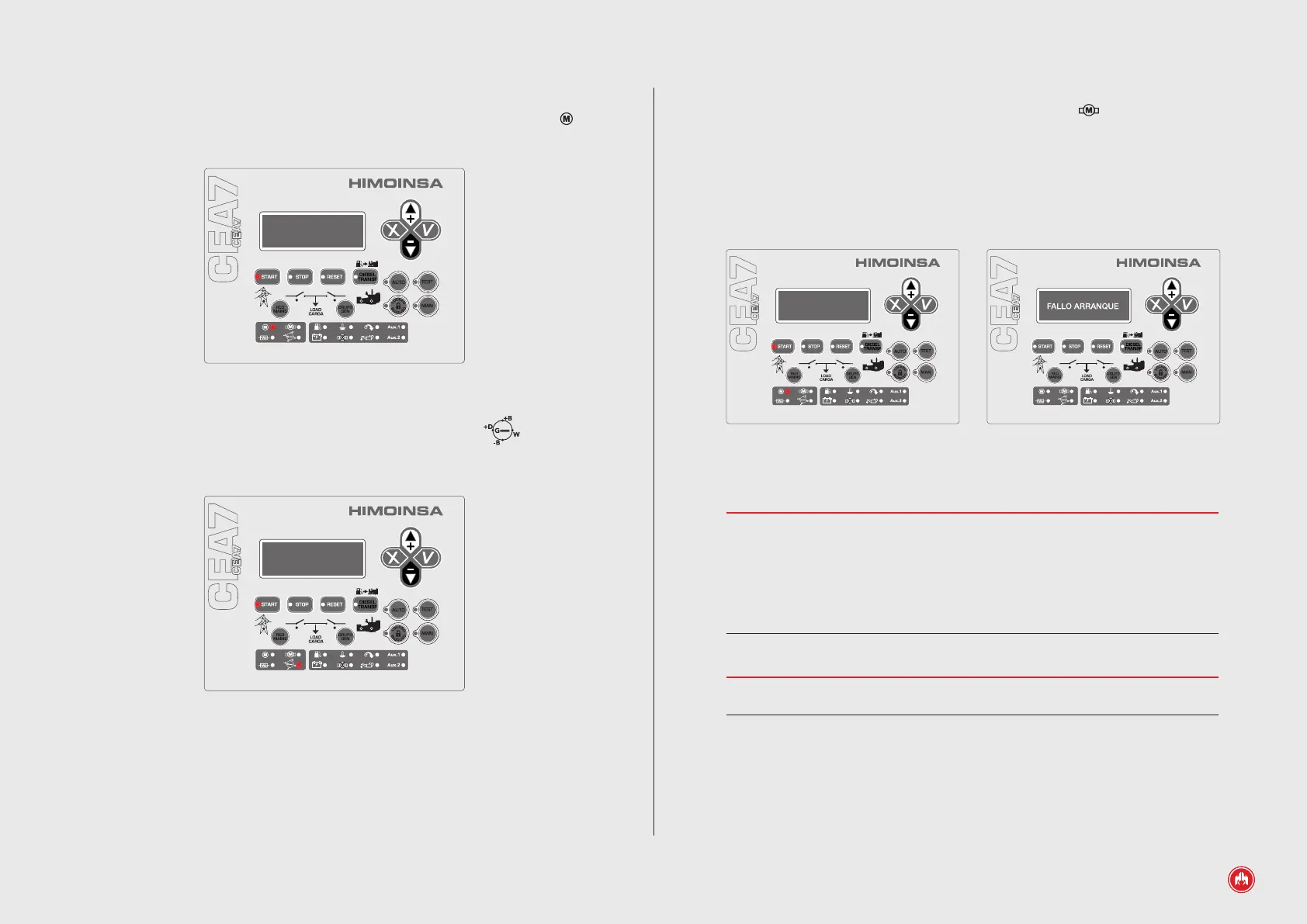
7. Fumes control. The CEM7 control unit allows you to handle start-up in fumes
limitation mode by:
• Assigning a programmable output (Settings table, parameter 1 to 4,
value 97) that enables a fumes limitation system during the start-up
process that remains active for a programmable length of time (Times
table, parameter 33) once the engine is running.
• It is possible to programme an idling start-up speed (table J1939,
parameter 8) that remains active for a programmable length of time
(Times table, parameter 33) before commuting to rated speed.
If during the set time no engine start-up is detected, the control unit waits for a
period of time (Times table, parameter 2) before retrying the start-up. Once a
certain number of start-ups has been exceeded without any start-up condition
being detected (Times table, parameter 1), the control unit activates the Start-up
Failure alarm.
During engine start-up, the excitation of the battery charging alternator is carried
out through the D+ output for a period of time (Times table, parameter 8). Once
the excitation of the alternator has been completed, the measurement module
monitors the correct functioning of the battery charging alternator. In the event a
battery charging alternator failure is detected, the Alternator Failure alarm is acti-
vated (Alarms table, parameter 10).
4. Starting the motor (ARR). For a maximum time (Times table, parameter 5),
the start output of the measurements module is activated while waiting to detect
at least one of the programmed start conditions. The possible engine starting
conditions are:
• Generator voltage (Regulations table, parameter 19). The motor is
considered started when a certain generator voltage is exceeded
(Threshold table, parameter 20).
• Alternator voltage (Regulations table, parameter 20). The motor is
considered started when a certain battery charging alternator voltage
is exceeded (Threshold table, parameter 21).
• Pickup frequency (Regulations table, parameter 21). The motor
is considered started when a certain pickup frequency is exceeded
(Threshold table, parameter 22). To activate the pickup calculation
via the engine ring gear, it is necessary to enter the number of teeth
on the engine's ywheel ring gear (Threshold table, parameter 24);
if the number of teeth for the ywheel ring gear is zero, the pickup
frequency is calculated via the generator frequency according to the
ratio 50Hz/1500rpm, 50Hz/3000rpm or 60Hz/1800rpm (Regulations
table, parameter 26).
• Low Oil Pressure Signal (Regulations table, parameter 22). Due to its
characteristics, it is not advisable to use the low oil pressure signal to
detect if the engine is running, but its use is recommended as protection
against a restart, as the engine is already running. Exceptions to this
engine start detection are SCANIA engines and sensors that have their
own power source.
5. Generator stabilisation. Once any start-up condition is detected, the control
unit waits for a xed time for stabilization of the generator signal before monitor-
ing the quality of the generator signal.
6. Rated condition. After achieving engine stabilisation, verication of the gener-
ator signal is performed. In this state, the quality of the signal produced by the
genset is evaluated (voltage levels, frequency,...).



 To Next Page