16
CFD configuration
Overview
Connectivity Fault Detection (CFD), which conforms to IEEE 802.1ag Connectivity Fault Management
(CFM) and ITU-T Y.1731, is an end-to-end per-VLAN link layer Operations, Administration and
Maintenance (OAM) mechanism used for link connectivity detection, fault verification, and fault location.
Basic concepts in CFD
Maintenance domain
A maintenance domain (MD) defines the network where CFD plays its role. The MD boundary is defined
by some maintenance association end points (MEPs) configured on the ports. An MD is identified by an
MD name.
To accurately locate faults, CFD assigns eight levels (from 0 to 7) to MDs. The bigger the number, the
higher the level and the larger the area covered. Domains can touch or nest (if the outer domain has a
higher level than the nested one) but cannot intersect or overlap.
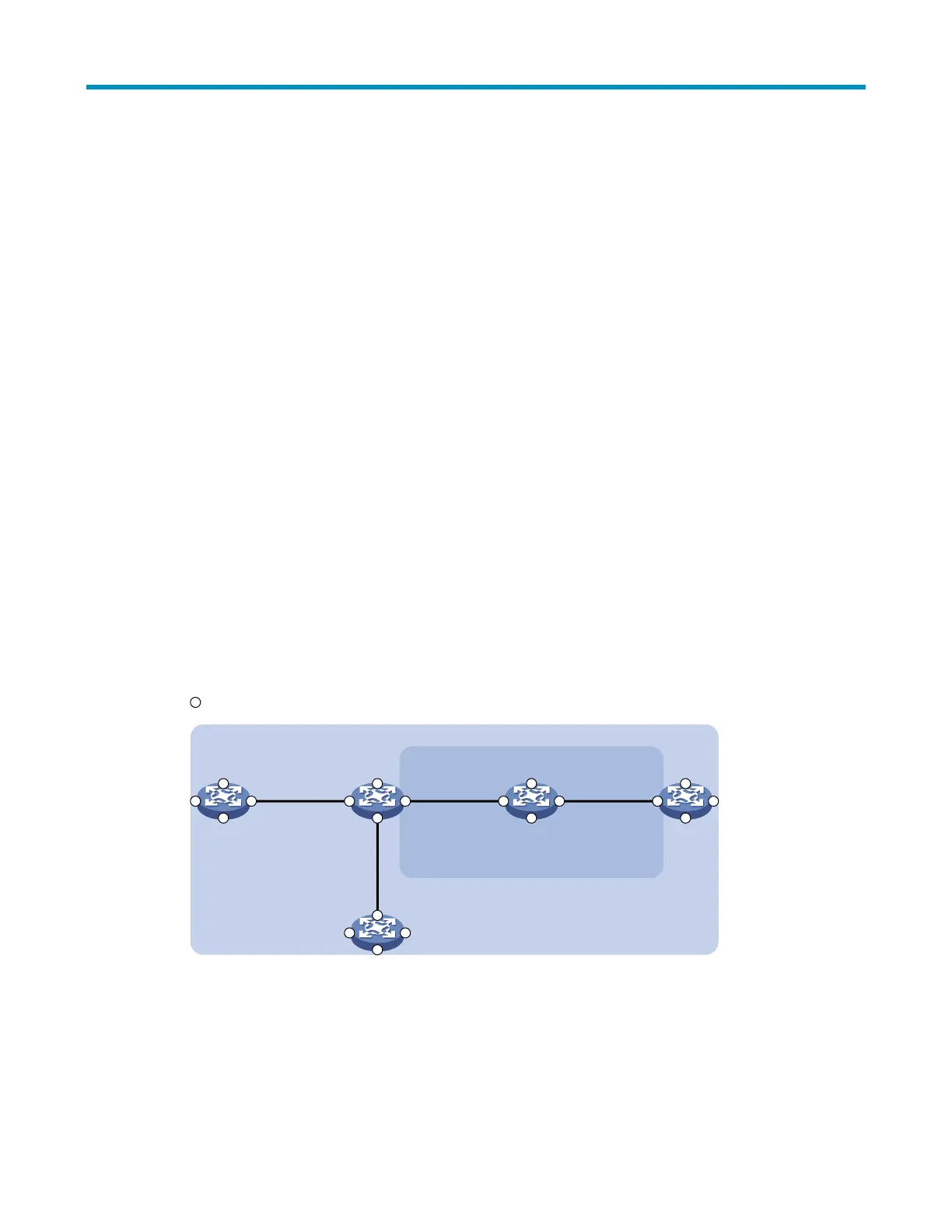
MD levels facilitate fault location and make fault location more accurate. As shown in Figure 3, MD_A in
light blue nests MD_B in dark blue. If a connectivity fault is detected at the boundary of MD_A, any of
the devices in MD_A, including Device A through Device E, may fail. If a connectivity fault is also
detected at the boundary of MD_B, the failure points may be any of Device B through Device D. If the
devices in MD_B can operate properly, at least Device C is operational.
Figure 3 Two nested MDs
Device A Device B Device C Device D
Device E
MD_A
MD_B
VLAN 100
Port
CFD exchanges messages and performs operations on a per-domain basis. By planning MDs properly in
a network, you can use CFD to locate failure points rapidly.
Maintenance association
A maintenance association (MA) is a set of maintenance points (MPs) in an MD. An MA is identified by
the “MD name + MA name.” You can configure multiple MAs in an MD as needed.


 To Next Page