23
SPECIAL WELDING METHODS
SPOT WELDING
The purpose of a spot weld is to join pieces of
metal together with a spot of weld instead of
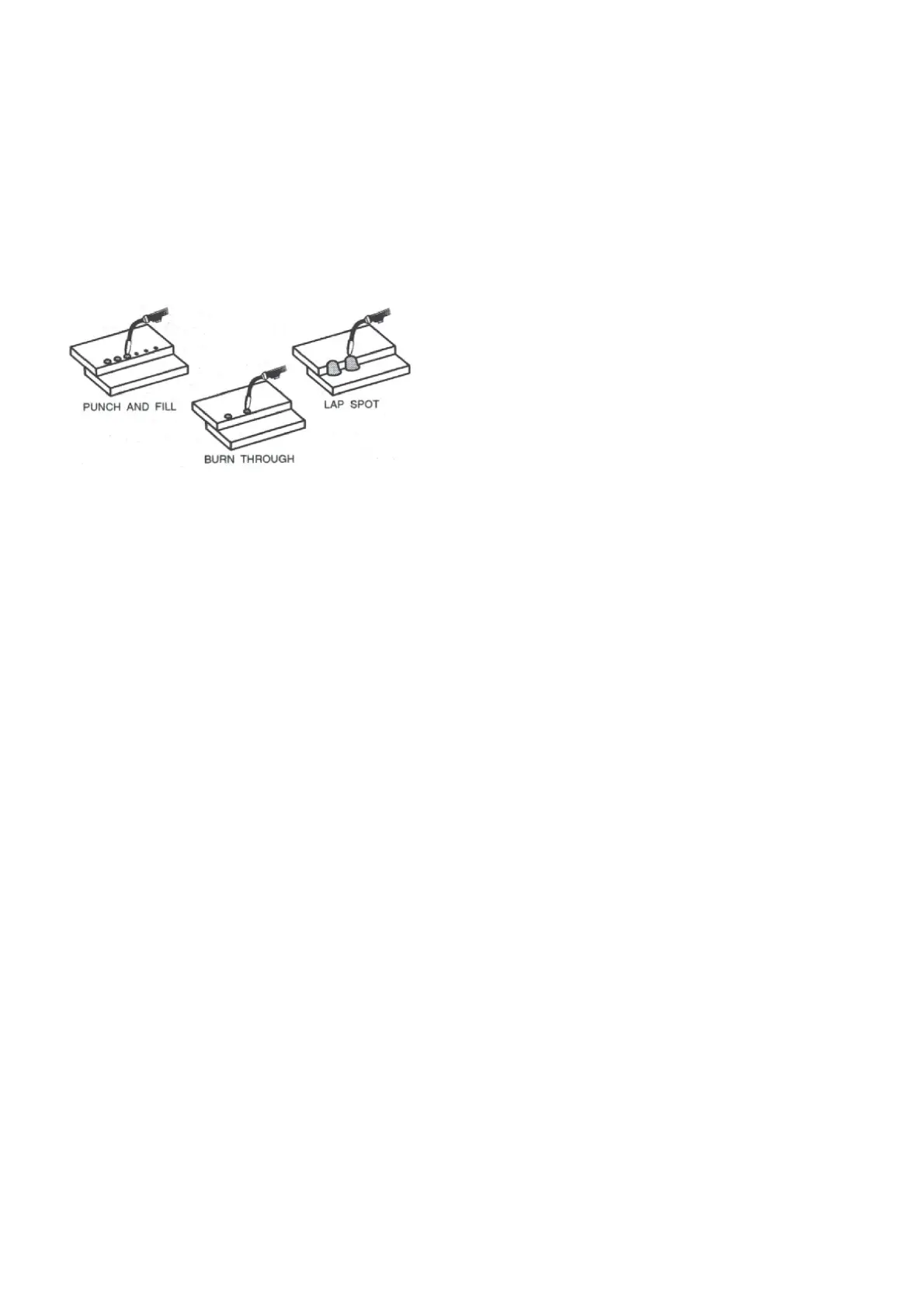
a continuous weld bead. There are three
methods of spot welding: Burn-Through,
Punch and Fill, and Lap (see Figure 19). Each
has advantages and disadvantages depend-
ing on the specific application as well as per-
sonal preference.
1. The BURN-THROUGH METHOD welds two
overlapped pieces of metal together by
burning through the top piece and into the
bottom piece.
With the burn-through method, larger wire
diameters tend to work better than smaller
diameters because they have greater cur-
rent carrying capabilities allowing the arc
to burn through very quickly while leaving
a minimal amount of filler metal build up.
Wire diameters that tend to work best, with
the burn-through method, are 0.030 inch
diameter solid wire or 0.035 inch self-
shielding flux-core wire.
Do not use 0.023 inch diameter solid or
0.030 inch self-shielding flux-core wires
when using the burn-through method
unless the metal is VERY thin or excessive
filler metal build-up and minimal penetra-
tion is acceptable.
Always select the HIGH heat setting with
the burn-through method and tune in the
wire speed prior to making a spot weld.
2. The PUNCH AND FILL METHOD produces a
weld with the most finished appearance of
the three spot weld methods. In this
method, a hole is punched or drilled into
the top piece of metal and the arc is direct-
ed through the hole to penetrate into the
bottom piece. The puddle is allowed to fill
up the hole leaving a spot weld that is
smooth and flush with the surface of the
top piece.
Select the wire diameter, heat setting, and
tune in the wire speed as if you were welding
the same thickness material with a continu-
ous bead.
3. The LAP SPOT METHOD directs the welding
arc to penetrate the bottom and top
pieces, at the same time, right along each
side of the lap joint seam.
Select the wire diameter, heat setting, and
tune in the wire speed as if you were weld-
ing the same thickness material with a con-
tinuous bead.
SPOT WELDING INSTRUCTIONS
1. Select the wire diameter and heat setting
recommended above for the method of
spot welding you intend to use.
2. Tune in the wire speed as if you were going
to make a continuous weld.
3. Hold the nozzle piece completely perpen-
dicular to and about 1/4 inch off the work
piece.
4. Pull the trigger on the gun and release it
when it appears that the desired penetra-
tion has been achieved.
5. Make practice spot welds on scrap metal,
varying the length of time you hold the
trigger, until a desired spot weld is made.
6. Make spot welds on the actual work piece
at desired locations.
Figure 19. Spot Welding


 To Next Page