Pg 2.13
SECTION 2BSECTION 2B
SECTION 2BSECTION 2B
SECTION 2B
,,
,,
,
SAW CUTTING CONTROLSAW CUTTING CONTROL
SAW CUTTING CONTROLSAW CUTTING CONTROL
SAW CUTTING CONTROL
SS
SS
S
This section has been prepared to give the operator the ability to set up the saw for most cutting
situations. The saw is equipped with variable blade speed control and hydraulic feed control, as well as
an extensive door chart to guide the operator to the correct setting of these controls.
BLBL
BLBL
BL
ADE BADE B
ADE BADE B
ADE B
ASICSASICS
ASICSASICS
ASICS
Technology is rapidly changing all aspects of production machining. Metal cutoff is no exception.
The advances made in the bandsaw blade industry have definitely brought down the cost per cut, despite
the three fold higher price of high technology blades. Variable pitch, bi-metal blades (like the 4/6 or 3/4
bi-metal blade supplied with the M-16/20) last much longer, cut faster, and more accurately than conven-
tional carbon steel blades. In order to take advantage of the superiority of bi-metal blades, it is critical to
properly break-in a new blade. This is accomplished by taking two or three cuts through solid four or
five inch diameter mild steel at an extremely slow feed rate. (It is also advisable to utilize a slow blade
speed.)
These two or three slow cuts sufficiently lap (polish) the new blade so that it does not snag the
material being cut. Proper break-in will alleviate blade vibration, improve surface finish, accuracy, and
blade life.
After break-in, the following six points must be closely monitored to ensure long blade life:
1. Proper blade tension should be maintained. (see section 3, Pg 3.2 Blade Changing)
2. Generous coolant application is essential with most materials. A high quality and well mixed
coolant will extend blade life, and also increase cutting rate and quality. On those materials
where coolant is undesirable for cutting, a slight coolant flow or periodic oiling of the blade is
necessary to prevent the blade from being scored by the carbide guides.
3. The stock being cut must be securely clamped in the vises.
4. The proper feed force should be chosen. (see section 2B - Saw Cutting Parameters: Step 2)
5. The proper blade speed must be selected. (see section 2B - Saw Cutting parameters: Step 4)
6. The proper feed rate must be applied. (see section 2B - Saw Cutting Parameters: Step 5)
VV
VV
V
ARIABLE SPEED CONTROLARIABLE SPEED CONTROL
ARIABLE SPEED CONTROLARIABLE SPEED CONTROL
ARIABLE SPEED CONTROL
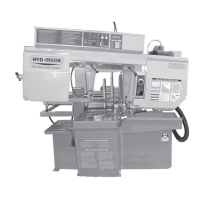
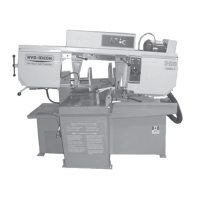
Blade speed can be adjusted infinitely between 75 to 400 SFM (23 to 122m/min) (Surface Feet/
Minute). Adjustment should be made only when the blade is running. Clockwise rotation of knob
increases blade speed while counter clockwise rotation decreases blade speed. If the saw is equipped
with an inverter (variable frequency drive) unit, then the blade speed is controlled with a dial on the
control panel.
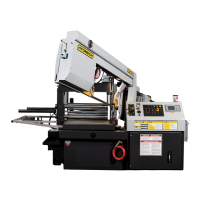
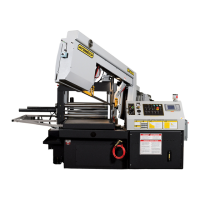
Speed adjusterSpeed adjuster
Speed adjusterSpeed adjuster
Speed adjuster
..
..
.
Speed adjuster for inverterSpeed adjuster for inverter
Speed adjuster for inverterSpeed adjuster for inverter
Speed adjuster for inverter
equiped saequiped sa
equiped saequiped sa
equiped sa
ww
ww
w
..
..
.



 To Next Page