1 INTRODUCTION
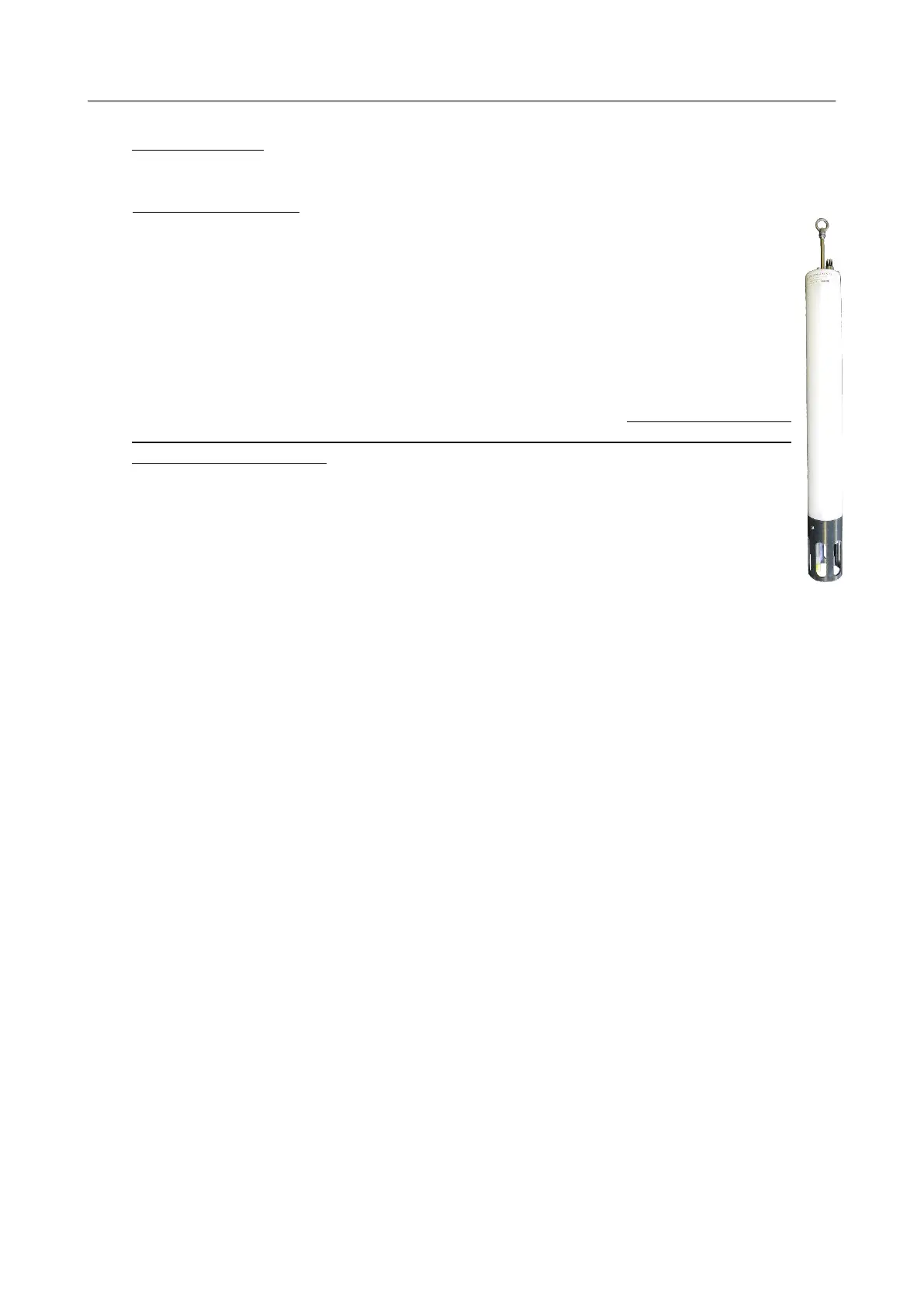
This section describes the main components of the OCEAN SEVEN 310 CTD multi-parameter probe.
1.1 PROBE DESCRIPTION
The OCEAN SEVEN 310 CTD multi-parameter probe represents a real breakthrough in the
concept of miniaturization, integration and performances. Thanks to the adoption of a new
generation of electronic devices, the OS310 can interface up to 14 analogue sensors and three
digital sensors (see list) and can guarantee sampling rates up to 28Hz, all of the above contained
in a CTD with very small diameter (see housings) and very low power consumption. Operator
can easily select the OS310 sampling rate among 2,4,8,12, up to 28 Hz (sample per second)
according to the required monitoring or profiling activity.
The OCEAN SEVEN 310 is equipped with the well-known and proven IDRONAUT pressure
balanced full ocean depth, pump free and long-term stability sensors. Central to which, is the
high accuracy seven-platinum-ring conductivity sensor, which can be cleaned in the field without
the need for re-calibration. Furthermore, an optional UV-LED (280nm) integrated into the
conductivity cell, sterilize the sample under measurement, thus avoiding the early growth of
biofouling inside the quartz measuring cell.
For added flexibility, the OCEAN SEVEN 310 CTD multi parameter probe can be operated in
either verbose or non-verbose modes, the latter being especially convenient for system
integrations on buoys data loggers, ROVs and AUVs, SAVs making this CTD an ideal choice for
both on-line profiling and self-recording moored applications.
Data is output using the standard RS232C interface or the telemetry option available for on-line full
ocean depth real-time data transmission. Other interfaces like RS485 and Wireless (Bluetooth, WiFi) can
be optionally installed.
Submersible bulkhead connectors, installed on the top cover, provide optional external power supplies
and data exchange with a suitable surface system. Also on the top cover, a stainless steel eyebolt is
provided with which to attach the probe to a cable. The connector area and the sensors area are protected
against accidental damage by titanium cages. Optional copper screens can be fitted to the sensor area to
limit biofouling in situations where the probe will remain immersed for extended periods of time (see
description in the dedicated appendix). The response time constant is 50ms for the CTD sensors and 3s
for oxygen, pH and redox. Software compensation is provided for changes in the internal temperature
of the probe, to guarantee both high performance and long-term stability. The electronic boards are
fitted in a sealed housing made of either PPS white plastic, AISI316 Stainless Steel or Titanium,
depending on favourite deployment pressure and weight requirements.
The OCEAN SEVEN 310 CTD in its basic configuration is equipped with three sensors: pressure,
temperature and conductivity. Other bulkhead sensors can be optionally added, like: highly precise
pressure transducer (0.01%), dissolved polarographic oxygen, optical dissolved oxygen, pH, redox,
reference electrode and the OEM Seapoint Turbidity Meter. Oxygen concentration in ppm, salinity,
density, sound velocity and other derived parameters are automatically calculated according to
UNESCO recommendations and formulae.
It is possible to interface external sensors or equipment like: altimeters, fluorometers, transmissometers,
PAR sensors, Rosette sampling systems, etc.
The following equipment is currently interfaced:
❖ GENERAL OCEANICS - Rosettes mod. 1018.
❖ IDRONAUT MISS miniaturized sampling system
❖ IDRONAUT – High precision 0.01% pressure transducer.
❖ IDRONAUT - String and Weight Bottom Sensor.


 To Next Page